
The initial human migration to the landmass now recognized as Australia occurred approximately 60,000 years ago, following two distinct migratory pathways, as elucidated by a recent genomic investigation.
Determining the precise timing of humanity’s first emergence on the Australian continent has been a subject of considerable debate among the archaeological community. While certain scholars point to prior genetic findings suggesting dates between 45,000 and 50,000 years ago, others posit that the southern continental region might have been populated as early as 65,000 years ago.
The contemporary study, which analyzed genetic data from nearly 2,500 samples of mitochondrial DNA sourced from Indigenous populations of Australia, New Guinea, Oceania, and Southeast Asia, lends further credence to an earlier settlement timeframe. Concurrently, it reveals that this initial colonization was not achieved through a solitary expedition.
Sahul, which encompassed present-day Australia, Tasmania, and New Guinea, was a unified landmass during the Pleistocene epoch. This mega-continent remained interconnected until approximately 9,000 years ago, following the post-glacial rise in sea levels at the conclusion of the last ice age.
Archaeogeneticist Martin Richards, affiliated with the University of Huddersfield in the United Kingdom, alongside his research associates, meticulously examined patterns of DNA mutation and the genetic interconnections between contemporary and ancient human populations. Their objective was to meticulously chart the remarkable journey undertaken – whether by foot or by raft – at such an early juncture in human history.
The investigative team also undertook a comparative analysis of this genetic information against available archaeological findings and paleoclimatic data.
Evidence suggests that hominids traversed two distinct routes from the ancient landmass of Sunda to reach Sahul. One migratory stream proceeded via Malaysia, Java, and Timor, entering Sahul to the west of the geographical vicinity of modern-day Darwin. The researchers have designated these as the ‘southern route lineages’.
In parallel, an independently originating genetic flow, which the researchers refer to as the ‘northern route lineages’, can be traced along the archipelago extending from the Philippines and Sulawesi, ultimately leading to Papua New Guinea. This pathway facilitated entry into Sahul via the northern extremity of what is now Queensland.
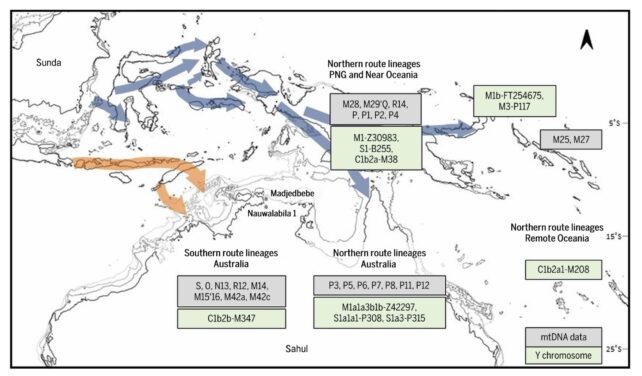
“Both migratory dispersals were estimated to have occurred around the same temporal period – approximately 60,000 years ago,” Richards stated to journalist James Woodford of New Scientist. “This finding lends support to the so-called ‘long chronology’ of settlement, in contrast to the ‘short chronology,’ which proposes settlement dates between 45,000 and 50,000 years ago.”
The research team’s estimations indicate that approximately 36 percent of these initial migratory lineages can be attributed to individuals who arrived in Australia via the northern migratory path, whereas 64 percent are descendants of ancestors who traversed the southern route.
Furthermore, the investigation suggests that some of the pioneering groups utilizing the northern route continued their eastward expansion towards the Bismarck Archipelago and the Solomon Islands shortly after their arrival in Sahul.

“Considering their enduring legacy, the majority of extant [surviving] lineages within ancient Sahul and Near Oceania trace their origins to ancestors who immigrated via the northern route, traversing the northern sector of the now-submerged Sunda continent and northern Wallacea, around 60,000 years ago,” the authors reported.
“Conversely, a smaller proportion of the overall lineages (though comprising approximately two-thirds of those found in Australia) originated from a southern migratory path, traveling through southern Sunda.”
The authors highlight the scarcity of ancient DNA evidence from southern Asia and Sahul, the retrieval of which could provide more granular insights into the precise temporal sequencing of these genetic migratory events.
This research has been disseminated through publication in Science Advances.