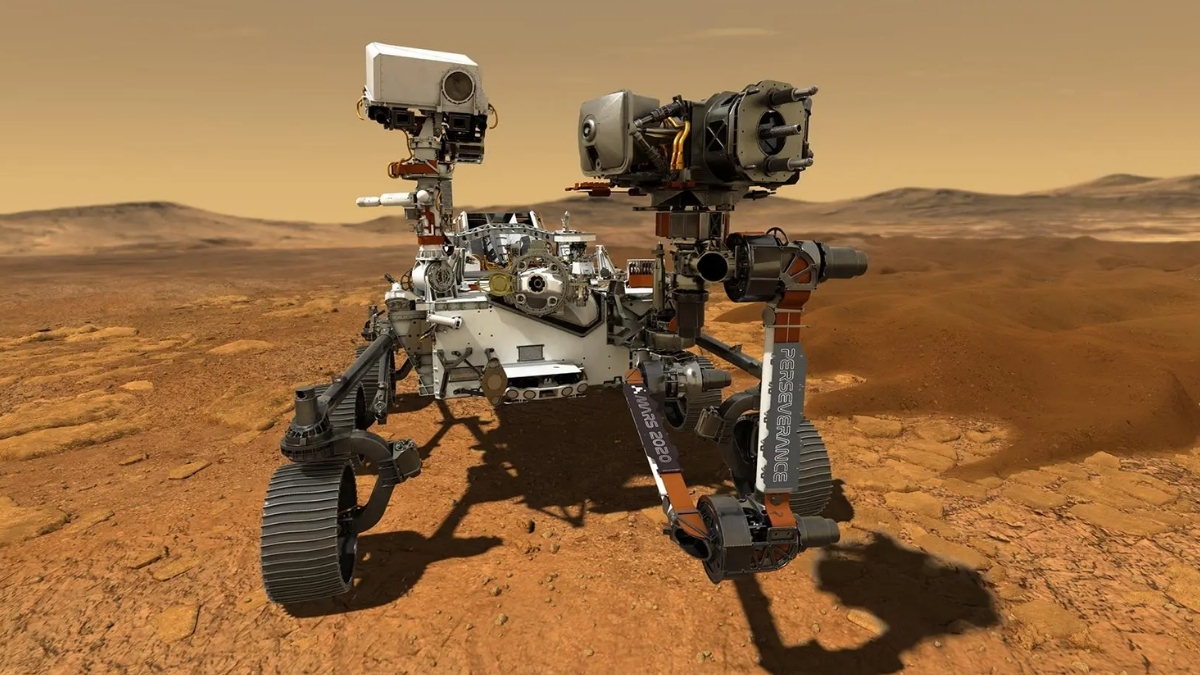
In December, NASA achieved another minor, progressive advancement toward self-guided surface exploration vehicles.
During a field test, the Perseverance mission team leveraged artificial intelligence to generate the rover’s traversal points. Perseverance utilized these AI-generated waypoints on two distinct occasions, covering a cumulative distance of 456 meters (1,496 feet) without any direct human intervention.
“This exercise underscores the significant evolution of our operational capacities and expands the horizons of how we will conduct explorations of other celestial bodies,” stated NASA Administrator Jared Isaacman.
“Autonomy-driven technologies such as this possess the potential to enhance mission efficiency, facilitate responses to complex terrains, and amplify scientific returns as the distance from Earth increases. It serves as a compelling illustration of teams diligently and prudently integrating novel technologies into active operational scenarios.”
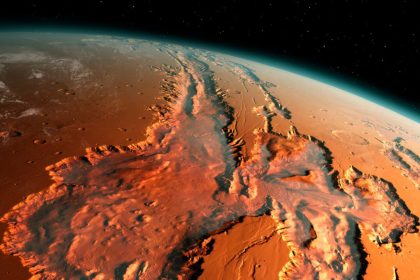
The vast distance to Mars presents a considerable communication challenge, with a round-trip signal delay of approximately 25 minutes between Earth and the Red Planet. Consequently, rovers must operate independently for brief intervals.
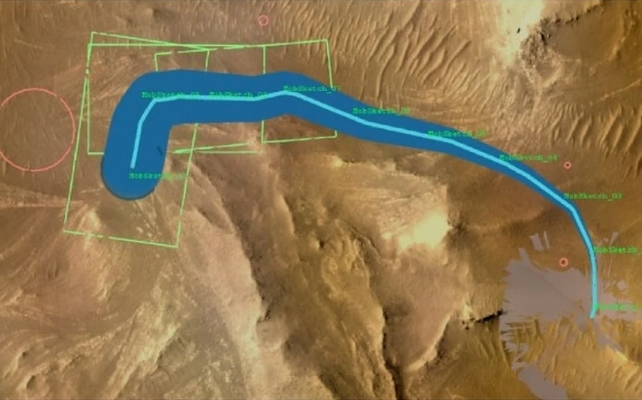
This temporal lag significantly influences the methodology for route planning. Ground control operators meticulously examine imagery and topographical data, subsequently programming a series of waypoints, which typically do not exceed 100 meters (330 feet) apart.
The resultant driving itinerary is transmitted to NASA’s Deep Space Network (DSN), which then relays the data to an orbiting spacecraft, which, in turn, communicates it to Perseverance.
In this particular demonstration, the AI system analyzed orbital imagery captured by the Mars Reconnaissance Orbiter’s HiRISE camera, in conjunction with digital elevation models. The AI algorithm, which draws upon the capabilities of Anthropic’s Claude AI, successfully identified potential hazards including sand deposits, rocky debris fields, exposed bedrock, and rugged outcrops. It then formulated a traversal path delineated by a sequence of waypoints designed to circumvent these obstacles.
Following this, Perseverance’s automated navigation system assumed command. This system exhibits a higher degree of autonomy compared to its predecessors, enabling it to process visual data and driving directives while in motion.
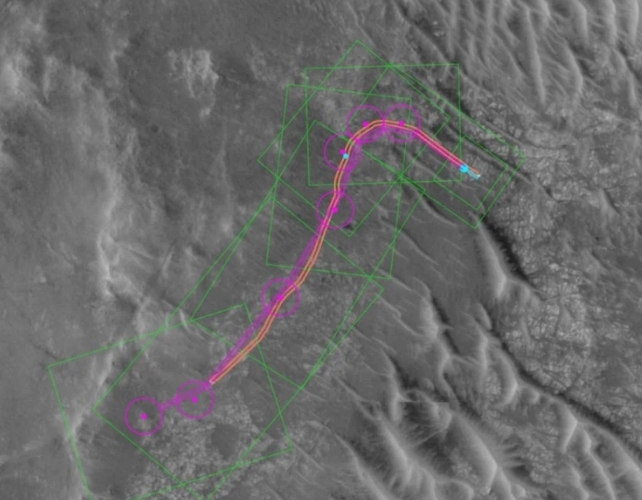
An additional crucial step preceded the dissemination of these waypoints to Perseverance. NASA’s Jet Propulsion Laboratory maintains a terrestrial replica of Perseverance, designated the “Vehicle System Test Bed” (VSTB), situated within JPL’s Mars Yard facility.
This engineering facsimile provides the operational team with a tangible platform on Earth for troubleshooting issues and conducting simulations, such as the one described. Such engineering models are standard practice for Mars missions, with JPL possessing a similar unit for the Curiosity rover as well.
“The foundational components of generative AI are demonstrating significant promise in optimizing the core elements of autonomous navigation for off-world surface operations, encompassing perception (identifying geological features), localization (determining precise positioning), and planning and control (selecting and executing the most secure route),” stated Vandi Verma, a roboticist specializing in space exploration at JPL and a member of the Perseverance engineering team.
“We are advancing towards an era where generative AI and other sophisticated tools will empower our surface rovers to undertake traverses extending over kilometers while substantially reducing operator workload, and to highlight noteworthy surface formations for our scientific contingent through the comprehensive analysis of extensive volumes of rover imagery.”
Artificial intelligence is rapidly becoming an pervasive presence in our daily lives, appearing in applications where its functional utility may not be immediately apparent.
However, this endeavor is not merely NASA embracing the prevalent AI trend. The agency has a protracted history of developing automated navigation systems, driven by operational imperatives. Indeed, Perseverance’s primary mode of locomotion is its self-directed autonomous navigation system.
One persistent impediment to fully autonomous driving stems from the cumulative increase in positional uncertainty as the rover operates without continuous human guidance. The longer the rover travels, the greater the ambiguity regarding its precise location on the Martian surface.
The established solution involves re-establishing the rover’s position on its navigational map. Currently, this task is performed by human operators, a process that consumes considerable time and necessitates a complete communication cycle between Earth and Mars. Collectively, these factors constrain the extent of Perseverance’s independent travel.
NASA/JPL is concurrently developing a capability for Perseverance to utilize AI for autonomous re-localization. The primary challenge lies in effectively correlating orbital imagery with the rover’s ground-level visual data. It is highly probable that artificial intelligence will be trained to master this specific task.
It is evident that AI is poised to assume a significantly amplified role in the realm of planetary exploration. The subsequent generation of Mars rovers may exhibit substantial divergence from their current counterparts, incorporating more sophisticated autonomous navigation systems and other AI-driven functionalities. Concepts are already in development for a coordinated deployment of aerial drones from a rover to expand its investigative reach across the Martian landscape. These swarms would be AI-directed to operate cohesively and autonomously.
Furthermore, the benefits of AI extend beyond Martian exploration. NASA’s Dragonfly mission, destined for Saturn’s moon Titan, will extensively integrate AI. This integration will encompass not only autonomous navigation for the rotorcraft’s aerial movements but also for the self-directed management of collected data.
“Envision intelligent systems that are not confined to ground operations on Earth but are also integrated into edge applications within our rovers, helicopters, drones, and other surface assets, imbued with the collective expertise of our NASA engineers, scientists, and astronauts,” remarked Matt Wallace, manager of JPL’s Exploration Systems Office.
“This represents the transformative technology essential for establishing the foundational infrastructure and systems required for a sustained human presence on the Moon and for propelling the United States’ ambitions toward Mars and beyond.”
This content was initially disseminated by Universe Today. Access the original publication.