A granular examination, conducted at the nanoscale, of the Bennu sample OREX-800066-3, recently retrieved by NASA’s OSIRIS-REx mission, reveals a patterned distribution of organic compounds and minerals into discrete zones. This spatial segregation suggests that the asteroid underwent water-induced alterations that were not uniform but rather localized in their impact.
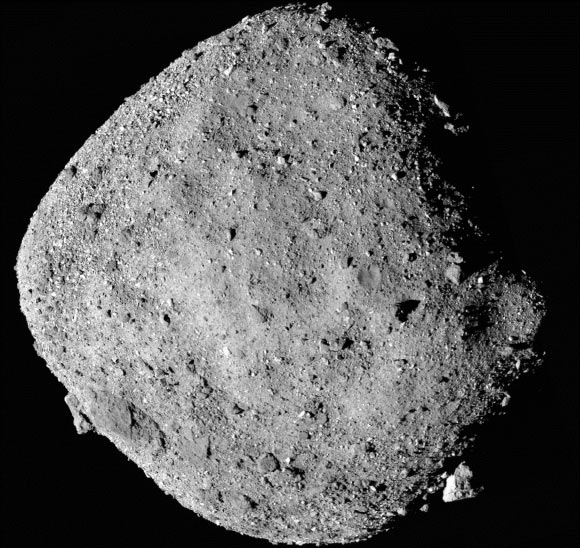
This mosaic image of asteroid Bennu is composed of 12 images collected on December 2, 2018 by OSIRIS-REx’s PolyCam instrument from a range of 15 miles (24 km). Image credit: NASA / NASA’s Goddard Space Flight Center / University of Arizona.
Bennu is classified as a primordial carbonaceous asteroid and is regarded as one of the most intact vestiges from the nascent Solar System.
Traditionally, meteorites have been viewed as a primary source of primitive asteroid material; however, they are susceptible to degradation from atmospheric entry and terrestrial contamination on Earth.
The samples returned from Bennu are considered genuinely unadulterated, thereby lending considerable credibility to findings derived from them.
In their recent investigation, scientists from Stony Brook University employed nanoscale-infrared and Raman spectroscopy techniques to scrutinize the chemical makeup of the OREX-800066-3 sample. This characterization was performed at spatial resolutions as fine as 20-500 nanometers per pixel.
All analytical procedures were conducted without exposing the sample to atmospheric conditions, as contact with air can induce modifications to delicate chemical bonds and organic functional groups, thereby compromising the very indicators the researchers sought to identify.
Furthermore, both spectroscopic methods are non-destructive, a critical requirement given the irreplaceable nature of these extraterrestrial samples.
At the nanoscale, the fundamental components of asteroid mineralogy and organic chemistry can be directly observed within these exceptionally pristine and valuable samples.
The novel analysis revealed discrete chemical domains. These included regions rich in aliphatic compounds, others abundant in carbonates, and still others characterized by nitrogen-bearing organic matter.
This observation substantiates the hypothesis that water-driven alterations on Bennu occurred in a chemically heterogeneous manner.
Notably, the nitrogen-bearing organic functional groups remain substantially intact, even in the presence of extensive aqueous alteration.
“These discoveries possess broader implications for planetary science and astrobiology,” stated Professor Mehmet Yesiltas of Stony Brook University.
“They underscore the survival of chemically sensitive, nitrogen-bearing organic molecules through aqueous alteration processes on a minor celestial body. This has direct relevance to enduring questions concerning the mechanisms by which organic complexity accumulates and is preserved within primitive planetary materials.”
“By extension, this research may shed light on how organic substances pertinent to prebiotic chemistry could have been transported to early Earth via carbonaceous asteroids and subsequently played a role in the chemical pathways that might have eventually given rise to life.”
The findings are published in the journal Proceedings of the National Academy of Sciences.
_____
Mehmet Yesiltas et al. 2026. Nanoscale infrared spectroscopy reveals complex organic-mineral assemblages in asteroid Bennu. PNAS 123 (14): e2601891123; doi: 10.1073/pnas.2601891123