For countless eras, the phenomenon of lightning has captivated human imagination, deeply woven into the fabric of mythology, religious narratives, and contemporary culture. Consider figures like Thor in the sagas of Norse mythology or Indra in the traditions of Hinduism.
Within Australia, lightning also holds significance, linked to primordial creation beings, as evidenced in the ancient rock art of First Nations peoples. This powerful atmospheric electrical discharge manifests in numerous variations, profoundly shaping both our societal structures and environmental dynamics.
Unveiling the Nature of Lightning
Lightning originates from the accumulation of electrical charge within clouds. This process bears a resemblance to static electricity generated by activities like brushing one’s hair or vigorous movement on a trampoline, causing hairs to stand on end, albeit on a far grander and more intense scale.
This charge buildup within clouds arises from the collision of various forms of water, both frozen and liquid, propelled by updrafts and downdrafts. These air currents are a consequence of convection, where heated air ascends and cooler air descends. The resulting electrical charge can reach such an extreme level that it forces a discharge through the atmosphere—the visible phenomenon we identify as lightning.
While the luminous flash of lightning is perceived almost instantaneously, the audible rumble of thunder follows with a delay.
Sound propagates through the air at a rate of approximately one kilometre every three seconds. By measuring the interval between the lightning flash and the subsequent thunderclap, one can ascertain the distance to the electrical discharge. Simply count the seconds and divide by three to estimate the distance in kilometres.
Furthermore, Earth is not the sole celestial body where lightning has been observed. Recent scientific investigations have confirmed its presence on Mars for the first time.
Philippe Donn/Pexels
)
Principal Lightning Classifications
Two primary categories of lightning are observed on Earth:
- Intra-cloud (or cloud-to-cloud) lightning: This form of discharge occurs between different sections of a single cloud, without extending to the ground. It can manifest as a cloud momentarily illuminating, with the entire cloud appearing aglow, sometimes obscuring the precise path of the electrical discharge. This happens when significant electrical potential differences exist between distinct areas within a cloud, and it is a frequent occurrence as the discharge path is typically short.
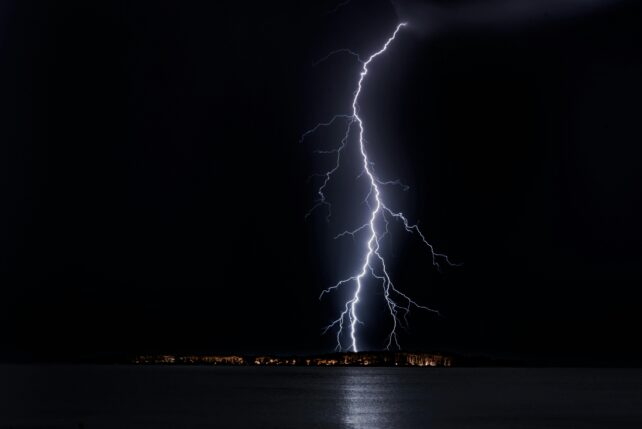
- Cloud-to-ground lightning: This type of lightning can develop when a substantial electrical charge disparity arises between a portion of a cloud and the Earth’s surface. It is arguably the most widely recognized form of lightning. Although awe-inspiring to behold, cloud-to-ground lightning represents a tangible risk to human well-being, contributing to a considerable number of documented fatalities annually.
Uncommon and Extraordinary Lightning Phenomena
Beyond the more common types, several rarer and even more breathtaking lightning manifestations exist:
- Pyrogenic lightning: This phenomenon can accompany severe bushfires, where the intense heat and convection within smoke plumes, forming pyrocumulonimbus clouds, can generate lightning. This lightning has the potential to trigger new fires at considerable distances, as observed during the Black Saturday event near Melbourne in 2009. Similarly, lightning can also erupt from other superheated plumes, such as those generated by volcanic eruptions or nuclear detonations.
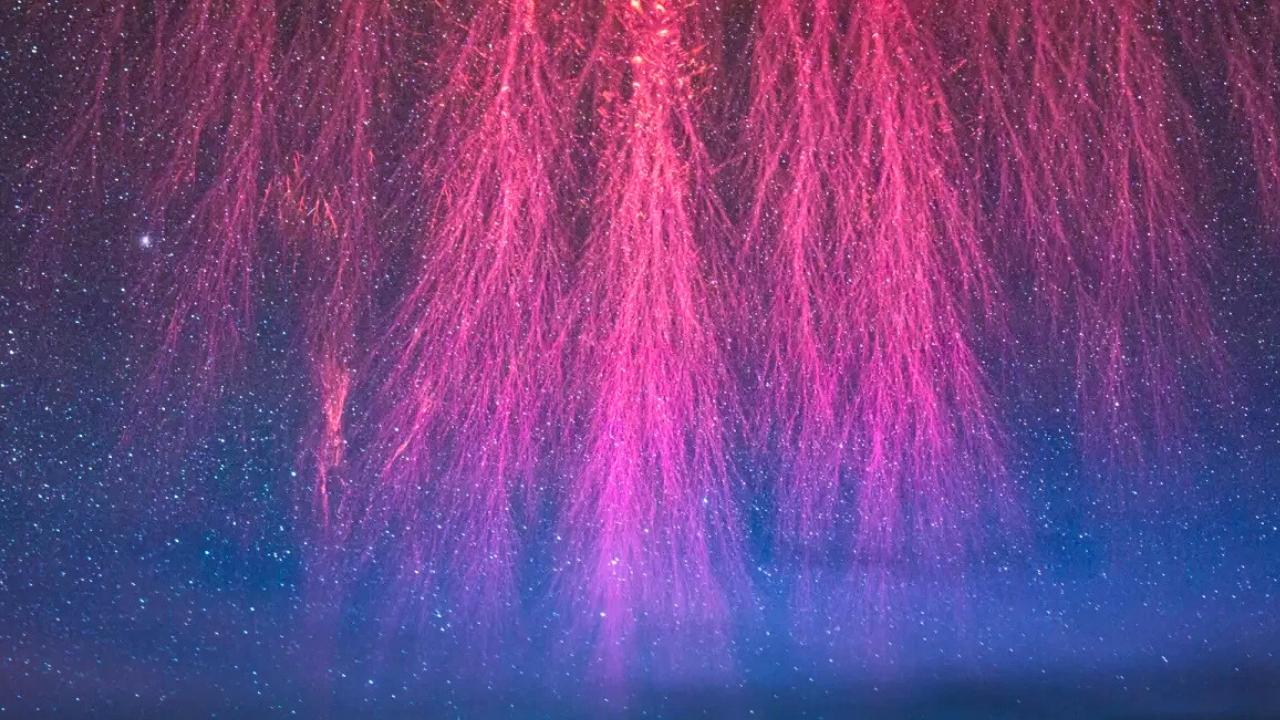
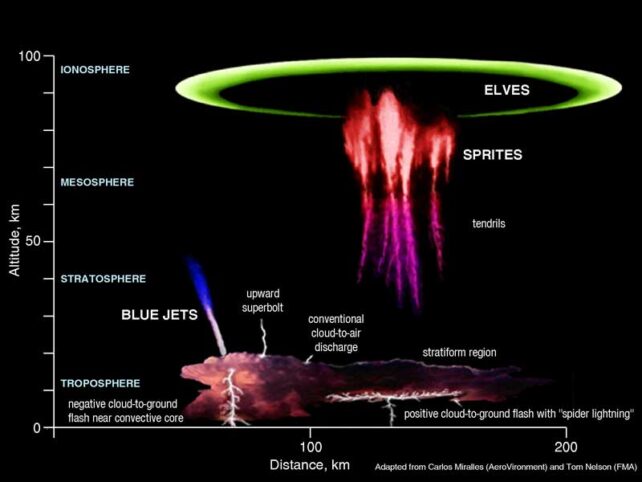
- Upper atmospheric electrical phenomena: These luminous occurrences, linked to lightning and often termed “transient luminous events” (TLEs), encompass sprites, blue jets, ELVEs, and PIXIES. Ongoing scientific research aims to elucidate the precise mechanisms behind their distinct shapes and colors. For instance, sprites are characterized by their glowing red, jellyfish-like appearance, while blue jets are described as immense sapphire beams ascending into the atmosphere. ELVEs present as radiant red halos, and PIXIES are characterized by flashes of electric blue light emanating from the apex of thunderstorms.
- Ball lightning: While numerous accounts of observing spherical lightning have been reported over the years, akin to claims of other elusive phenomena like the Loch Ness Monster or extraterrestrial visitors, scientific verification remains elusive. It is plausible that various alternative explanations exist for perceived floating luminous spheres, similar to the proposed origins of the Min Min lights in the Australian Outback, which may be attributed to the illumination from distant vehicle headlights.
NOAA NSSL
)
Lightning in an Evolving Climate
The thunderstorms responsible for generating lightning are frequently perceived as towering, billowy formations known as cumulonimbus clouds. These clouds often resemble colossal cauliflowers suspended in the sky, boasting an anvil-like structure at their apex in mature storm systems.
Our recent research into thunderstorms and analogous meteorological systems indicates a discernible shift since the 1970s, with a reduction in thunderstorm frequency in northern Australia and an increase in their occurrence towards the southeast. Significant uncertainties persist regarding the precise influence of climate change on thunderstorm development and lightning activity.
Generally, it is understood that warmer atmospheric conditions can accommodate a greater volume of water vapor, which in turn can potentially fuel more intense convective storms and an increase in lightning activity.
Should lightning frequency escalate in a warming global climate, this increase could, paradoxically, contribute to further warming. This is because lightning facilitates the dissociation of nitrogen and oxygen molecules in the atmosphere, leading to the formation of ozone, a gas that exerts a warming influence on the atmosphere. Ozone also contributes to air pollution and acts as a respiratory irritant.
Nevertheless, lightning is by no means the primary driver of global warming, and further investigation is imperative to fully comprehend the magnitude of its potential role in a warming climate through these complex feedback mechanisms.
Therefore, the next time you witness the spectacular luminous display accompanying a storm, consider the diverse forms that lightning can assume. It stands as one of the natural wonders of our world, and indeed of other worlds, to be appreciated from a secure vantage point.