Since its inception into archaeological discourse following Heinrich Schliemann’s excavations at the fabled citadel of Troy, the depas amphikypellon—a characteristic cylindrical chalice distinguished by its two arched handles, widely believed to be the ceremonial drinking vessel referenced in Homeric epics—has been consistently posited as a conduit for wine consumption. Recent comprehensive analyses undertaken by a consortium of archaeologists from the University of Tübingen, the University of Bonn, and the University of Jena lend robust empirical support to this long-standing hypothesis. Their investigations revealed pronounced concentrations of fruit acids, strongly indicative of recurrent utilization for vinous beverages. It is noteworthy, however, that analogous acidic traces were also detected in other chalices and cups unearthed from the Trojan strata. This discovery prompts a profound re-evaluation of the societal and cultural standing of wine; what was once largely conceptualized as an exclusive marker of the Early Bronze Age aristocracy may, in fact, have enjoyed a far more pervasive presence within the populace than previously surmised.

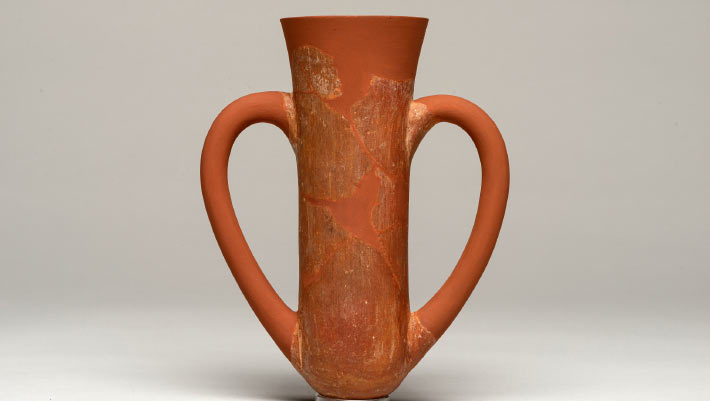
A 15-cm-tall depas amphikypellon unearthed by Heinrich Schliemann at Troy. Credit: Valentin Marquardt / University of Tübingen.
The esteemed epic, the Iliad, in its inaugural book, vividly recounts a scene where the deity of fire, metallurgy, and volcanoes, Hephaestus, exhorts his revered maternal figure, stating, ‘Hephaestus spoke, then stood up, passed a double goblet across to his dear mother.’
Further narration from the same passage elaborates on the interaction: ‘As he spoke, the white-armed goddess Hera smiled. She reached for her son’s goblet.’
And subsequently: ‘He poured the drink, going from right to left, for all the other gods, drawing off sweet nectar from the mixing bowl.’
This particular drinking accoutrement, identified as the depas amphikypellon, is a familiar artifact within archaeological circles.
The artifact is characterized by its elegant, slender form, featuring two distinctive handles and tapering to a pointed base.
To date, more than one hundred such ceramic vessels, dating from the period spanning 2500 to 2000 BCE, have been brought to light at the archaeological site of Troy.
These objects are also distributed across the broader Aegean region, extending to Asia Minor and Mesopotamia, and possess capacities ranging from 0.25 to 1 liter.
“Even in the era of Heinrich Schliemann, it was posited that the depas goblet served as a vessel for communal drinking during festive occasions, mirroring the narratives found within the Iliad,” remarked Dr. Stephan Blum, an esteemed archaeologist affiliated with the University of Tübingen.
“The University of Tübingen’s collection of classical antiquities includes a depas goblet and two fragments originating from Schliemann’s excavations.”
In a recent scholarly endeavor, the research team subjected a 2-gram sample derived from these two fragments to a controlled heating process. The resultant emanations were subsequently subjected to rigorous analysis utilizing gas chromatography (GC) and mass spectrometry (GC-MS).
“The definitive identification of succinic and pyruvic acids served as irrefutable evidence, as these compounds are exclusively formed during the fermentation of grape juice,” explained Dr. Maxime Rageot, a researcher associated with the University of Bonn.
“Consequently, we can now assert with a high degree of certainty that wine, rather than mere grape juice, was indeed consumed from these depas goblets.”
During the Bronze Age, wine held the distinction of being the most opulent beverage, and a depas goblet represented an object of considerable value. The discovery of depas goblets has predominantly occurred within temple precincts and palace complexes.
Based on this evidence, scholars had previously concluded that wine consumption was an activity reserved for special occasions and confined to elite social stratums.
However, this raises a pertinent question: Was wine also a staple food and a luxury item for individuals of lower socioeconomic standing in Troy?
“Our chemical investigation extended to common pottery cups recovered from the peripheral settlements of Troy, situated beyond the citadel’s confines. These vessels also yielded traces of wine,” stated Dr. Blum.
“This finding definitively establishes that wine was an everyday beverage for the general populace as well.”
The collective findings of the research team have been formally documented in their publication, appearing in the esteemed American Journal of Archaeology.
_____
Stephan W.E. Blum et al. 2025. The Question of Wine Consumption in Early Bronze Age Troy: Organic Residue Analysis and the Depas amphikypellon. American Journal of Archaeology 129 (2); doi: 10.1086/734061