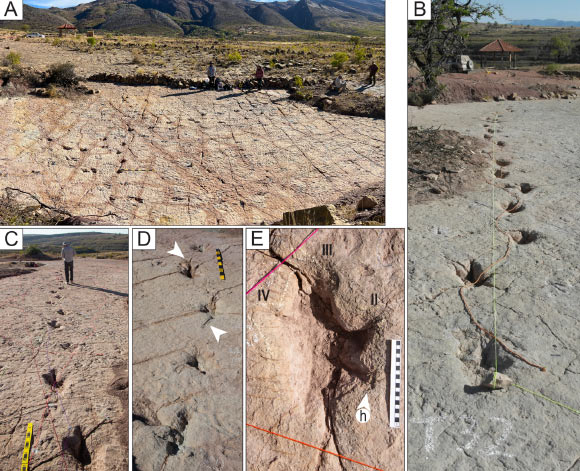
The Carreras Pampa locale within Bolivia’s Torotoro National Park showcases an extraordinary fossil record, featuring 1,321 documented trackways and 289 individual tracks, collectively accounting for 16,600 theropod dinosaur imprints. Furthermore, it contains 280 swim trackways comprising 1,378 distinct swimming tracks, alongside numerous trackways exhibiting tail drag marks.
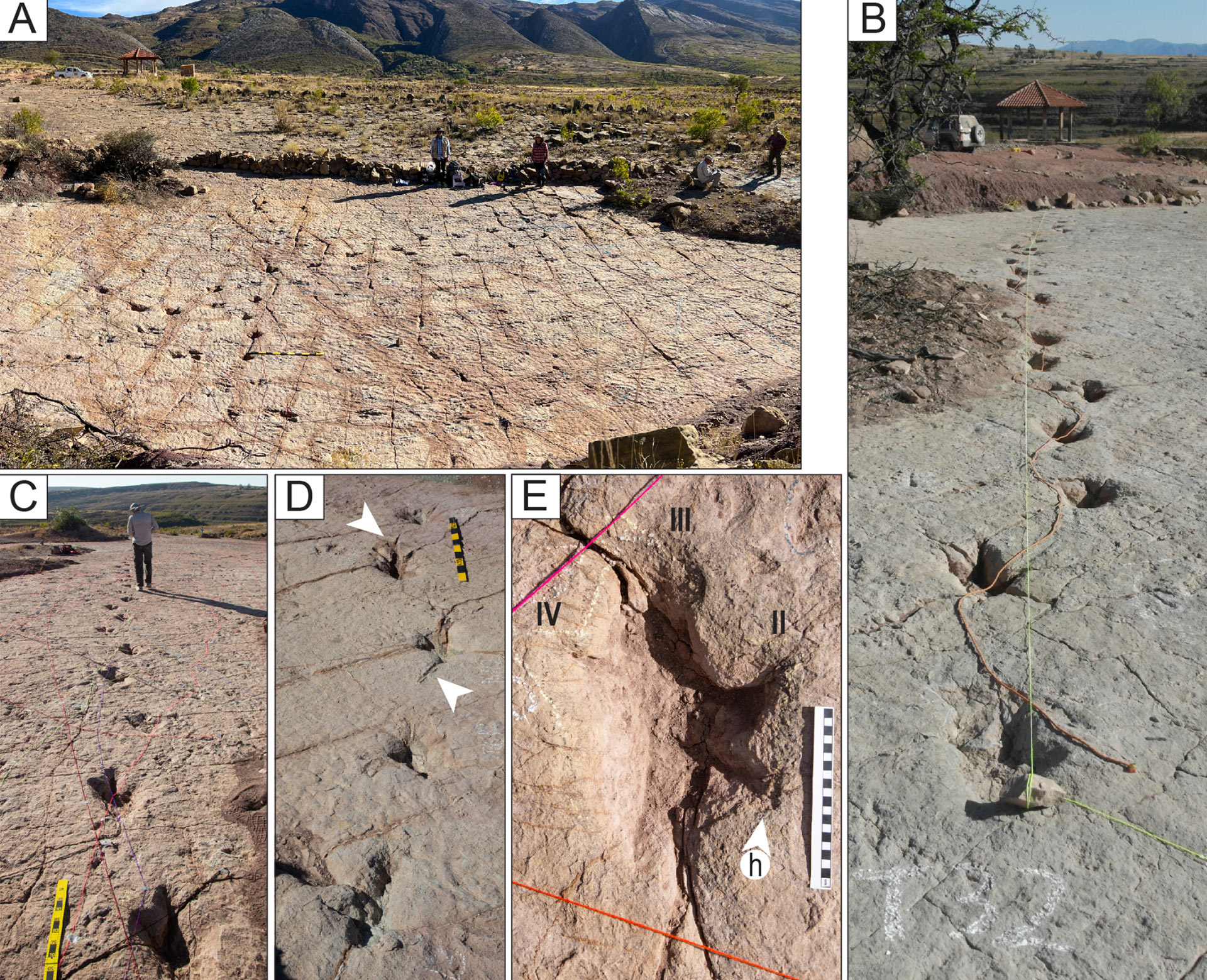
Dinosaur footprints at the Carreras Pampa tracksite in the Torotoro National Park, Bolivia. Image credit: Esperante et al., doi: 10.1371/journal.pone.0335973.
Bolivia possesses one of the most comprehensive and varied collections of dinosaur fossil sites globally, with evidence dating back to the Triassic, Jurassic, and Cretaceous geological periods.
Despite this considerable wealth of track-bearing locations, a surprisingly limited number of detailed scientific investigations have been published.
In a recent scientific endeavor, paleontology researcher Raúl Esperante from the Geoscience Research Institute, in collaboration with his colleagues, has meticulously cataloged an unparalleled spectrum of dinosaur tracks at the Carreras Pampas tracksite, situated within Torotoro National Park.
Across nine distinct investigation zones, they identified a staggering 16,600 tracks attributed to tridactyl theropod dinosaurs, dating to the terminal Cretaceous epoch.
These fossilized footprints display a broad range in dimensions, from diminutive marks under 10 cm to substantial impressions exceeding 30 cm. They serve as a chronicle of diverse dinosaur behaviors, including locomotion, aquatic movement, the dragging of tails, and even abrupt changes in direction.
“The majority of the track-making individuals (80%) exhibited a hip height ranging from 65 cm to 1.15 m, with a more concentrated distribution between 75 cm and 1.05 m,” the paleontologists reported.
“It is noteworthy that very few individuals are estimated to have surpassed a height of 1.25 m.”
The prevailing orientation of these tracks, generally pointing northwest to southeast, coupled with preserved ripple marks in the sedimentary layers, strongly implies these dinosaurs were traversing environments adjacent to ancient coastlines.
“The Carreras Pampas tracksite establishes new global benchmarks for the sheer quantity of individual dinosaur footprints, contiguous trackways, evidence of tail movement, and aquatic locomotion traces,” the research team stated.
“This exceptional density of findings suggests that the area was a locus of high animal activity, and the parallel alignment observed in some track sets may indicate cooperative movement among groups of dinosaurs.”
“There remain numerous additional footprints yet to be studied at this site and others throughout Bolivia,” they further commented.
“This location provides a remarkable glimpse into the prehistoric ecosystem of this region, revealing not only the volume of dinosaur traffic but also their activities during their passage.”
“The experience of working at this site is truly astonishing, as dinosaur tracks are comprehensively distributed across the landscape as far as the eye can see.”
The comprehensive report detailing the team’s discoveries has been published online in the esteemed journal PLoS ONE.
_____
R. Esperante et al. 2025. Morphotypes, preservation, and taphonomy of dinosaur footprints, tail traces, and swim tracks in the largest tracksite in the world: Carreras Pampa (Upper Cretaceous), Torotoro National Park, Bolivia. PLoS One 20 (12): e0335973; doi: 10.1371/journal.pone.0335973