Researchers in Brazil have unearthed a distinct species of somphospondylan sauropod, exhibiting traits reminiscent of European dinosaurs. This finding provides compelling indications of ancient migratory pathways that once interconnected continents now separated by the vast expanse of the Atlantic Ocean.
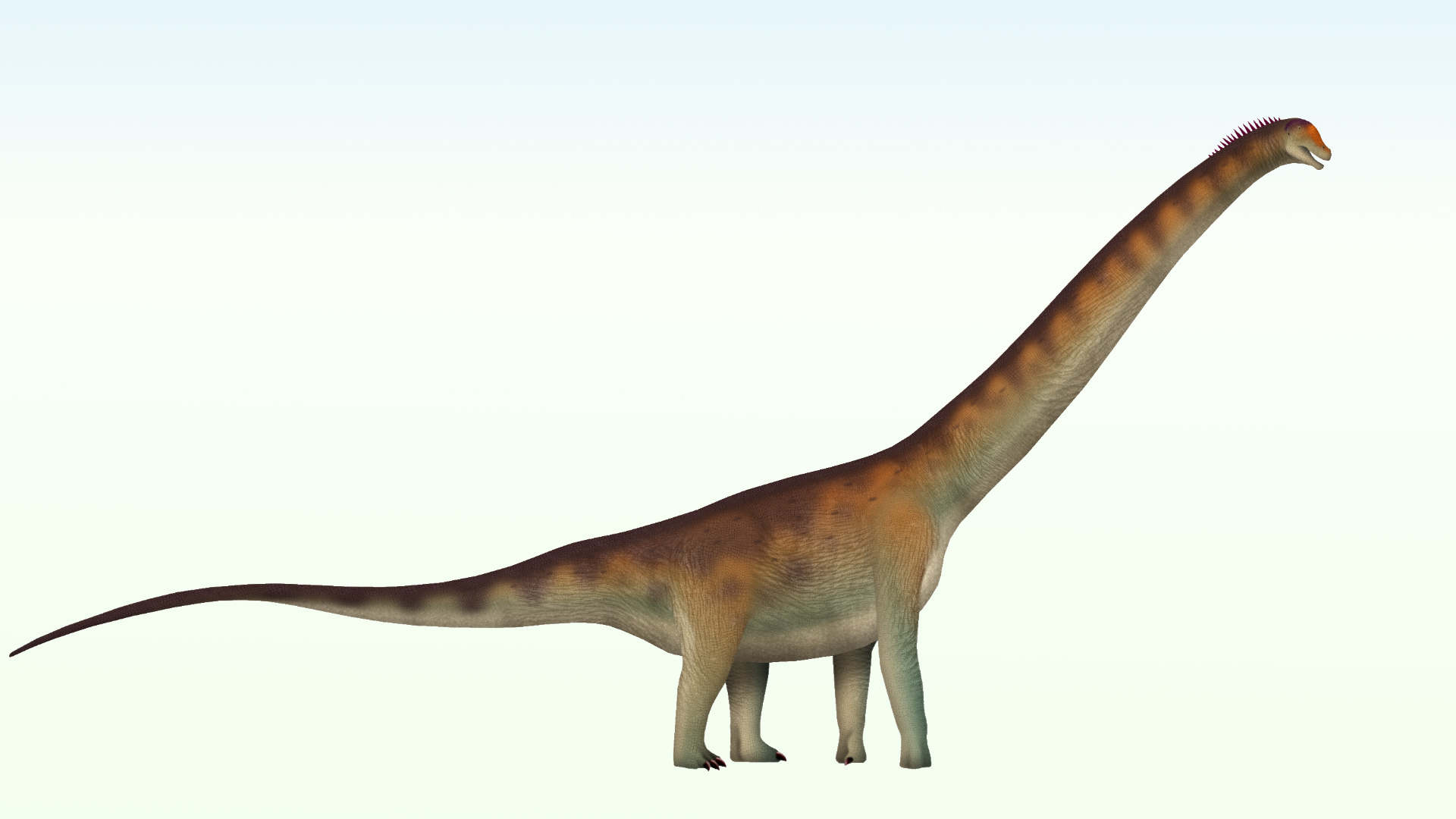
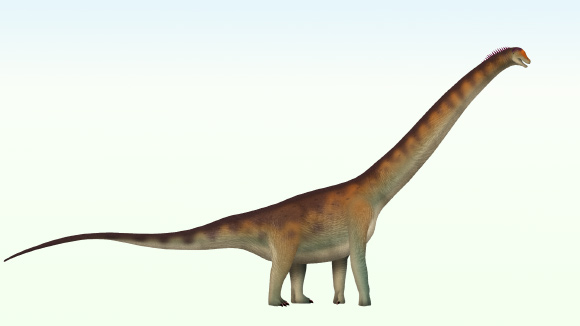
An artist’s impression of Dasosaurus tocantinensis. Image credit: TotalDino / CC BY 4.0.
This newly identified dinosaur inhabited the planet approximately 120 million years ago, during the Early Cretaceous geological period, a time when a significant portion of Earth’s landmasses remained consolidated within the southern supercontinent known as Gondwana.
Designated Dasosaurus tocantinensis, this creature is estimated to have reached a length of roughly 20 meters (66 feet).
It belonged to the Somphospondyli classification, a group of titanosauriform sauropods that flourished from the Late Jurassic epoch through to the conclusion of the Cretaceous period.
The remnants of a partial skeleton belonging to Dasosaurus tocantinensis were discovered within the Itapecuru Formation, located in the northeastern region of Brazil.
Distinctive anatomical characteristics are present in the dinosaur’s caudal vertebrae, featuring a unique configuration of three elongated ridges and grooves. Furthermore, its femur exhibits a notable lateral protruberance — these specific morphological signatures have not been observed in conjunction within any previously documented species.
These particular features suggest that Dasosaurus tocantinensis falls outside the titanosaur lineage, a subgroup of sauropods that subsequently became predominant across the southern landmasses.
Instead, this novel species appears to be the closest known relative to Garumbatitan morellensis, a sauropod species that existed in the area now identified as Spain approximately 122 million years ago.
Beyond the formal classification of a new species, this discovery substantially bolsters the existing evidence suggesting that South America during the Early Cretaceous was not an isolated evolutionary domain.
Rather, it was an integral part of a dynamic network of terrestrial connections, facilitating dinosaur dispersal between continents well before the complete formation of the Atlantic Ocean.
“In addition to broadening our understanding of Early Cretaceous sauropod diversity in northern South America, this finding underscores biogeographical links with more northerly Gondwanan territories, as well as Europe,” stated Dr. Max Langer, the principal author from the Universidade de São Paulo, and his colleagues.
“Indeed, quantitative biogeographical analyses indicate that the clade comprising Dasosaurus tocantinensis and Garumbatitan morellensis originated in Europe, with the lineage that includes Dasosaurus tocantinensis making its way to South America by way of northern Africa at some point between the Valanginian (spanning 137-133 million years ago) and Aptian (121-113 million years ago) stages.”
The identification of Dasosaurus tocantinensis was formally announced in a publication released on February 12th in the esteemed Journal of Systematic Palaeontology.
_____
Elver L. Mayer et al. 2026. A new titanosauriform with European affinities in the Early Cretaceous of Brazil: insights on Somphospondyli phylogeny, histology and biogeography. Journal of Systematic Palaeontology 24 (1); doi: 10.1080/14772019.2025.2601579