The recently identified species, christened Bakiribu waridza, represents the inaugural discovery of a filter-feeding pterosaur native to tropical regions.
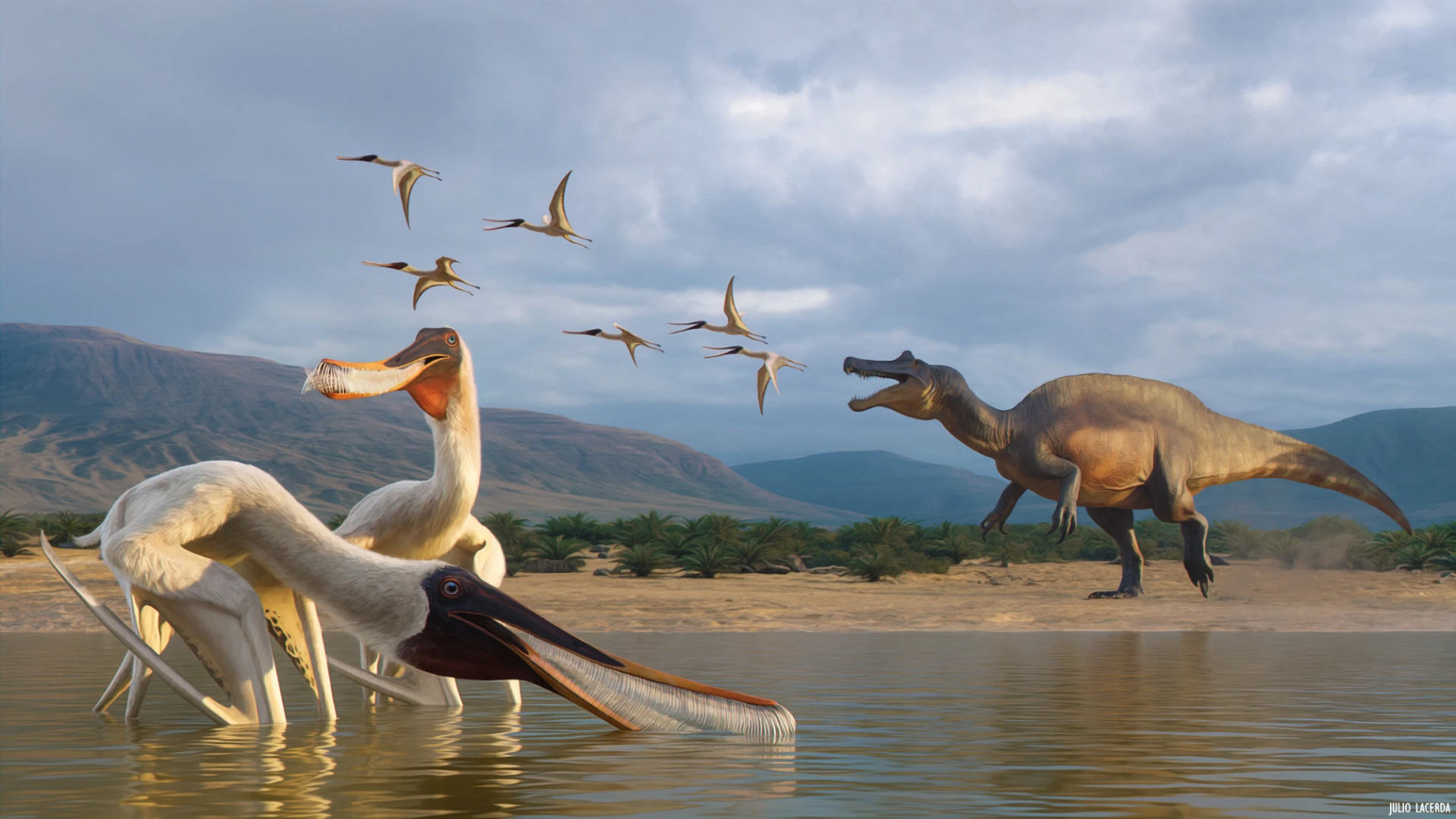
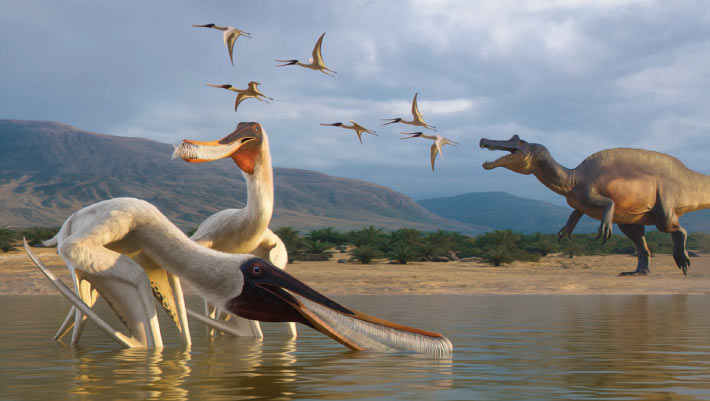
Artistic reconstruction of the filter-feeding pterosaur Barikibu waridza situated within the Early Cretaceous Romualdo Formation ecosystem; the depicted spinosaurid dinosaur in the backdrop is presumed to be the predator of Barikibu waridza. Image credit: Julio Lacerda.
The ancient aerial reptile, Bakiribu waridza, inhabited the equatorial latitudes of the supercontinent Gondwana during the Early Cretaceous epoch, an era that spanned roughly 113 million years ago.
This prehistoric flying creature is classified within the Pterodaustrini tribe, a distinct group of pterosaurs belonging to the larger clade known as Ctenochasmatidae.
“The Ctenochasmatidae lineage comprises pterodactyloid pterosaurs that flourished from the Late Jurassic through the Early Cretaceous periods,” stated Dr. Aline Ghilardi, affiliated with the Universidade Federal do Rio Grande do Norte, alongside her research colleagues.
“Recent paleontological findings have significantly enhanced our comprehension of this group’s diversity and ecological specializations, largely through the analysis of novel fossil specimens unearthed from diverse geographical locales and geological strata.”
“These pterosaurs demonstrate a remarkable path of evolution, characterized by a wide array of morphological adaptations and a broad geographical distribution across ancient continents.”
“Discoveries emerging from China, South America, and Europe in recent times have substantially advanced our understanding of their ecological roles and underscored the dynamic evolutionary history of this particular line of reptiles.”
“While Ctenochasmatids experienced peak proliferation from the Late Jurassic up to the Barremian stage, their numbers began a progressive decline towards the latter part of the Early Cretaceous,” the scientists elaborated.
“Our knowledge remains limited regarding the later species and the mechanisms of lineage dispersal and diversification between the supercontinents of Laurasia and Gondwana.”
According to the research team, Bakiribu waridza possessed exceptionally elongated jaws equipped with dense, brush-like rows of teeth, exhibiting similarities to the ctenochasmatine pterosaur Pterodaustro, yet differing in tooth cross-sectional geometry and interdental spacing.
“Within the Ctenochasmatidae family, the Ctenochasmatinae subfamily is notably characterized by elongated rostrums and a profusion of fine teeth, adaptations presumably linked to their specialized feeding methodologies,” the researchers explained.
“The evolutionary journey of this group has been illuminated by significant discoveries, such as that of Liaodactylus primus, unearthed from the Upper Jurassic strata of western Liaoning, China. This specimen illustrates a discernible ecological transition within the clade, shifting from piscivory to filter-feeding behaviors.”
“An exemplary case of extreme morphology is observed in Pterodaustro guinazui, which features an astonishing complement of a thousand hyper-elongated, baleen-like teeth adorning its lower jaw.”
“The highly specialized morphology of Pterodaustro strongly suggests an extreme adaptation geared towards filter-feeding as its primary mode of sustenance.”
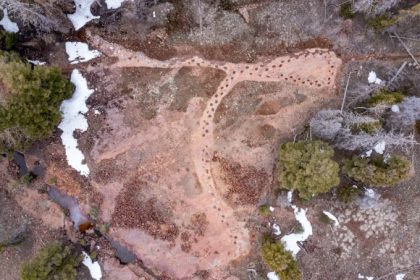
The fossilized remains of two individual Bakiribu waridza specimens were recovered from either side of a calcareous concretion found in the Romualdo Formation, situated within Brazil’s Araripe Basin.
This same concretion also yielded the fossilized remains of four fish, identified as likely belonging to the Early Cretaceous bony fish genus Tharrhias.
“The pterosaurs and associated fish were meticulously preserved within a wackestone concretion, which is characterized by a high concentration of non-oriented ostracodes and foraminifera, consistent with other concretionary finds from the Romualdo Formation,” the scientific team reported.
“The contiguous presence of densely packed, partially articulated, and fragmented pterosaur bones—predominantly oriented in a subparallel fashion—alongside a cluster of similarly aligned fish fossils buttresses the interpretation of this assemblage as a regurgitalite, signifying a mass of indigestible material orally expelled by a predatory organism.”
Bakiribu waridza exhibited a composite of anatomical characteristics shared with both its South American and European ancestral relatives.
“Its distinctive confluence of anatomical features—most notably its remarkably elongated jaws, dense dentition comprising long, slender teeth with subquadrangular cross-sections, and acrodont-like tooth insertion in both jaws—offers novel insights into the evolutionary pathway of filter-feeding pterosaurs,” the study’s authors asserted.
“The extraordinary state of preservation of this specimen within a regurgitalite, accompanied by fish remains exhibiting cranial alignment, provides exceptionally rare, direct evidence of trophic interactions within the Early Cretaceous Araripe paleoecosystem.”
“This discovery not only bridges a paleobiogeographical void in the known distribution of Ctenochasmatinae but also underscores the paramount importance of understudied, long-archived museum specimens in revealing crucial evolutionary and paleoecological insights.”
“The genus Bakiribu adds to the accumulating evidence that the Araripe Basin serves as an indispensable portal into the biodiversity, ecological intricacy, and continental-scale faunal exchanges characteristic of the Early Cretaceous period.”
The research team’s published study was officially released on November 10, 2025, within the esteemed journal Scientific Reports.
_____
R.V. Pêgas et al. 2025. A regurgitalite reveals a new filter-feeding pterosaur from the Santana Group. Sci Rep 15, 37336; doi: 10.1038/s41598-025-22983-3