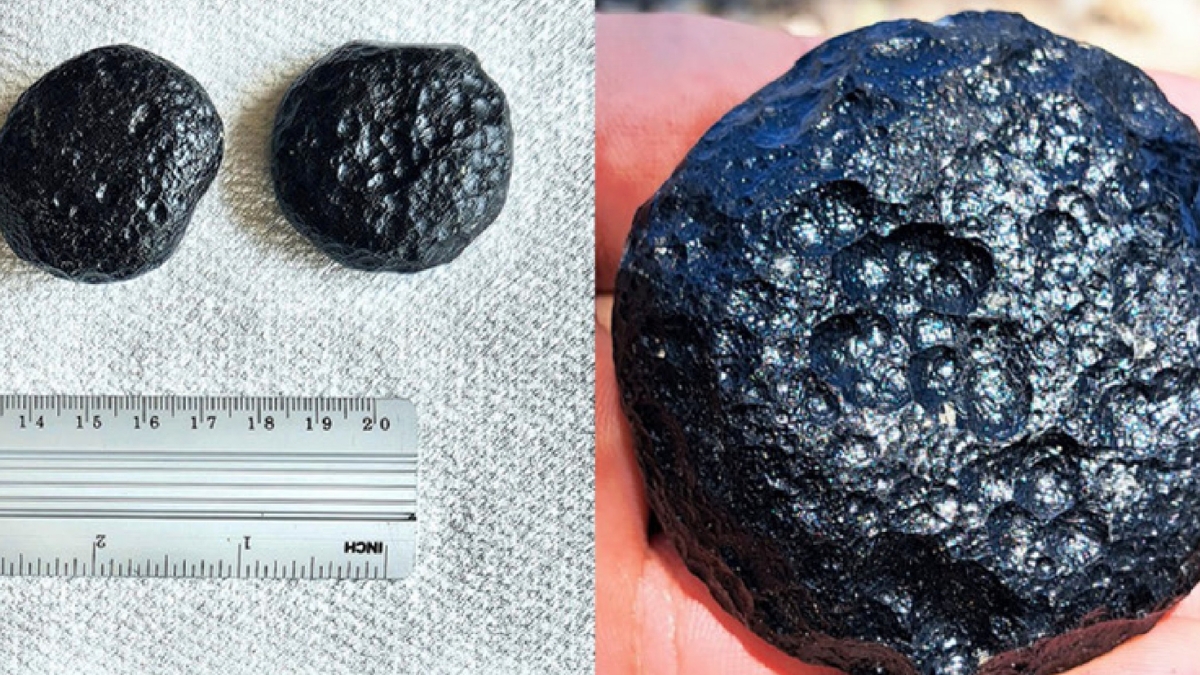
An investigation into numerous glass fragments unearthed in Brazil has revealed definitive evidence of an ancient impact event responsible for their formation and dispersal millions of years ago, according to scientific findings.
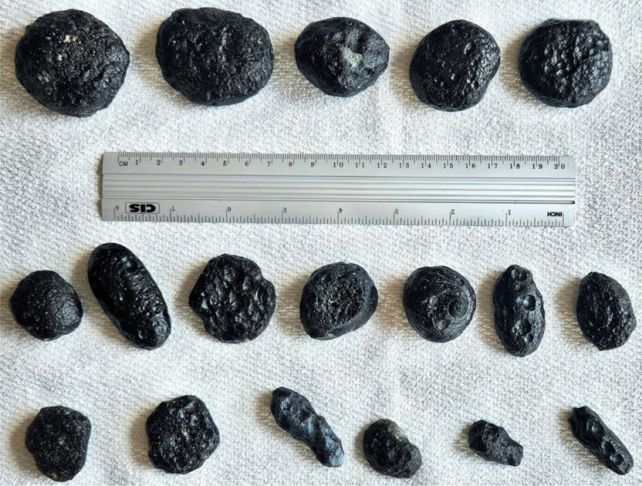
These particulate masses are understood to be ejecta derived from molten rock that was vaporized during the celestial collision. Subsequently, this molten material underwent rapid cooling and solidification, resulting in the creation of glassy, pebble-like formations. These formations, referred to as tektites, vary in size from that of a small pea through to that of a golf ball.
The resultant distribution pattern of these tektites forms a strewn field, a geological phenomenon that is exceptionally uncommon, with only a limited number having been cataloged to date.
“The discovery was quite astonishing!” conveyed geologist Álvaro Penteado Crósta, affiliated with the University of Campinas in Brazil, in his remarks to ScienceAlert. “Tektites are an exceedingly scarce geological resource on Earth.”
Intriguingly, an associated impact crater has yet to be definitively identified by researchers.
The historical record of terrestrial impacts is considerably less lucid when contrasted with that of other solid celestial bodies like the Moon, Mercury, and Mars. Our planet’s dynamic processes—encompassing tectonic, geological, and atmospheric activity—progressively erode or obscure the physical traces of significant extraterrestrial collisions.
Tektites serve as one of the telltale indicators of an impact event. Their formation is triggered when a meteorite impacts Earth with sufficient kinetic energy to generate temperatures capable of liquefying surface rock. These molten droplets are then propelled into the atmosphere, solidifying into glassy spheres that can be distributed over vast distances from the impact origin.
The geographical area encompassing their dispersal is termed a strewn field. However, these fields are exceptionally rare due to the relatively ephemeral nature of tektites, which typically degrade within tens of millions of years at most.
The genesis of this particular discovery narrative did not stem from direct scientific fieldwork or laboratory examination but rather from a local inhabitant in Minas Gerais, Brazil. This individual chanced upon one of the unusual glassy spherules, investigated its potential identity, and subsequently contacted Gabriel Silva, a specialist in meteorites from the University of São Paulo.
“Despite the initial appearance of the tektites in the photographs provided by the resident, both Gabriel and I harbored some skepticism,” Crósta admitted. “This was partly due to the contemporary availability of tektites from regions such as Thailand and the Philippines through online marketplaces. Furthermore, distinguishing between tektites and obsidian, a type of volcanic glass, can be challenging based solely on photographic representations.”
However, a secondary report emerged a few weeks later, originating from another resident located approximately 60 kilometers (37 miles) from the initial discovery site. Consequently, the researchers requested samples for analysis. Preliminary examinations indicated a strong likelihood that the globular fragments were indeed tektites. This led to the inevitable progression: an expedition to Minas Gerais was undertaken to personally search for additional specimens.
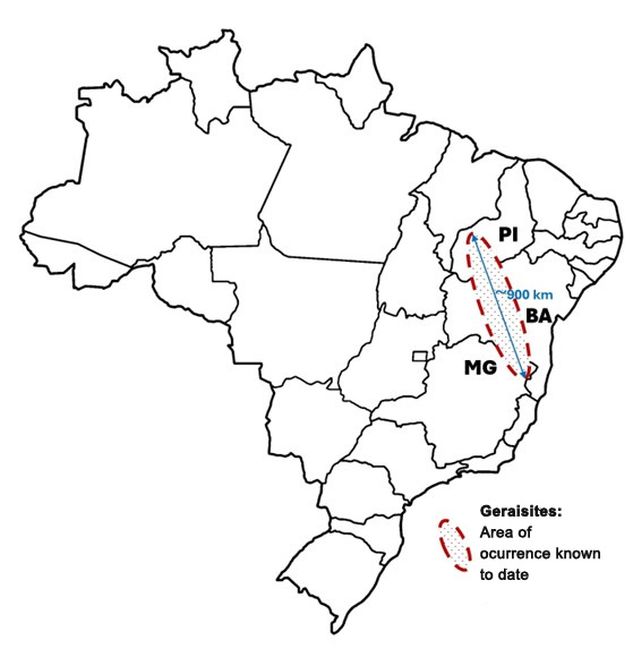
To date, over 600 such objects have been cataloged. At the time of the study’s publication, their distribution spanned a region measuring 90 kilometers in length within Minas Gerais. However, subsequent discoveries in the adjacent states of Bahia and Piauí have since expanded the recognized strewn field to an impressive extent of over 900 kilometers.
These tektites originating from Brazil have been designated as geraisites, named in honor of the Brazilian state where they were initially identified.
“The most rewarding moments occur when we personally uncover these tektites in situ,” Crósta shared. “This is subsequently amplified when analytical data provides definitive confirmation of their extraterrestrial genesis.”
A critical factor in substantiating the impact-derived origin of the glass was a notable deficiency in a specific component: water.
Typical volcanic glasses, such as obsidian, exhibit water content ranging from approximately 700 parts per million to as high as 2 percent. In contrast, the geraisites contained significantly lower concentrations, between 71 and 107 parts per million. “A principal determinant in classifying this material as tektite was its exceptionally low moisture content,” Crósta explained.
The near-complete absence of water in tektites is attributed to the extreme thermal energy of an impact event—vastly exceeding volcanic temperatures—which effectively vaporizes virtually all moisture from the molten rock as it traverses the atmosphere.
Radiometric dating, performed on argon isotopes within the tektites, established a maximum age of approximately 6.3 million years. This age might be revised downward if the impact site itself contained its own argon isotopes. Further chemical and isotopic analyses of the geraisites unveiled a remarkable characteristic concerning the geological materials subjected to melting by the impact event.
The source material was identified as ancient continental crust, most plausibly granitic rocks originating from the São Francisco Craton, a region recognized as one of the most ancient and geologically stable geological formations in South America.
“The isotopic signature strongly suggests a source rock of ancient continental, granitic composition,” Crósta stated. “This significantly narrows the pool of potential geographical origins.”
How ancient, precisely? The rocks that were vaporized by the impact were already approximately 3 billion years old at the time of the meteorite’s strike. Their formation dates back to the Mesoarchean era, a period when Earth itself was less than half its present age.
The most conspicuous omission in this scientific narrative is the absence of a corresponding impact crater. The dimensions and configuration of the strewn field, coupled with the identified composition of the geraisite source rock, should theoretically provide strong indications of the impact’s locus. However, thus far, no impact structure of the appropriate age has been discovered in the proximity.
This scenario is not as anomalous as it might initially appear. To date, only three of the documented tektite strewn fields have a clearly identifiable impact crater associated with them. The largest known strewn field, the Australasian field, is believed to have its associated crater submerged deep beneath the ocean’s surface.
The research team is actively engaged in a process of reverse-engineering the parameters of the impact event. They are recalibrating their models as new data emerges, such as the recent expansion of the strewn field from 90 to 900 kilometers. This data is indispensable for accurately calculating the energy dynamics, velocity, and volume of ejected molten rock.
The researchers highlight that the revelation of the geraisite strewn field serves to fill a significant void in Brazil’s heretofore incomplete record of impact events. Furthermore, it suggests that tektites may not be as exceptionally rare as previously presumed, but perhaps are occasionally misidentified as other types of glass.
“This finding carries substantial implications for our understanding of Earth’s comprehensive impact history,” Crósta and his colleagues articulate in their publication. “It raises the possibility of other, as yet undiscovered, tektite occurrences possessing distinct origins, chemical makeup, and ages.”