A recent examination of fossilized horned animal crania unearthed within Spain’s Des-Cubierta Cave has intensified the enigma surrounding the temporal and motivational aspects of their deposition by Neanderthals.
Based on converging evidentiary streams, these skulls were not introduced simultaneously but were likely transported into a confined passageway on multiple occasions over an extended duration, specifically during the latter stages of the Middle Paleolithic epoch, dating back approximately 70,000 to 50,000 years ago.
The excavation endeavors at the cave, commencing in 2009, brought to light a particular stratum that captivated the attention of archaeologists due to its substantial collection of Mousterian lithic implements, a tool industry predominantly linked with Neanderthal populations spanning the European continent.
However, the site yielded more than just artifacts; it also presented an unusual aggregation of faunal remnants, overwhelmingly comprising cranial specimens.
Scholars meticulously documented the superior portions of skulls belonging to no fewer than 35 distinct animals, encompassing 28 individuals from the bovine family, five deer, and two rhinoceroses. The majority of the remaining skeletal components, such as mandibular fragments, appendicular bones, and even zygomatic structures, were conspicuously absent.
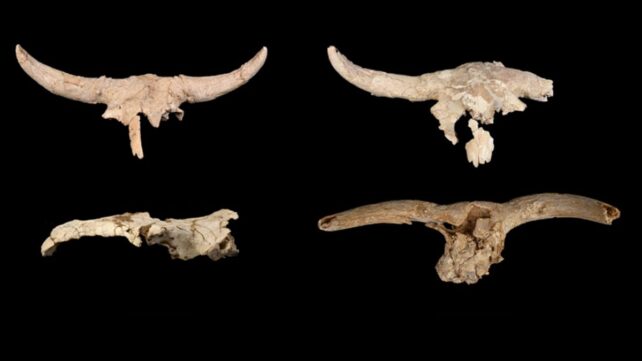
The intentional amassing of animal crania represents a relatively infrequent phenomenon within the archaeological chronicle. A research consortium, spearheaded by archaeologist Lucía Villaescusa from the University of Alcalá in Spain, sought to ascertain whether the geological context of the excavation site could illuminate the methodology behind the placement of these skulls.
Their investigation incorporated a multifaceted analytical approach, including an assessment of the spatial distribution of geological detritus and paleoanthropological findings within the deposit, the meticulous reconstruction of fragmented osseous material, and the evaluation of bone preservation states.
The outcomes of their inquiry indicated that an initial rockfall event introduced a conical accumulation of debris into the gallery. It was subsequent to this geological disturbance that Neanderthals commenced the translocation of animal skulls, positioning them within the cave across discrete phases of activity.
While the precise temporal framework of these actions remains elusive, the discernible stratification between the deposited materials unequivocally signifies that the gathering of skulls was not a singular, isolated incident.
As is often the case with many ancient hominin and Neanderthal practices, the definitive rationale behind the repeated Neanderthal tradition of depositing crania within Des-Cubierta Cave may remain forever beyond our grasp. Nevertheless, the recurring pattern strongly suggests a structured behavior, offering a rare window into the potential symbolic existence of our extinct relatives.
“The synthesis of geological, spatial, and taphonomic datasets unequivocally demonstrates that the aggregation of large herbivore crania was not the product of a solitary depositional event but rather the consequence of recurrent episodes embedded within a prolonged process of gallery utilization,” the research team articulated.
“This sustained and reiterated conduct underscores the structured and transmissible character of this practice, thereby contributing a significant element to the broader discourse concerning the sophistication and symbolic capacity inherent in Neanderthal cultural expressions.”
The empirical findings have been formally disseminated in the scholarly journal Archaeological and Anthropological Sciences.