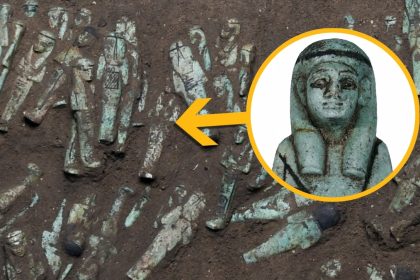
An unusual metallic fragment, concealed within the earth for millennia, has the potential to illuminate a particularly enigmatic ancient Chinese civilization.
This artifact, estimated to be approximately 3,000 years old and originating from the Sanxingdui culture, appears to be an axe-like implement forged from iron. This material likely originated from outer space, arriving on Earth as a meteorite.
This remarkable finding offers dual insights: it enhances our comprehension of the Sanxingdui civilization and demonstrates the utilization of iron in crafting esteemed objects considerably earlier than the widespread adoption of iron smelting techniques.
“As the earliest Bronze Age meteoritic iron artifact discovered in Southwest China,” state a research group spearheaded by archaeologist Haichao Li from Sichuan University in China, in a publication detailing their findings, “it effectively bridges a crucial void in the region’s metallurgical documentation and furnishes novel perspectives on the early application of iron, both regionally and on a global scale.”
Sanxingdui represents a significant archaeological location in southwestern China, with a historical span from 2800 to 600 BCE. Its zenith occurred during the Shang Dynasty, roughly between 1600 and 1050 BCE, leaving behind a legacy of distinctive, haunting art and evidence of a profound focus on ritualistic practices.
Among the types of deposits unearthed from the Sanxingdui civilization are what archaeologists categorize as “sacrificial pits,” situated within the ritualistic zone of the fortified settlement. Eight such pits have yielded approximately 17,000 extraordinary ritualistic items, including bronze visages, statuettes, ivory carvings, and jade implements.
The precise function of these pits remains elusive. However, the presence of ash, charcoal, and indications of combustion on some of the recovered objects suggests that these locations may have served as sites for ritualistic offerings.
Regardless of their ultimate purpose, these pits have provided an exceptionally valuable repository of artifacts, significantly aiding our understanding of the aesthetic values and material priorities of the Sanxingdui people.
However, one particular sacrificial pit revealed an artifact of singular distinction within the entire collection.
“Within the extensive array of artifacts recovered at Sanxingdui, an unusual iron object (K7QW-TIE-1) was exhumed from Pit No. 7,” the research team reports.
“This artifact was discovered embedded vertically at the base of the southern segment of the eastern wall. Its configuration is elongated, resembling an axe-like tool or weapon.”
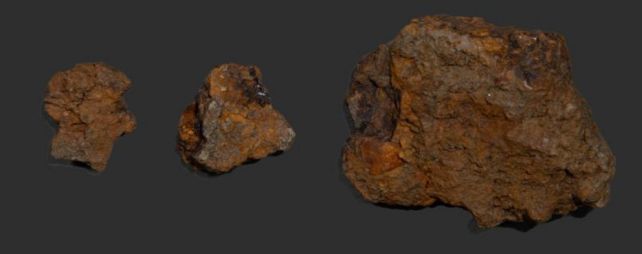
The object measures approximately 20 centimeters (8 inches) in length and spans 5 to 8 centimeters (2 to 3 inches) in width. Its deteriorated condition necessitated the careful extraction of the section of the pit wall containing the artifact, which was then transported to the laboratory for comprehensive analysis.
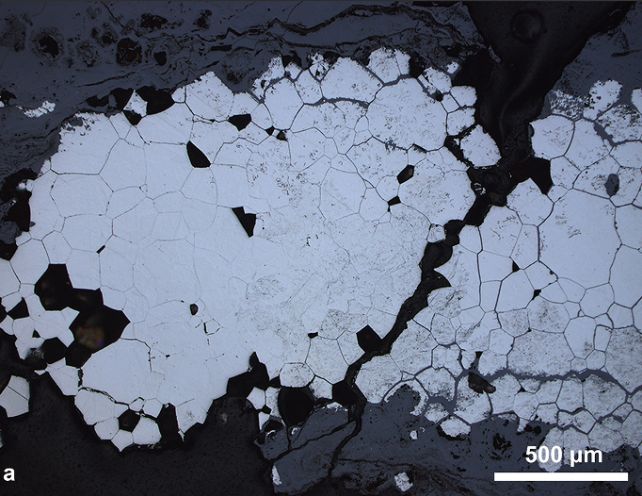
The dating of surrounding excavated materials places this object within the Shang Dynasty, preceding the widespread diffusion of iron smelting across China. Nevertheless, analysis via X-ray fluorescence revealed that the object comprises at least 90 percent iron by mass, with a nickel content of 7.41 percent, and the remainder consisting of trace elements.
This specific elemental composition, the researchers contend, would have been exceedingly difficult to achieve using the metalworking methodologies prevalent during the Late Shang period.
During the Bronze Age – so named for its defining metal – bronze was the predominant material for implements, armaments, and adornments, a period that commenced in China around 2000 BCE. This alloy was favored for its resilience and ready availability, produced by smelting copper and combining it with tin and other metallic elements.
Cast iron smelting did not gain significant traction in China until approximately 800 BCE, at which point the technology for extracting iron from its ore became widely disseminated. This development followed the discovery of how to attain the exceptionally high temperatures essential for this process.
Consequently, the utilization of iron during the Bronze Age is indeed uncommon, though not entirely unprecedented. In various other global regions, including other parts of China, certain rare and valuable artifacts appear to have been fashioned from iron that originated not from terrestrial sources but from celestial descent, falling blazing from the heavens.
However, the Sanxingdui discovery suggests a distinct application of this rare material within that culture. In contrast to artifacts from China’s Central Plains, which frequently integrated meteoritic iron with bronze, the Sanxingdui artifact seems to have been exclusively composed of iron.
“The presence of meteoritic iron at Sanxingdui further underscores the unique metallurgical practices observed in Southwest China, presenting a contrast to the contemporaneous methods employed in the Central Plains,” the researchers articulate.
Coupled with its discovery within a ritualistic context, this find cultivates an intriguing hypothesis: that meteoritic iron was not merely an ordinary material to the Sanxingdui populace but held sufficient value to be incorporated into whatever activities involved the accumulation of treasures in pits and their subsequent immolation.
“The artifact’s delicate condition presents substantial conservation hurdles for any further cleaning efforts,” the research team notes.
“Subsequent investigations will need to concentrate on high-resolution characterization techniques to refine the artifact’s classification and elucidate its associated functional and ceremonial roles.”
This groundbreaking discovery has been formally documented and published in the esteemed journal Archaeological Research in Asia.