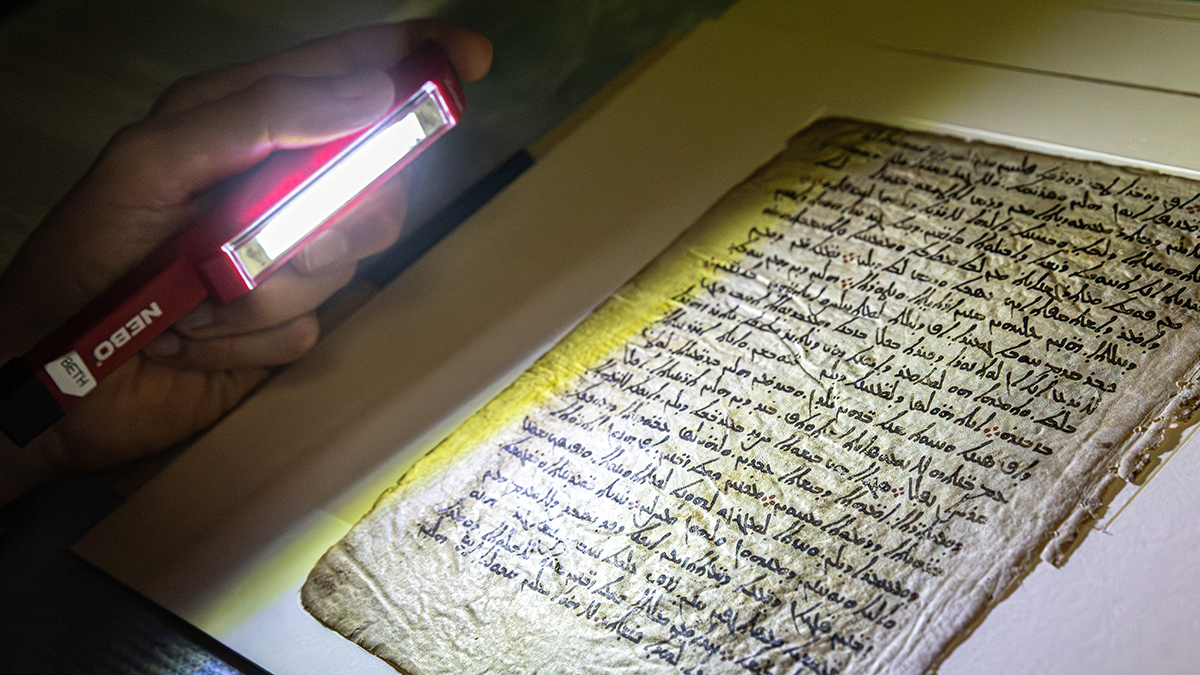
Scholars are meticulously undertaking the reconstruction of what is believed to be the most ancient celestial chart known to humankind. This astronomical document, once presumed irretrievably lost, is being brought to light through an innovative process of X-raying parchment containing a hidden star catalog concealed beneath subsequent layers of text.
The cosmos map originates from the esteemed ancient astronomer Hipparchus, whose active period spanned from approximately 190 to 120 BCE, predating the advent of the telescope by a considerable margin. He is widely recognized as the inaugural astronomer in the Western hemisphere to embark on such a cataloging endeavor and the first to accurately ascertain the celestial mechanics of the Sun and Moon.
However, until this recent development, the sole surviving testament to Hipparchus’s lifetime of scholarly pursuits was a body of commentary he authored concerning two seminal works that detailed stellar constellations – works with which he identified several discrepancies.
Now, there is a remarkable prospect of accessing a considerably more comprehensive and illuminating piece of Hipparchus’s work. The narrative commenced in 2022 when an in-depth examination of a 6th-century monastic manuscript indicated the potential presence of an ancient star chart attributed to Hipparchus.
Given the considerable expense of parchment during the medieval era, it was a common practice to thoroughly scrape away the ink and repurpose the material. This appears to be precisely what transpired in this instance.
While prior observations had identified underlying astronomical script on the folio, it was in 2022 that researchers successfully correlated these references with phenomena such as Earth’s axial precession (the subtle wobble of our planet’s axis) to the temporal period when Hipparchus was actively engaged in his astronomical studies.
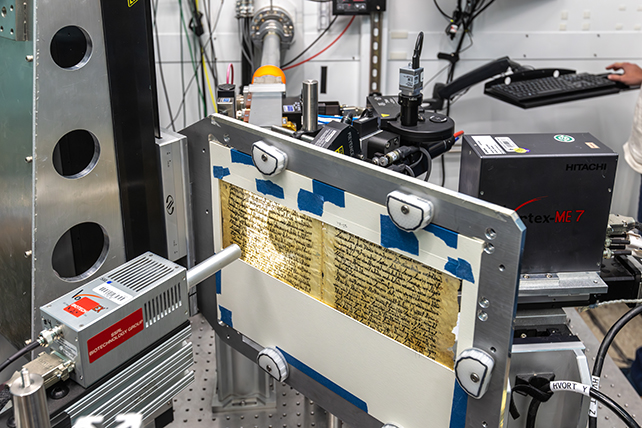
This leads us to the latest significant development in this extraordinary undertaking of textual restoration. The manuscript, identified as the Codex Climaci Rescriptus, is currently undergoing X-ray scanning at the SLAC National Accelerator Laboratory, with the objective of discerning the extent of the concealed content.
“The ultimate aim is to retrieve as many of these celestial coordinates as feasible,” historian Victor Gysembergh, affiliated with the French national scientific research center CNRS, communicated to Ayah Ali-Ahmad of KQED. “And this endeavor will significantly contribute to our understanding of the genesis of scientific inquiry.”
“What prompted the inception of scientific pursuits over two millennia ago? How did they achieve such remarkable proficiency so rapidly? The reason is that the coordinates we are uncovering exhibit an astonishing degree of precision, especially considering they were derived through naked-eye observation.”
The sophisticated apparatus employed in this investigation is a particle accelerator known as a synchrotron. This device generates X-rays by accelerating electrons to velocities approximating the speed of light. These high-energy X-rays possess the capability to differentiate between various chemical compositions within a material, all without causing damage to the delicate substrate.
While the monastic scribes who superimposed their texts utilized ink rich in iron, the underlying script – written in Greek, not the Syriac language favored by the monks – exhibits a distinct calcium signature. This chemical difference provides researchers with the means to unveil the obscured text.
Tangible progress is already being achieved; several stellar descriptions have been successfully retrieved, alongside a reference to “Aquarius,” as reported by KQED. The fervent hope is that through continued scanning, experts will be able to fully illuminate the details contained within the manuscript.
Believed to have been originally acquired from St Catherine’s Monastery in Egypt, which holds the distinction of being the world’s oldest continuously inhabited Christian monastic community, the Codex Climaci Rescriptus has been carefully transported from The Museum of the Bible in Washington D.C. specifically for this analytical project.
The logistical undertaking itself has been substantial: Each leaf of the codex has been housed in bespoke frames, situated within humidity-controlled enclosures, and transported by hand. The illumination within the scanning facility is also meticulously regulated to preclude any further degradation of the ink.
Nevertheless, only eleven pages are presently undergoing examination at the SLAC laboratory. The manuscript comprises approximately two hundred pages in its entirety, and these pages are dispersed across various global locations. Consequently, further collaborative efforts may be requisite to facilitate the complete retrieval of this celestial map.
Even acknowledging the enduring challenges that lie ahead, the opportunity to reconstruct what is essentially the primordial map of the night sky is nothing short of extraordinary – particularly given that its rediscovery was once considered a remote possibility.
“I am currently experiencing the pinnacle of my professional exhilaration,” Gysembergh disclosed to KQED. “As a direct result of this nascent scanning initiative, textual lines are progressively emerging in ancient Greek from the astronomical manuscript.”