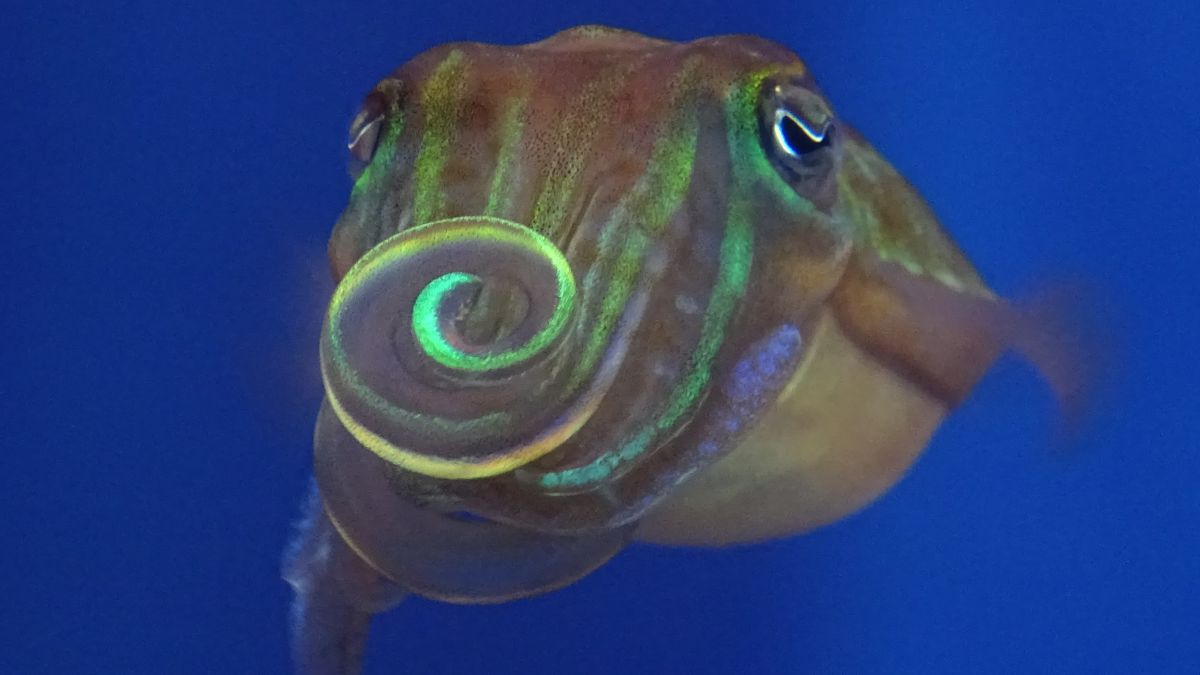
Every organism on Earth that propagates through sexual reproduction has developed distinct strategies for attracting a mate. However, cuttlefish possess a truly extraordinary capability in this regard.
Male Andrea cuttlefish (Doratosepion andreanum), whose coloration appears rather subdued to human observers, utilize their birefringent appendages to manipulate light. This optical feat generates a highly conspicuous signal, meticulously calibrated to the visual perception of cuttlefish.
It was previously understood that cuttlefish possess remarkably specialized eyes, capable of discerning the orientation of light waves, also known as polarization. This recent investigation reveals an even more sophisticated level of interaction, demonstrating their active modulation of polarization as a specific form of communication.
“Our findings,” state a research collective led by Arata Nakayama, an aquatic bioscientist at the University of Tokyo, “underscore the substantial role of light polarization in animal communication. Furthermore, they indicate that polarization signals, akin to vibrant sexual ornamentation, can achieve pronounced visibility through fundamentally distinct optical mechanisms.”
The repertoire of communication employed by cuttlefish is astonishingly intricate. It encompasses not only mesmerizing transformations in color and pattern but also the execution of elaborate movements with their pliable arms.
The ocular structures of cuttlefish are equally peculiar, exhibiting unique W-shaped pupils, dissimilar to those found in any other animal. Despite a presumed inability to perceive color, they can detect aspects of visible light beyond human capabilities, specifically the polarization of its transverse waves.
Light propagation typically involves vibrations in numerous directions simultaneously. However, this motion can be constrained to a singular orientation—a phenomenon referred to as polarization. Polarized eyewear functions by obstructing light vibrating in particular directions, permitting only light aligned in a specific orientation to traverse the lenses.
Light can also undergo polarization when it reflects off certain surfaces or passes through a semi-transparent or transparent medium, which can compel its vibrations into a preferred direction.
Ever since the discovery that cuttlefish can perceive polarization, scientific conjecture has suggested that this characteristic of light might serve a communicative purpose within their species. A study conducted in 2004 not only established that cuttlefish dermal tissues polarize light but also provided preliminary evidence indicating that these animals react to such signals.
To rigorously investigate this phenomenon, Nakayama and his associates conducted a carefully designed study, capturing footage of the courtship-related arm displays presented by male Andrea cuttlefish.
These cephalopods possess a pair of exceptionally elongated arms, displaying sexual dimorphism, which they extend forward in a coiled and then straightened manner during courtship, concurrently exhibiting iridescent bands of color across their bodies.
The researchers procured wild cuttlefish and housed male-female pairings in observation tanks subjected to precisely controlled illumination that replicated the horizontal polarization of light present in the marine environment. Concurrently, they recorded each interaction utilizing polarization-sensitive cameras, in addition to capturing imagery of the cuttlefish in a non-courting state to serve as a reference point.
The recorded data revealed that the translucent muscle tissue of these specialized arms, when manipulated in a particular configuration, allows horizontally polarized light to pass through. This tissue also exhibits birefringence, effectively rotating the light’s polarization by approximately 90 degrees, transforming it into a vertical orientation.
This process culminates in the generation of alternating bands of horizontally and vertically polarized light—an optimal contrast for cuttlefish visual processing, thereby creating a signal uniquely engineered to capture attention. It functions as a potent, visually communicated serenade.
An intriguing aspect of this mechanism is how the cylindrical contour of the arm amplifies this contrast, representing an ideal form for converting a horizontal light beam into a vertical one.
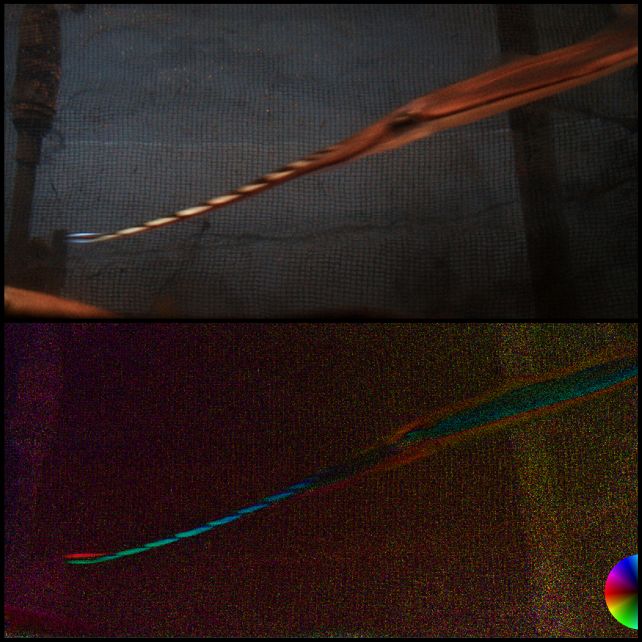
In their typical, non-courting state, the cuttlefish did not produce any polarization signal. This observation suggests that these creatures may have evolved a sophisticated biological waveplate specifically for reproductive purposes.
The extent to which cuttlefish utilize polarization signals beyond courtship remains an unresolved query. This question may only be definitively answered once researchers develop methods to perceive more of their concealed visual world.
“Much like the long-acknowledged and thoroughly investigated array of animal coloration, there might exist a comparable diversity of polarization signals among polarization-sensitive species—signals that presently elude our perception due to their invisibility to the human eye,” the authors report.
“This investigation illuminates a facet of that hidden diversity.”