Utilizing NASA’s James Webb Space Telescope, astronomers have obtained the most detailed infrared depiction to date of the central region of the Circinus Galaxy, recognized as one of the active galaxies most proximate to our own Milky Way. The insights derived from Webb’s observations indicate that a substantial portion of the intense heat emanating from dust clouds near the galaxy’s supermassive black hole is being consumed by the black hole itself, contrary to prevailing models that anticipated this energy being ejected in forceful streams.
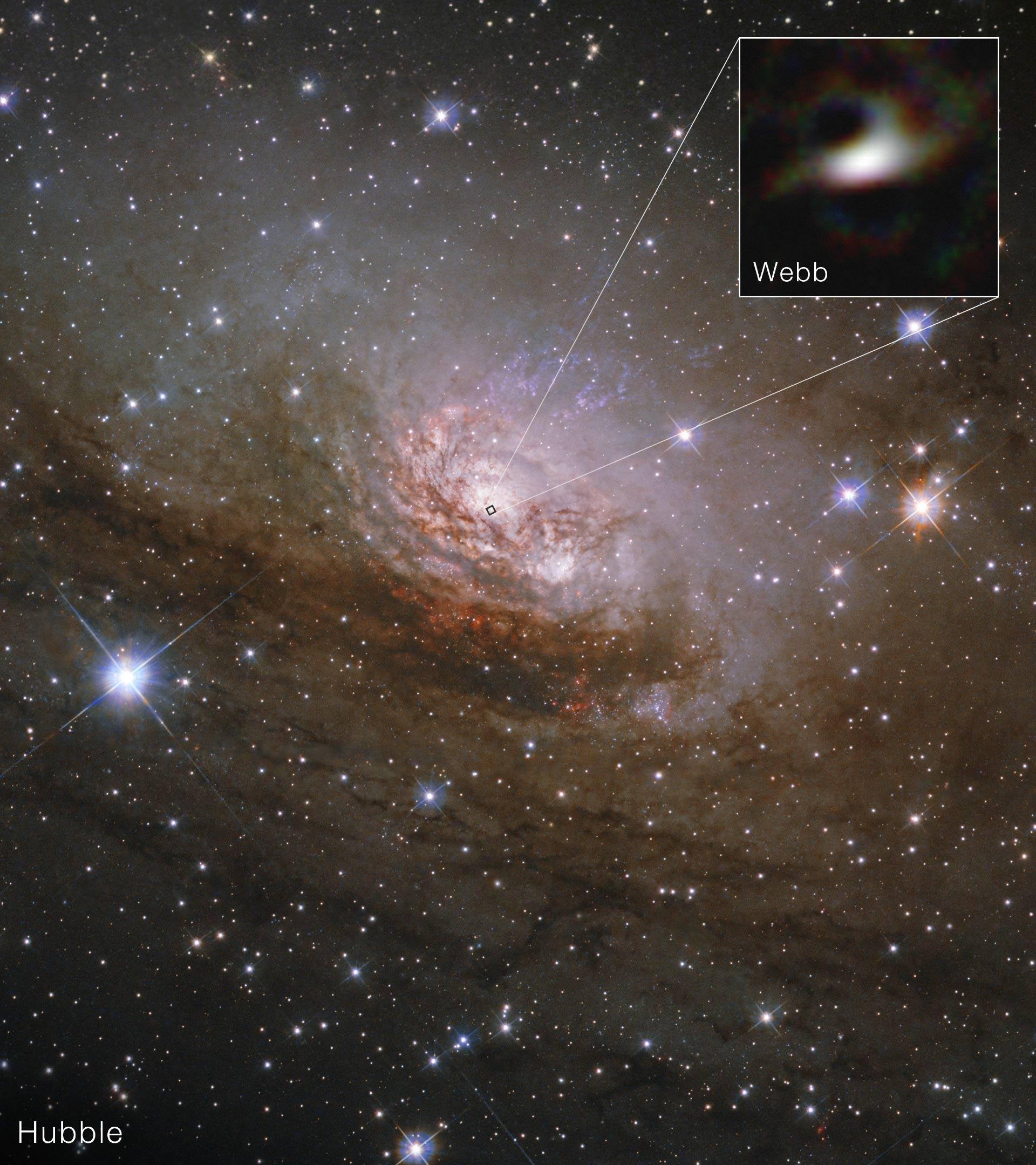
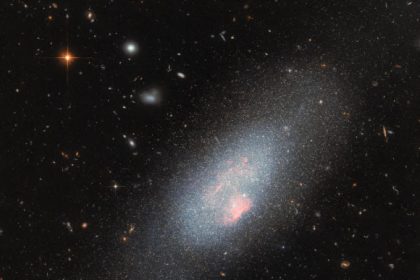
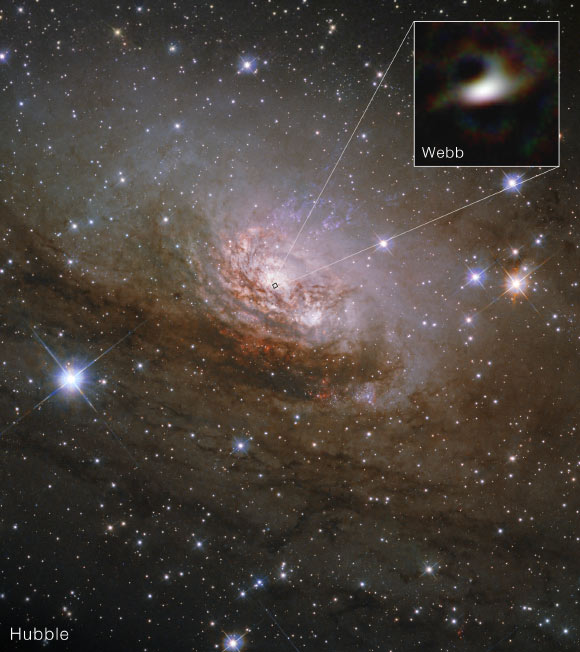
The Hubble image shows the Circinus Galaxy, a spiral galaxy about 13 million light-years away in the southern constellation of Circinus; a close-up of its core from Webb shows the inner face of the hole of the donut-shaped disk of gas disk glowing in infrared light; the outer ring appears as dark spots. Image credit: NASA / ESA / CSA / Webb / Hubble / Enrique Lopez-Rodriguez, University of South Carolina / Deepashri Thatte, STScI / Alyssa Pagan, STScI / NSF’s NOIRLab / CTIO.
Situated approximately 13 million light-years distant within the southern constellation of Circinus, the Circinus Galaxy is classified as a spiral galaxy.
This celestial entity, also referred to by designations such as ESO 97-G13 or LEDA 50779, has long captivated the attention of astrophysicists due to the substantial obscuration of its core by dense nebulae of gas and particulate matter.
Conventional ground-based astronomical instruments have encountered considerable challenges in resolving the immediate vicinity of the central black hole, an area where material descends inward, emitting potent infrared radiation.
The advanced observational capabilities of the Webb telescope have empowered Dr. Julien Girard of the Space Telescope Science Institute and his research collaborators to pierce through this veil of dust with an unprecedented level of clarity.
A significant advancement was achieved through the deployment of Webb’s Near-Infrared Imager and Slitless Spectrograph (NIRISS) in a specialized high-contrast operational mode known as the Aperture Masking Interferometer.
This sophisticated technique essentially transforms the instrument into a compact interferometer, meticulously merging light from a series of minute apertures to generate intricate interference patterns.
Through the meticulous analysis of these generated patterns, the astronomers were able to reconstruct a remarkably precise depiction of the Circinus Galaxy’s central engine, revealing that the majority of the infrared emissions originate from the toroidal structure of dust encircling and feeding the black hole, rather than from outward-moving ejected material.
“This marks the inaugural instance where a high-contrast mode of the Webb telescope has been employed to examine an extragalactic celestial body,” Dr. Girard commented.
“We aspire for our research to serve as an impetus for fellow astronomers to leverage the Aperture Masking Interferometer mode for the investigation of subtle yet comparatively small, dust-enshrouded structures located in proximity to any luminous object.”
The sustained activity of supermassive black holes is contingent upon their continuous consumption of surrounding matter.
Gaseous and dusty material coalesces into a doughnut-shaped structure, or torus, surrounding the black hole. As this material spirals inward, it forms a rotating accretion disk that experiences intense heating due to friction, consequently becoming radiant across a broad spectrum of electromagnetic wavelengths, including the infrared.
The novel data acquired by Webb indicate that the preponderance of the infrared luminosity observed near the Circinus Galaxy’s core is a direct consequence of the innermost segments of this dusty torus, thereby challenging prior hypotheses that suggested outflows were the dominant source of emission.
This groundbreaking methodology establishes a precedent for more in-depth investigations of black holes residing in other galaxies.
By extending the application of Webb’s high-contrast imaging techniques to an expanded array of celestial targets, the research team aims to compile a more comprehensive catalog of emission signatures. This, in turn, could elucidate whether the observed behavior of the Circinus Galaxy is characteristic of active galactic nuclei in general or represents an atypical phenomenon.
These findings not only furnish a more refined understanding of the mechanisms governing black hole accretion but also underscore the escalating prowess of interferometric methodologies within the realm of space-based astronomy.
With further observational campaigns slated for execution, the Webb telescope continues to progressively redefine the frontiers of what can be perceived from the most concealed regions of the cosmos.
“A statistically significant sample of black holes, perhaps numbering a dozen to two dozen, is imperative for us to comprehend the interplay between the mass within their accretion disks and their associated outflows in relation to their overall power output,” stated Dr. Enrique Lopez-Rodriguez, an astronomer affiliated with the University of South Carolina.
The outcomes of this research were formally presented today within the pages of the journal Nature Communications.
_____
E. Lopez-Rodriguez et al. 2026. JWST interferometric imaging reveals the dusty torus obscuring the supermassive black hole of Circinus galaxy. Nat Commun 17, 42; doi: 10.1038/s41467-025-66010-5