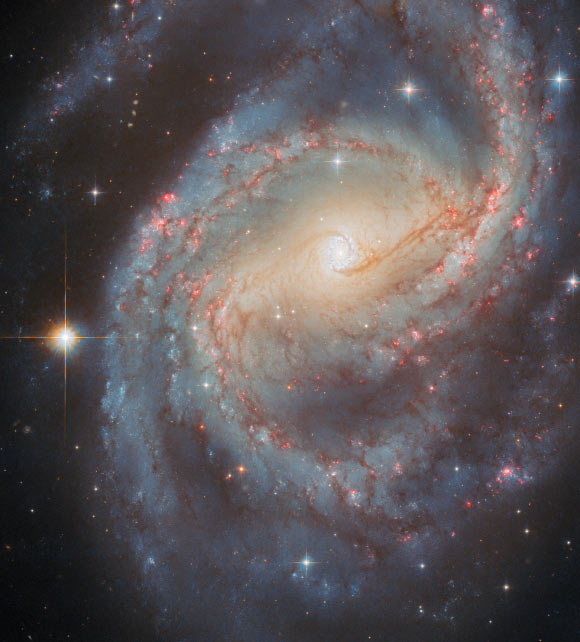
An exquisite, high-resolution portrayal of NGC 6951, a galaxy characterized by its prominent bar and spiral arms, has been unveiled by NASA, originating from imagery meticulously captured by the NASA/ESA Hubble Space Telescope.
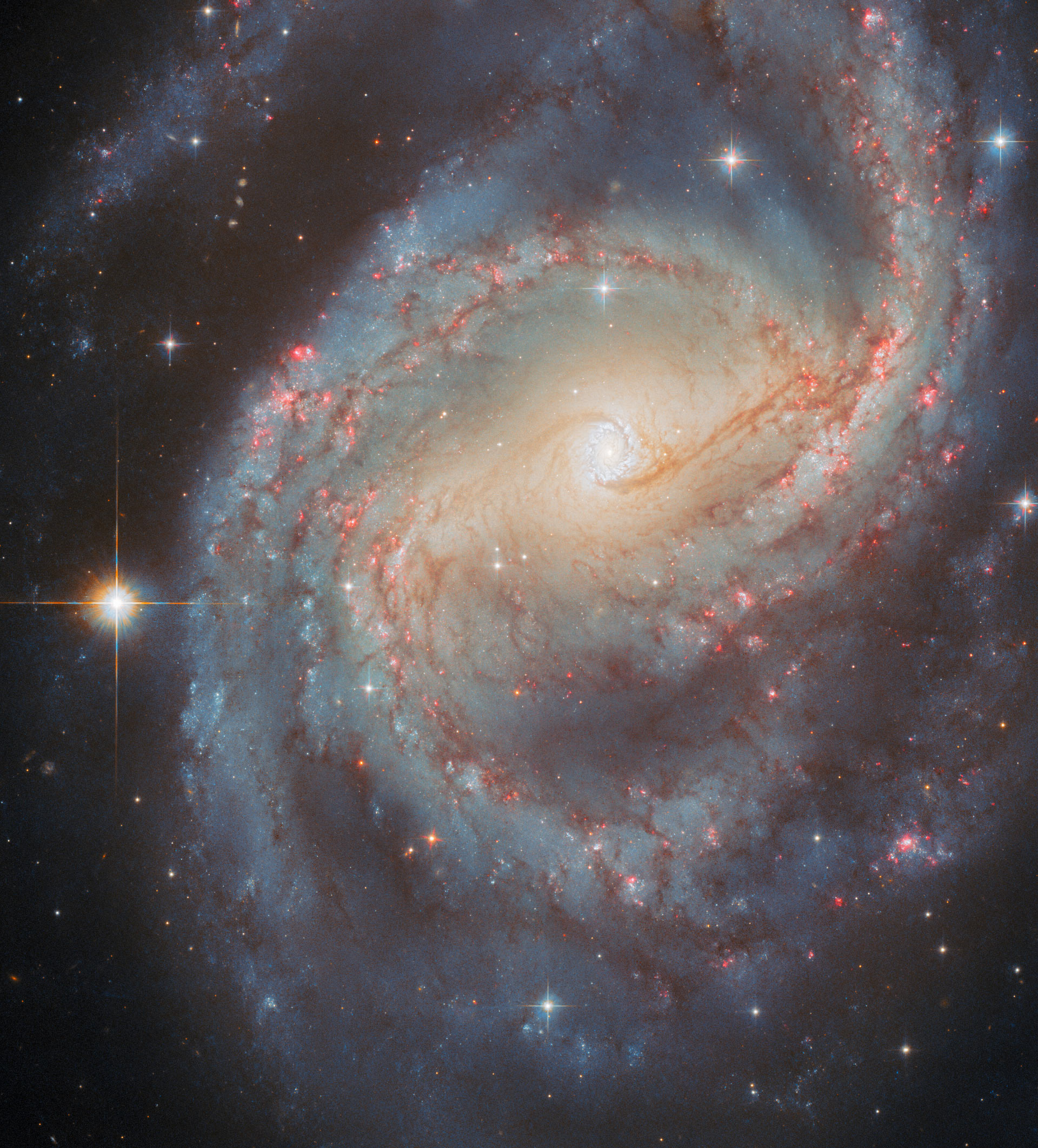
This Hubble rendering showcases NGC 6951, a barred spiral celestial body situated approximately 70 million light-years distant within the Cepheus constellation. The resultant color composite was compiled from distinct exposures obtained across the visible and near-infrared portions of the electromagnetic spectrum utilizing Hubble’s Advanced Camera for Surveys (ACS). A pair of filters were employed to acquire data at various wavelengths. The final color presentation is achieved by attributing unique hues to each monochromatic image corresponding to an individual filter. Credit for the image is attributed to NASA, ESA, Hubble, L.C. Ho, G. Brammer, A. Filippenko, and C. Kilpatrick.
NGC 6951 resides roughly 70 million light-years from our planet, nestled within the celestial sphere of Cepheus.
This galactic entity, also identified under the designations NGC 6952, LEDA 65086, IRAS 20366+6555, and UGC 11604, spans an impressive diameter of approximately 75,000 light-years.
The discovery of NGC 6951 is credited to two independent astronomical observations: the French astronomer Jerome Coggia in 1877 and the American astronomer Lewis Swift in 1878.
Astrophysicists categorize this object as a barred spiral galaxy, a Type II Seyfert galaxy, and a galaxy exhibiting a low-ionization nuclear emission-line region (LINER).
“As evidenced by this remarkable capture from Hubble, NGC 6951 presents itself as a spiral galaxy adorned with a multitude of captivating structures,” stated the Hubble astronomers in an official release.
“Its spiral arms, particularly striking, are abundantly populated with vividly red nebulae, luminous blue stellar populations, and intricate, filamentary formations of cosmic dust.”
“These spiral arms gracefully encircle the galactic core, which emanates a warm, golden luminescence derived from an assemblage of ancient stars.”
“Furthermore, the central region of the galaxy displays a pronounced elongation, indicative of a slowly revolving stellar bar.”
At the core of NGC 6951 lies a supermassive black hole, encircled by a structure known as a circumnuclear ring.
“The prominent bar structure of NGC 6951 is likely instrumental in shaping another notable characteristic: a whitish-blue ring that envelops the absolute heart of the galaxy,” the astronomers elaborated.
“This feature is designated as a circumnuclear starburst ring—essentially, a circular zone of heightened star formation activity surrounding a galaxy’s nucleus.”
“The galactic bar acts as a conduit, channeling interstellar gas towards the galaxy’s center, where it accumulates to form a ring approximately 3,800 light-years in extent.”
“Two distinct lanes of dark dust, running parallel to the bar, delineate the precise entry points where the channeled gas converges into this central ring.”
“The compressed gaseous material within a circumnuclear starburst ring provides an ideal crucible for the vigorous genesis of a substantial number of stars.”
Leveraging the data acquired by the Hubble telescope, researchers have identified in excess of 80 potential stellar clusters situated within the ring of NGC 6951.
“A significant portion of these stars have undergone formation within the last 100 million years; however, the ring itself possesses a far greater antiquity, with its existence potentially spanning between 1 and 1.5 billion years,” the research team elucidated.