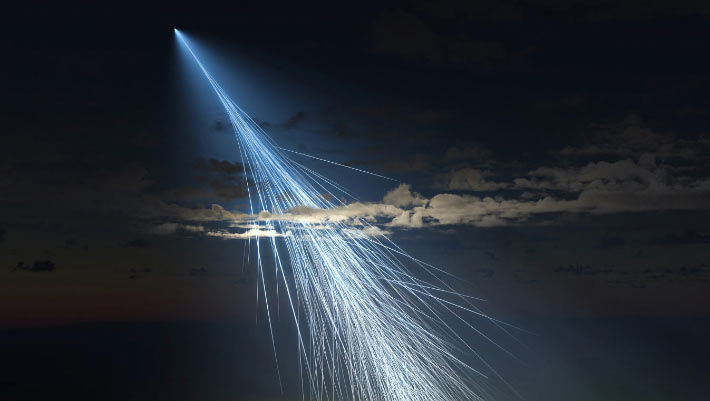
Cosmic rays possessing extraordinary energies represent the universe’s most energetic particles, with their power exceeding human-generated energies by over a millionfold.
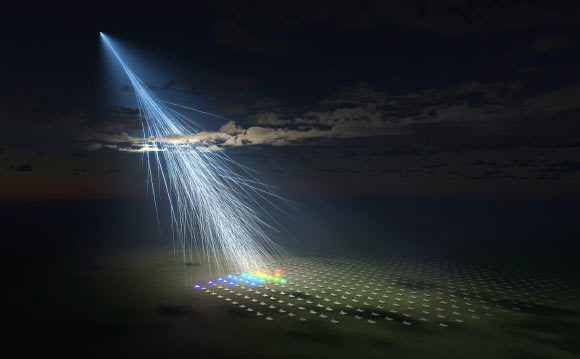
Professor Farrar proposes that binary neutron star mergers are the source of all or most ultrahigh energy cosmic rays; this scenario can account for the heretofore inexplicable narrow rigidity range of ultrahigh energy cosmic rays because the jets of binary neutron star mergers are generated by a gravitationally driven dynamo and thus are nearly identical due to the narrow range of binary neutron star masses. Image credit: Osaka Metropolitan University / L-INSIGHT, Kyoto University / Ryuunosuke Takeshige.
For nearly sixty years, the existence of these ultrahigh energy cosmic rays has been acknowledged, yet astrophysicists have struggled to develop a compelling origin hypothesis that reconciles all observed phenomena – a challenge that may now be overcome.
A novel theoretical framework, put forth by Glennys Farrar of New York University, offers a plausible and empirically verifiable explanation for the genesis of these high-energy particles.
“Following six decades of dedicated investigation, the source of the universe’s most energetic and enigmatic particles may finally be illuminated,” stated Professor Farrar.
“This breakthrough provides a fresh perspective for comprehending the cosmos’ most cataclysmic events: the collision of two neutron stars, culminating in the formation of a black hole. This monumental process is responsible for the synthesis of numerous precious and rare elements, including gold, platinum, uranium, iodine, and xenon.”
Professor Farrar posits that ultrahigh energy cosmic rays are propelled to immense energies within the turbulent magnetic fields of binary neutron star mergers, being ejected from the remnant material before the final black hole coalesces.
Concurrently, this process yields powerful gravitational waves, some of which have already been documented by researchers at the LIGO-Virgo Collaboration.
“This research offers the first comprehensive explanation for two of the most perplexing characteristics of ultrahigh energy cosmic rays: the precise correlation between their energy and electric charge, and the exceptional energies observed in a select few of the most potent events,” Professor Farrar explained.
“The implications of this study present two avenues for experimental verification in future research endeavors:
(i) The cosmic rays with the absolute highest energies are theorized to originate from scarce ‘r-process’ elements, such as xenon and tellurium, prompting a focused search for such a component within existing ultrahigh energy cosmic ray data;
(ii) Ultrahigh-energy neutrinos, resulting from collisions involving ultrahigh energy cosmic rays, are intrinsically linked to the gravitational waves generated during the parent neutron star merger.”
This groundbreaking research has been published in the esteemed journal Physical Review Letters.
_____
Glennys R. Farrar. 2025. Binary Neutron Star Mergers as the Source of the Highest Energy Cosmic Rays. Phys. Rev. Lett 134, 081003; doi: 10.1103/PhysRevLett.134.081003