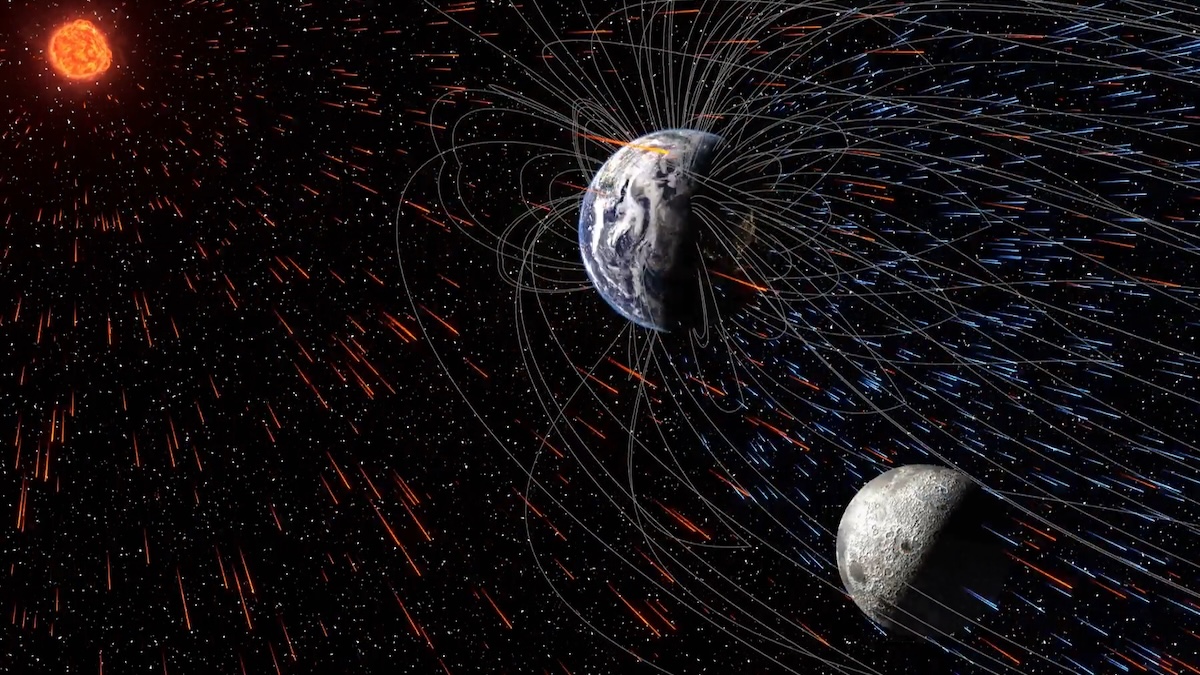
While the Moon is devoid of a substantial atmosphere, our planet has, in essence, been actively contributing its own atmospheric constituents for eons. A recent investigation has illuminated how Earth’s magnetic field may be instrumental in transporting particles from our atmosphere to the lunar surface.
An unexpected profusion of volatile elements has been identified within the lunar regolith, the fine particulate matter that blankets the Moon, ever since the initial lunar sample returns by the Apollo astronauts.
While the solar wind has been posited as a potential contributor to these volatiles, it is insufficient on its own to explain the observed concentrations, particularly for nitrogen. Furthermore, the impact of minute meteoroids striking the lunar surface could also be a factor in modifying its composition.
The prospect of Earth’s atmosphere serving as a source has been previously entertained; however, the prevailing assumption was that this transfer could only have occurred prior to the establishment of our planet’s magnetic field, which was believed to subsequently impede the escape of most atmospheric particles.
This latest research endeavor, undertaken by astrophysicists affiliated with the University of Rochester, critically examined this prior assumption.
The research team developed simulations for two distinct planetary evolution scenarios to ascertain which best aligned with the empirical data: one positing an ‘early Earth’ condition characterized by an absent magnetic field and a more vigorous solar wind, contrasted with a ‘modern Earth’ scenario featuring a robust magnetic field and a diminished solar wind.
Intriguingly, the ‘modern Earth’ model demonstrated a superior congruence with the observed phenomena. The solar wind, in its interaction with Earth’s atmosphere, ionizes atmospheric particles, directing them along the trajectories defined by the planet’s magnetic field lines.
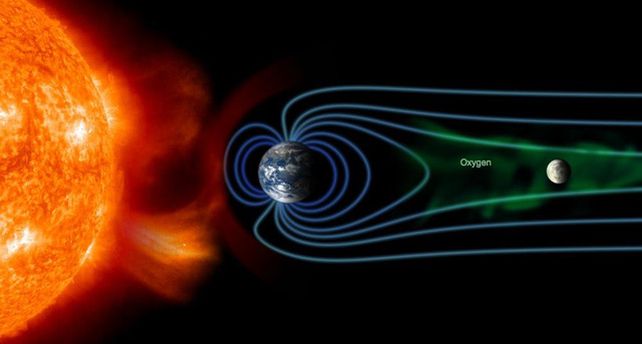
Earth’s magnetosphere, contrary to its name’s implication of a spherical form, is sculpted into a more elongated, comet-like shape due to the persistent outward pressure exerted by the solar wind. Consequently, when the Moon traverses this elongated magnetic tail, particles become deposited upon its surface.
Prior scientific inquiries have put forth analogous mechanisms that could facilitate the delivery of oxygen to the Moon, a process potentially leading to the formation of water and even lunar rust.
The current investigation posits that this atmospheric particle transfer has been an ongoing process for billions of years, providing ample temporal duration for these volatile compounds to accumulate within the lunar regolith.
Given the significant transformations that Earth’s atmosphere has undergone throughout this extensive period, the Moon’s surface may consequently host a valuable repository of historical atmospheric data.
This groundbreaking research has been disseminated in the esteemed journal Nature Communications Earth & Environment.