An extraordinary discovery has been made by astronomers, prompted by the unusual dimming and flickering of a celestial body, reminiscent of a faltering candle flame.
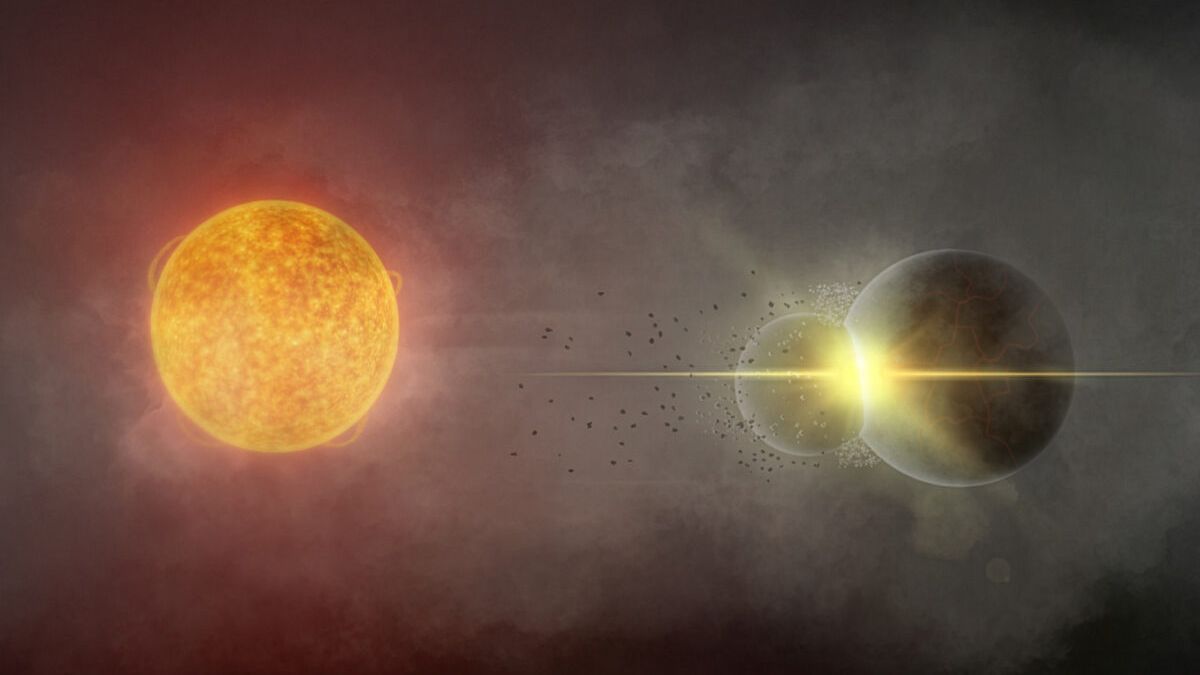
Analysis of the peculiar luminosity variations observed in a Sun-like star, designated Gaia-GIC-1 and situated approximately 11,600 light-years distant, indicates that its erratic behavior is most plausibly attributed to the impact of two nascent planets in its immediate celestial neighborhood.
“It is truly remarkable that multiple telescopic instruments captured this cosmic impact in realtime,” stated Dr. Anastasios Tzanidakis, an astronomer affiliated with the University of Washington.
“Records of planetary collisions of any kind are exceedingly scarce, and this particular event bears a striking resemblance to the cataclysmic impact believed to have formed Earth and its Moon. Further observations of similar phenomena across the galaxy promise to significantly enhance our comprehension of planetary genesis, including that of our own world.”
The early stages of planetary system evolution are often characterized by extreme dynamism. Aggregations of cosmic dust coalesce into planetary precursors, or planetesimals, in regions where gravitational forces and material density are conducive, irrespective of other celestial bodies in proximity to the young star.
Such conditions can precipitate frequent collisions, a scenario hypothesized to have occurred within our own Solar System. Beyond the protracted epoch of intense bombardment by asteroids impacting nascent planets, it is theorized that a Mars-sized body collided with Earth, ejecting debris into orbit that subsequently coalesced to form the Moon.
Obtaining empirical evidence of this formative process around other stars presents considerable challenges. Planetary impacts are relatively localized events and transpire swiftly, leaving behind transient clouds of dust that are exceedingly difficult to discern from vast interstellar distances.
However, the advent of extensive sky surveys, such as those conducted by the Gaia mission, now enables astronomers to monitor expansive celestial regions concurrently. These surveys meticulously record stellar luminosity, spectral characteristics, and spatial positions for countless stars, thereby facilitating the detection of any deviations in their observed behavior.
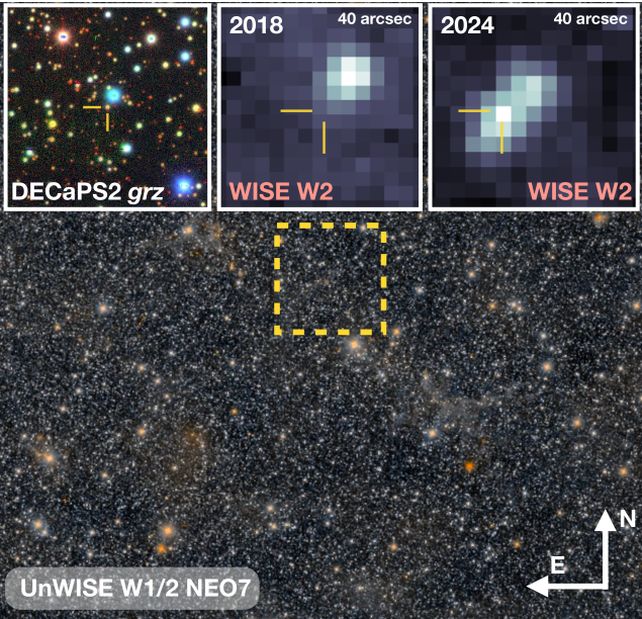
The anomalous changes in Gaia-GIC-1’s light output were initially documented nearly a decade prior. It was during a review of archival data by Tzanidakis that an anomaly became apparent.
“The star’s baseline luminosity remained consistent until 2016, when it exhibited three distinct periods of diminished brightness. Subsequently, around 2021, its behavior became dramatically erratic,” he elaborated.
“It bears reiteration that stars akin to our Sun do not display such erratic patterns. Consequently, upon observing this phenomenon, our immediate reaction was one of profound intrigue regarding its underlying cause.”
Gaia-GIC-1 is classified as an F-type star, exhibiting characteristics similar to our Sun but with greater dimensions and elevated temperature. Its radius is approximately 1.7 times that of the Sun, with a mass roughly 1.3 times greater. It is situated in the vicinity of the southern constellation Puppis, within the periphery of the Milky Way’s galactic disk.
While its precise age remains indeterminate, the star appears remarkably stable, firmly positioned on the main sequence. This indicates that it has attained stellar maturity, deriving its energy from the fusion of hydrogen in its core. F-type stars are generally quiescent; they do not exhibit the pronounced variability observed in red dwarf stars, nor the unusual fluctuations associated with stars nearing the end of their lifecycles, such as Betelgeuse.
Therefore, the pronounced variations in Gaia-GIC-1’s luminosity, which ultimately diminished by an astonishing 25 percent in an unprecedented pattern, presented a considerable enigma.
Astronomer James Davenport of the University of Washington proposed an alternative perspective, shifting the focus to a different spectral range, which proved pivotal in unraveling the mystery.
“The infrared light curve presented a stark contrast to that observed in visible light,” Tzanidakis remarked.
“As the visible light intensity waned, the infrared emissions experienced a surge. This observation suggests the presence of intensely heated material obstructing the starlight, sufficiently hot to emit radiation in the infrared spectrum.”
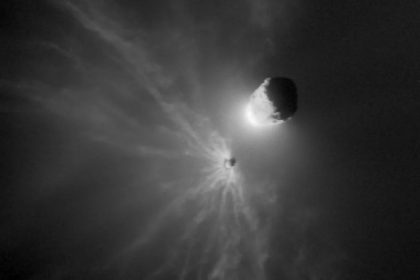
This discovery indicated the presence of a dust cloud with a mass comparable to a substantial asteroid, potentially approaching half the mass of the dwarf planet Ceres, and heated to approximately 900 kelvins. According to the computational models developed by the research team, a singular type of event aligns with all these specific parameters.
A collision between planetesimals can account for the observed mass and thermal energy, as well as the peculiar brightness fluctuations, encompassing both the initial dimming and the subsequent chaotic phase. It is plausible that as two planetesimals approach each other, they undergo a series of glancing impacts before culminating in a singular, cataclysmic event.
The researchers’ modeling suggests that this collision occurred at a distance of approximately one astronomical unit from the parent star, a separation comparable to that between Earth and the Sun. This finding holds significant implications for understanding the formative epochs of our Solar System, our home planet, and the very origins of terrestrial life.
“The frequency of the event that ultimately formed the Earth-Moon system is a fundamental question in astrobiology,” Davenport commented.
“The Moon appears to be a crucial element in rendering Earth conducive to life. It offers a degree of protection against asteroid impacts, influences oceanic tides and global weather patterns that facilitate chemical and biological interactions, and may even contribute to tectonic plate activity.
“Currently, our understanding of the prevalence of such dynamics is limited. However, the observation of additional planetary collisions will undoubtedly facilitate our ability to quantify their frequency.”