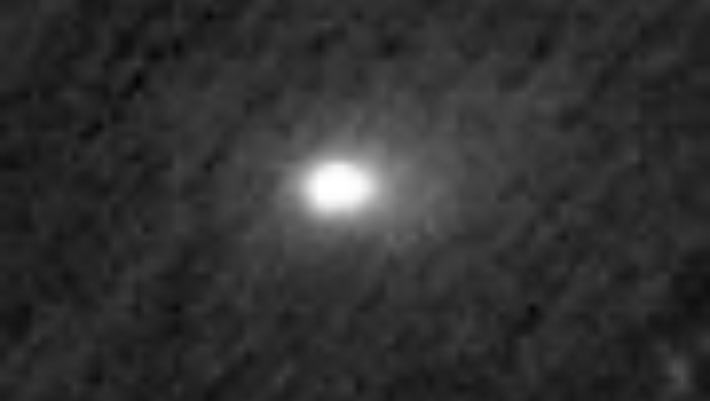
Enhanced predictions regarding the trajectory of interstellar comet 3I/ATLAS have been achieved with a tenfold increase in precision, a significant advancement facilitated by data acquired by the Colour and Stereo Surface Imaging System (CaSSIS) aboard the European Space Agency’s (ESA) Trace Gas Orbiter (TGO) spacecraft during its Martian orbit.
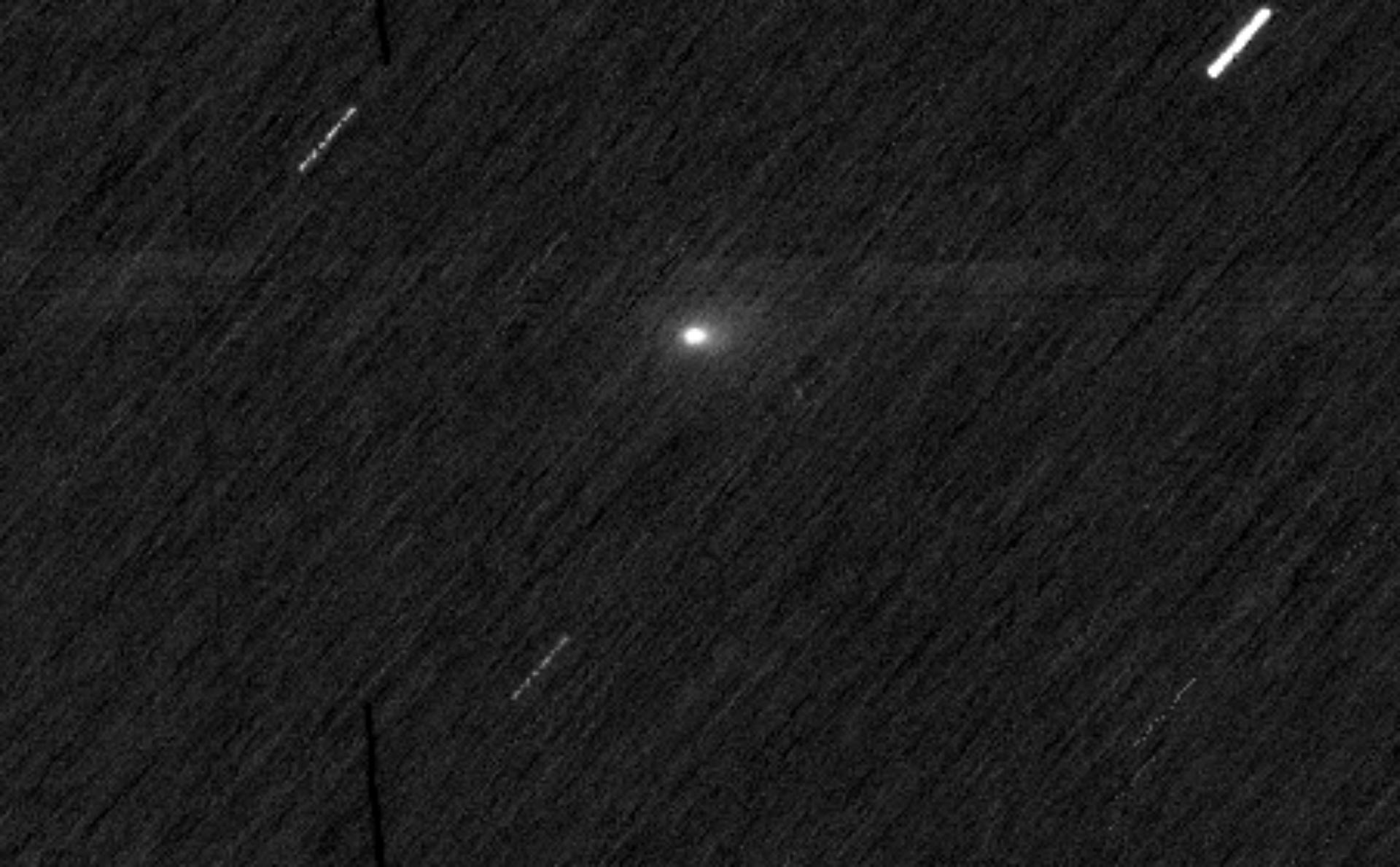
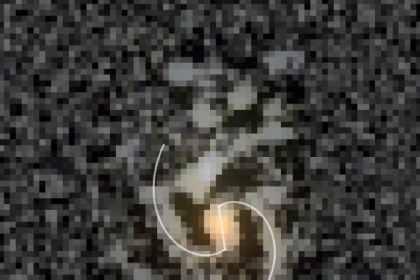
This image of the interstellar comet 3I/ATLAS was captured on October 3, 2025 by the CaSSIS instrument aboard ESA’s Trace Gas Orbiter. Image credit: ESA / TGO / CaSSIS.
The discovery of 3I/ATLAS was made by the ATLAS (Asteroid Terrestrial-impact Last Alert System) survey telescope, funded by NASA and situated in Rio Hurtado, Chile, on July 1, 2025.
Prior to September, the determination of the interstellar comet’s position and flight path was exclusively reliant on observations from terrestrial telescopes.
From October 1 to October 7, the TGO spacecraft reoriented its scientific instruments to focus on 3I/ATLAS from its vantage point in orbit around Mars.
This celestial visitor maintained a relatively close proximity to Mars, achieving its closest approach of approximately 29 million kilometers on October 3.
The Martian probe provided an observational perspective that was roughly ten times nearer to 3I/ATLAS than that offered by Earth-based telescopes, and it also captured imagery from a novel viewing angle.
By integrating the observational data from TGO/CaSSIS with the datasets obtained from Earth, a substantial enhancement in the accuracy of the comet’s predicted trajectory was realized.
Although the scientific team initially anticipated only a modest refinement in the predictions, the outcome was a remarkable tenfold increase in precision.
“Leveraging the data from the Mars orbiter to refine the trajectory of an interstellar comet was a demanding undertaking,” stated representatives of the TGO mission in a formal announcement.
“The CaSSIS instrument was fundamentally engineered for imaging the Martian surface in high resolution, focusing on nearby geological features.”
“On this occasion, the camera was repurposed to observe the celestial expanse above Mars, successfully capturing the faint, distant 3I/ATLAS as it traversed the star-filled firmament.”
Astronomers affiliated with the planetary defence division at ESA’s Centre for Near-Earth Object Coordination, who possess extensive experience in charting the paths of asteroids and comets, had to incorporate the spacecraft’s unique orbital position into their calculations.
“Typically, trajectory observations are conducted from fixed astronomical observatories on Earth, and occasionally from spacecraft operating in Earth’s vicinity, such as the NASA/ESA Hubble Space Telescope or the NASA/ESA/CSA James Webb Space Telescope,” the researchers elaborated.
“These astronomers are highly adept at factoring in their own positional data when forecasting the future locations of celestial bodies, a process known as determining ephemerides.”
“In this specific instance, the ephemeris of 3I/ATLAS, and particularly the accuracy of its projection, was contingent upon precisely accounting for TGO’s exact whereabouts—at Mars and within a rapid orbital path around it.”
“This endeavor necessitated a collaborative effort involving multiple ESA departments and their associated partners, spanning expertise from flight dynamics to scientific operations and instrument management.”
“Challenges and subtle factors that are typically considered insignificant were required to be meticulously addressed to minimize error margins as much as possible, thereby achieving the utmost level of precision.”