Employing the capabilities of the Very Large Telescope (VLT) and the VLT Interferometer (VLTI) situated in Chile, an international consortium of astronomers has achieved a direct observation of two gas giant planets in the process of formation within the planet-forming disc encircling the star designated WISPIT 2. This remarkable achievement offers one of the most detailed perspectives to date on the genesis of a planetary system. The configuration of the disc, characterized by distinct openings and annular structures in the surrounding material, strongly intimates the ongoing assembly of additional extraterrestrial worlds.
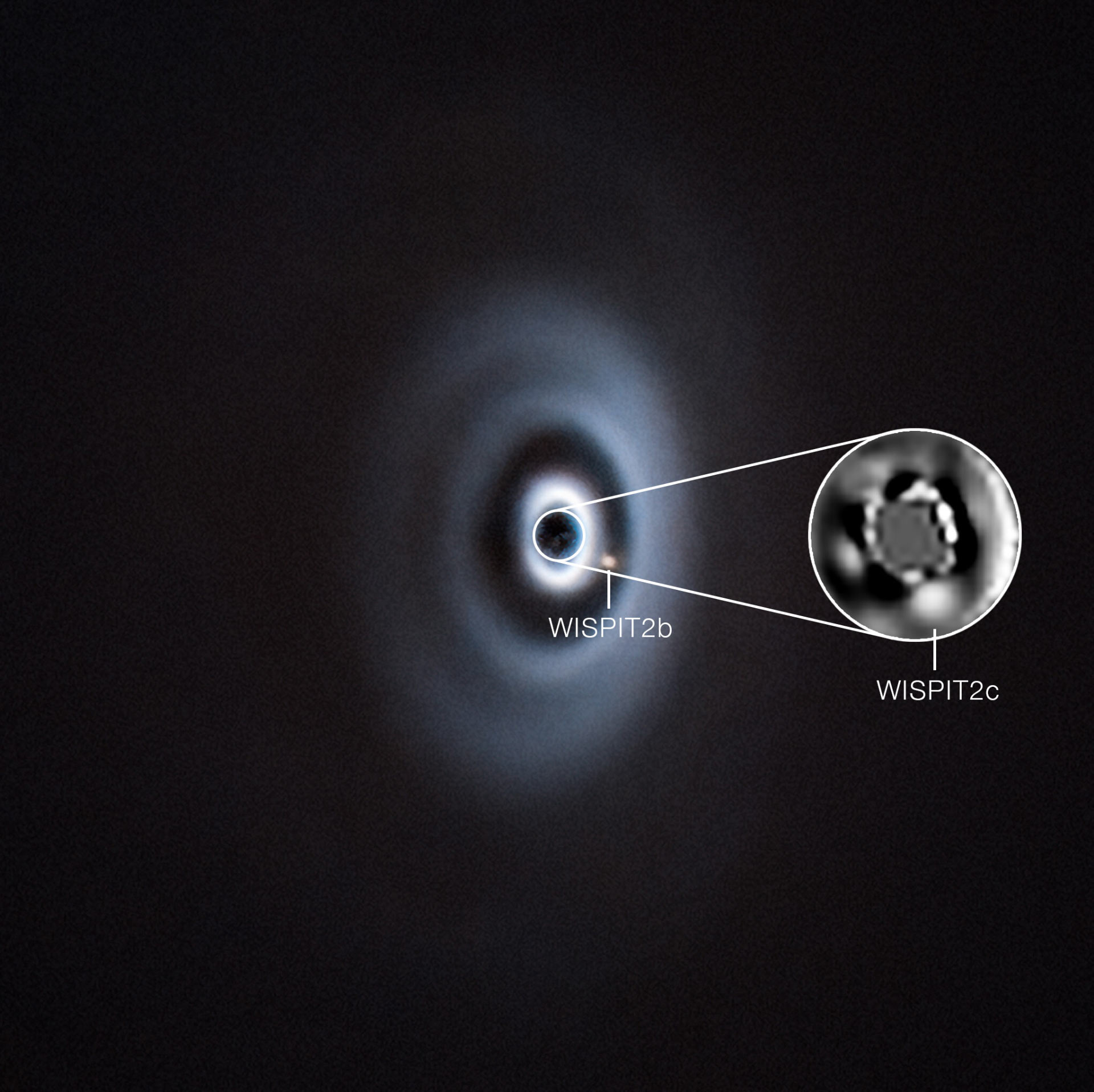
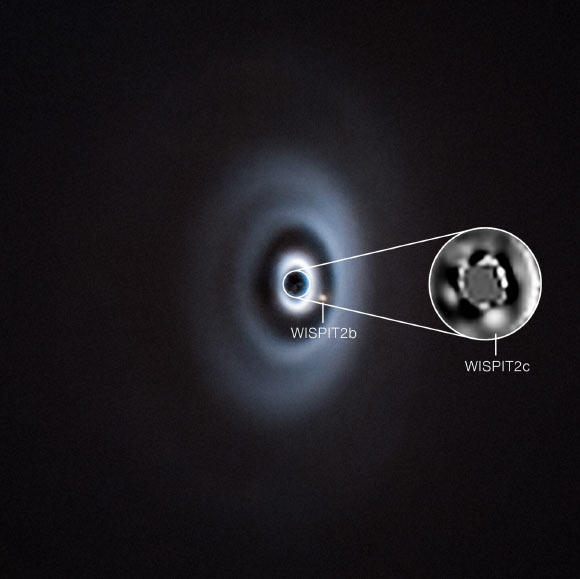
These visualizations, acquired through the Very Large Telescope, depict the formative stages of a planetary system around the nascent star WISPIT 2. Credit for the image: ESO / Lawlor et al.
“WISPIT 2 presents an unparalleled window into our own cosmic origins, offering insights we haven’t had before,” stated Chloe Lawlor, a doctoral candidate at the University of Galway.
Dr. Christian Ginski, also affiliated with the University of Galway, added, “WISPIT 2 serves as a crucial observatory, enabling us to scrutinize not merely the evolution of an individual planet, but the intricate dynamics of an entire planetary system.”
“Through such detailed observations, astrophysicists endeavor to gain a more profound comprehension of how nascent planetary systems mature into fully developed entities, akin to our own solar system.”
The initial protoplanet identified within the WISPIT 2 system was discovered a year prior, possessing a mass approximately five times that of Jupiter.
Designated WISPIT 2b, this celestial body traverses its orbit around the central star at a distance roughly sixty times that separating Earth from the Sun.
“This discovery of a nascent world in formation truly underscored the immense potential of our contemporary observational instruments,” remarked Richelle van Capelleveen, a doctoral candidate at Leiden Observatory.
Following the identification of an additional celestial object in proximity to the star, meticulous measurements conducted with the VLT and VLTI telescopes served to unequivocally confirm its planetary status.
The planet newly brought to light, WISPIT 2c, resides at a distance four times closer to the central star and exhibits a mass double that of WISPIT 2b.
Both of these newly identified planets are classified as gas giants, mirroring the outer planets within our Solar System.
To substantiate the existence of WISPIT 2c, the astronomical team utilized the SPHERE instrument attached to the VLT.
Subsequently, the GRAVITY+ instrument, integrated with the VLTI, was employed to definitively ascertain that the observed object was indeed a planet.
“Crucially, our research leveraged the recent enhancements to GRAVITY+, without which we would have been unable to achieve such a clear detection of the planet situated so near to its star,” explained Dr. Guillaume Bourdarot, an astrophysicist at the Max Planck Institute for Extraterrestrial Physics.
Both planetary bodies orbiting WISPIT 2 are situated within distinct cleared regions, or gaps, present in the disc of dust and gas that encircles the young star.
These observed gaps are a consequence of the developmental processes of each planet: particulate matter within the disc aggregates, with its gravitational influence drawing in further material until a planetary embryo begins to form.
The residual material, accumulating in the regions surrounding each gap, gives rise to characteristic dust rings within the disc.
In addition to the two gaps where the planets were detected, a minimum of one further, smaller gap has been identified further out within the WISPIT 2 disc.
“We surmise the potential presence of a third planet responsible for sculpting this particular gap, possibly possessing a mass comparable to Saturn, given that this gap is considerably less expansive and shallower,” commented Lawlor.
The comprehensive findings are published in Astrophysical Journal Letters.
_____
Chloe Lawlor et al. 2026. Direct Spectroscopic Confirmation of the Young Embedded Protoplanet WISPIT 2c. ApJL 1000, L38; doi: 10.3847/2041-8213/ae4b3b