Recent investigations conducted on the International Space Station (ISS) by microbiologists affiliated with the University of Wisconsin-Madison and Rhodium Scientific Inc. have yielded significant findings regarding the profound influence of near-weightless conditions on the intricate relationships between bacteriophages, which are viruses targeting bacteria, and their microbial hosts.
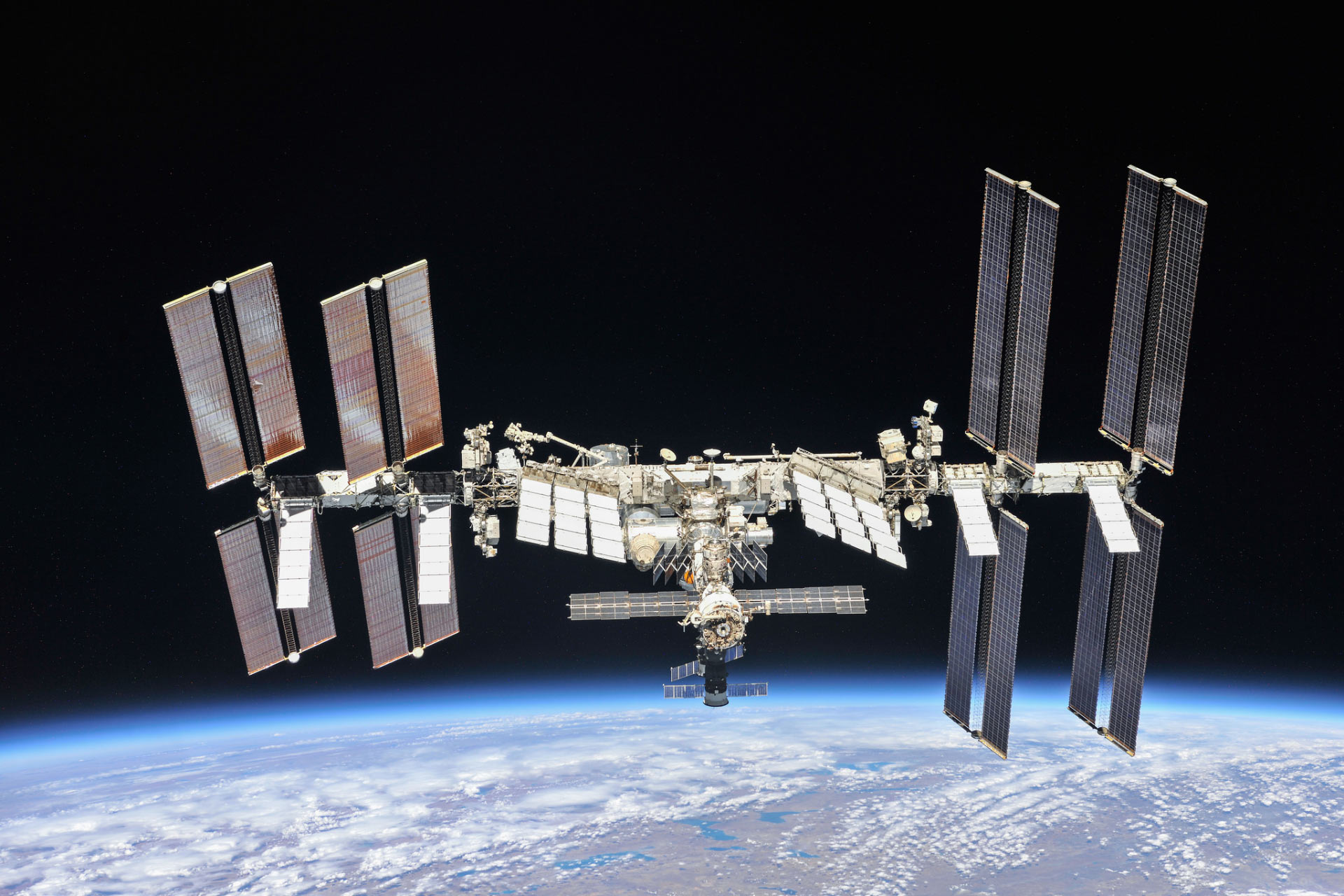
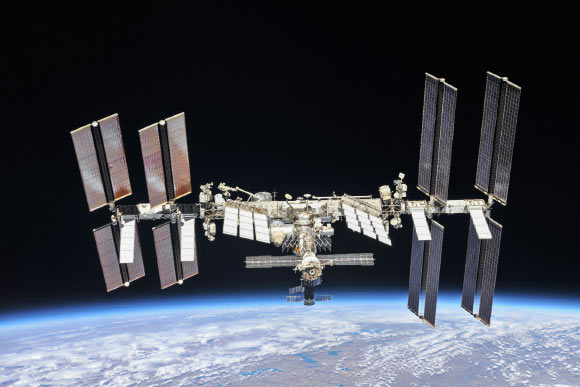
The International Space Station is seen with Earth in the background. Image credit: NASA.
In a meticulously designed inquiry into bacteriophage-host dynamics within a microgravity setting, researcher Phil Huss from the University of Wisconsin-Madison, alongside his collaborators, scrutinized the interactions between the T7 phage and Escherichia coli bacteria during their cultivation aboard the orbiting laboratory.
These experimental results indicated that the microgravity environment initially impeded the virus’s capability to infect and eradicate the bacteria, though it did not permanently obstruct the infection process.
Under standard Earth-bound conditions, T7 phages typically infect and induce lysis in Escherichia coli within a timeframe of 20 to 30 minutes.
However, in the microgravity experiments, the scientific team observed no discernible progression in bacteriophage proliferation during the initial hours of incubation.
It was after a period of 23 days that bacteriophages were noted to have effectively multiplied and led to a reduction in bacterial numbers, suggesting that the bacteriophage activity ultimately surmounted the initial inhibitory effects of the microgravity milieu.
The unique physical attributes of microgravity, including diminished fluid convection and alterations in bacterial physiological processes, are hypothesized to modify the mechanisms by which bacteriophage particles engage with and infect their bacterial targets.
In the absence of gravitational force, the conventional fluid mixing that facilitates contact between viral particles and bacteria is disrupted, potentially retarding the nascent stages of infection.
To gain a more comprehensive understanding of the evolutionary and molecular ramifications stemming from these altered interaction patterns, the researchers proceeded to sequence the complete genomes of both the bacteriophages and the bacteria following extended incubation periods.
Their genomic analyses revealed a multitude of novel mutations in both viral and bacterial DNA, providing evidence that both organisms underwent adaptation in response to the prevailing environmental conditions.
Conspicuously different mutation profiles were observed in the microgravity samples when contrasted with those that evolved under Earth’s gravitational pull, thereby indicating that the extraterrestrial setting imposed distinct selective pressures on both the bacteriophages and their hosts.
Subsequent investigations concentrated on the bacteriophage’s receptor binding protein, a critical component dictating the efficacy with which a virus identifies and infects its designated bacterial recipient.
Employing deep mutational scanning techniques, the investigators identified substantial divergences in the mutational spectrum of this protein when comparing microgravity and terrestrial experimental conditions, which reflects underlying shifts in host adaptation and selection processes.
In a particularly noteworthy outcome, the researchers utilized genetic libraries of receptor binding protein variants that had been shaped by microgravity selection to generate bacteriophage variants exhibiting enhanced infectivity against specific antibiotic-resistant strains of Escherichia coli on Earth. This finding underscores the potential for space-based research to yield practical applications in terrestrial biotechnology.
“Our research provides an initial perspective on the ways in which microgravity influences phage-host interactions,” the researchers stated in their conclusion.
“Investigating phage activity in extraterrestrial environments uncovers new genetic factors contributing to fitness and paves the way for innovative strategies in engineering phages for applications on Earth.”
“The successful execution of this methodology contributes to establishing a foundation for future phage research initiatives aboard the ISS.”
This scientific work has been published online in the esteemed journal PLoS Biology.
_____
P. Huss et al. 2026. Microgravity reshapes bacteriophage-host coevolution aboard the International Space Station. PLoS Biol 24 (1): e3003568; doi: 10.1371/journal.pbio.3003568