Designated KM3-230213A, the recently identified neutrino possessed a staggering energy level of 220 peta-electronvolts (PeV), positioning it among the most potent fundamental particles ever registered. This energy output was approximately 100 million billion times that of visible light photons and about 30 times the peak neutrino energy previously recorded.

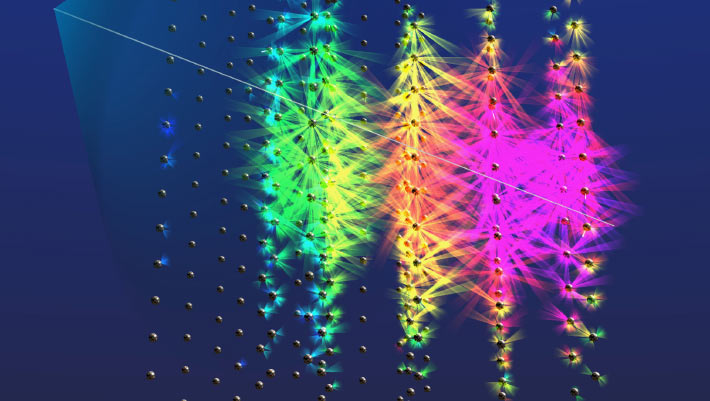
Visual impression of the ultra-high energy neutrino event observed in KM3NeT/ARCA. Image credit: KM3NeT.
The genesis of cosmic neutrinos can occur either in proximity to their originating cosmic-ray source or along the trajectory of cosmic-ray propagation. This process leads to the formation of transient secondary particles, which subsequently decay to yield neutrinos.
Atmospheric neutrinos, which constitute an experimental baseline for cosmic neutrino investigations, are a byproduct of cosmic ray interactions within Earth’s atmosphere.
To facilitate the detection of cosmic neutrinos, vast-volume neutrino observatories meticulously monitor extensive bodies of natural water or ice. These observatories capture the Cherenkov radiation emitted as charged particles, resulting from neutrino interactions within or near the detector, traverse the medium.
“The extreme rarity of high-energy neutrinos like this makes this a pivotal discovery,” commented Professor Miroslav Filipovic of Western Sydney University.
“This observation signifies the most energetic neutrino ever documented, providing substantiation that such elevated neutrino energies are indeed generated across the cosmos.”
“The capture of such an exceptional particle brings us nearer to comprehending the most formidable forces that sculpt our universe.”
The successful detection of KM3-230213A was rendered feasible by the sophisticated capabilities of the KM3NeT telescope. This instrument employs photomultiplier tubes to record the light generated by charged particles produced when the neutrino interacts with the detector apparatus.
“The KM3NeT research infrastructure consists of two arrays of optical sensors situated in the profound depths of the Mediterranean Sea,” the physicists explained.
“The ARCA detector is positioned offshore Portopalo di Capo Passero, Sicily, Italy, at an approximate depth of 3,450 meters. It is interconnected via an electro-optical cable to the shore station operated by INFN, Laboratori Nazionali del Sud.”
“The architectural configuration of ARCA is specifically engineered for the detailed study of high-energy cosmic neutrinos.”
“The ORCA detector, located offshore Toulon, France, at a depth of approximately 2,450 meters, is optimized for investigations into neutrino oscillations.”
“While both detectors are still in various stages of construction, they are already actively operational.”
The KM3-230213A event registered over 28,000 photons of light. This rich data provided a discernible trajectory and robust evidence strongly indicating the particle’s extraterrestrial origins.
“KM3NeT possesses the capacity to meticulously reconstruct the neutrino’s path and its energetic magnitude,” stated Dr. Luke Barnes, also affiliated with Western Sydney University.
“The creation of such a neutrino necessitates extraordinarily extreme cosmic phenomena, such as stellar explosions (supernovae) or the immense gravitational pull of supermassive black holes.”
“It is precisely in these scenarios that our collaborative efforts with radio telescopes, including the Australian Square Kilometre Array Pathfinder, can prove instrumental in unraveling their mysteries.”
The research team concluded that, based solely on the observation of a single neutrino, it is challenging to definitively ascertain its precise point of origin.
Future observational campaigns will prioritize the identification of additional comparable events. This will enable the construction of a more comprehensive understanding of their sources and the underlying astrophysical mechanisms responsible for their creation.
“The energy level associated with the KM3-230213A event substantially surpasses that of any neutrino detected to date,” the scientists elaborated.
“This observation suggests that the neutrino might have emanated from a distinct cosmic accelerator compared to lower-energy neutrinos. Alternatively, this could represent the initial detection of a cosmogenic neutrino, a product of the interactions between ultra-high-energy cosmic rays and ambient photons within the universe.”
The team’s publication detailing these findings appeared in the February 12th issue of the esteemed journal Nature.
_____
The KM3NeT Collaboration. 2025. Observation of an ultra-high-energy cosmic neutrino with KM3NeT. Nature 638, 376-382; doi: 10.1038/s41586-024-08543-1