Exceptional solar particle phenomena, magnitudes greater than anything directly documented, are exceedingly rare. These potent events possess the capacity to significantly alter the generation of cosmogenic radionuclides, such as radiocarbon (14C), within Earth’s biosphere, leaving discernible imprints in geological archives, including precisely dated arboreal growth rings. Over the preceding 12,000 years, eight such occurrences have been identified, with the most formidable being the event of 775 CE. Recent investigations have brought to light a newly identified candidate for an extreme solar particle event, exhibiting the most pronounced radiocarbon surge ever recorded, dated to 12350 BCE. Contemporary research indicates that this event surpassed the intensity of the 775 CE occurrence by 18% and likely transpired between January and April of 12350 BCE, with a strong probability of its onset in early March.
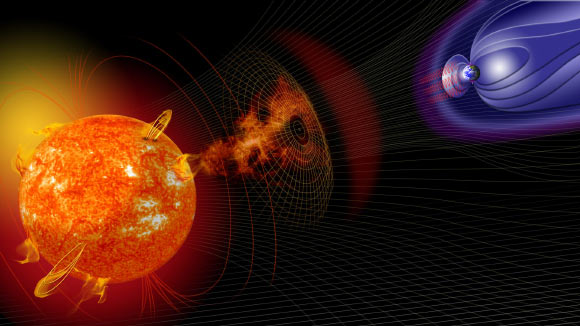
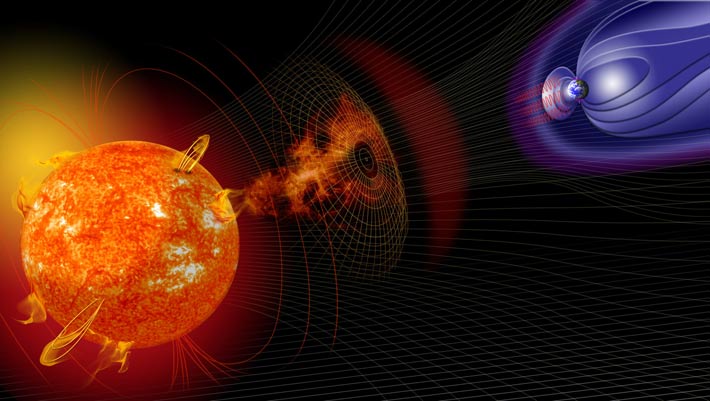
An artist’s illustration of a solar storm. Image credit: NASA.
“The atmospheric concentration of cosmogenic isotopes like radiocarbon, normally influenced by galactic cosmic rays, can be significantly amplified by solar particle storms,” stated Kseniia Golubenko, a postdoctoral researcher at the University of Oulu, alongside her colleagues.
“This heightened production, preserved within annual tree rings, functions as a definitive cosmic marker, thereby enabling the absolute chronological determination of tree samples.”
“These pronounced deviations, recognized as Miyake events—named in honor of the Japanese scientist who first identified them—provide invaluable empirical data for researchers investigating solar activity, ancient terrestrial environments, and space weather dynamics.”
“Miyake events facilitate the precise anchoring of calendar years within chronologies that are otherwise subject to relative dating,” explained Professor Ilya Usoskin from the University of Oulu.
“The radiocarbon signatures derived from these events have already proven instrumental in accurately dating historical sites such as Viking settlements in Newfoundland and Neolithic communities in Greece.”
To meticulously recreate the conditions of solar particle storms under prehistoric glacial climatic regimes, the research team devised and employed novel chemistry-climate modeling software, designated SOCOL:14C-Ex.
The efficacy of this model was rigorously confirmed through its application to tree ring data corresponding to the 775 CE event, after which it was utilized to simulate the impact under Ice Age conditions for the study of the 12350 BCE event.
“The ancient event from 12350 BCE represents the sole documented extreme solar particle event occurring outside the Holocene epoch, which encompasses the last 12,000 years characterized by a period of stable, temperate climate,” remarked Dr. Golubenko.
“Our estimations indicate that this ancient event was more than 500 times more intense than the most significant solar particle storm recorded during the modern satellite era—the 2005 event.”
“Additional notable solar particle storms have been identified around the years 994 CE, 663 BCE, 5259 BCE, and 7176 BCE, with several other potential candidates undergoing examination.”
“Furthermore, the 12350 BCE event establishes a new benchmark for worst-case scenarios,” she added.
“Comprehending the magnitude of this event is paramount for accurately assessing the potential risks that future solar storms could pose to contemporary critical infrastructure, including satellites, power grids, and communication networks.”
The scientific publication detailing the team’s findings has been featured in the esteemed journal Earth and Planetary Science Letters, accessible via the provided link.
_____
Kseniia Golubenko et al. 2025. A new SOCOL:14C-Ex model reveals that the Late-Glacial radiocarbon spike in 12350 BC was caused by the record-strong extreme solar storm. Earth and Planetary Science Letters 661: 119383; doi: 10.1016/j.epsl.2025.119383