The notion that life might traverse celestial bodies traces its origins to antiquity, with the ancient Greek philosopher Anaxagoras being an early proponent. This concept, termed panspermia, while not a universally accepted scientific tenet, has demonstrated remarkable resilience. The development of our understanding regarding the ubiquity of life’s fundamental constituents has lent some credence to this hypothesis.
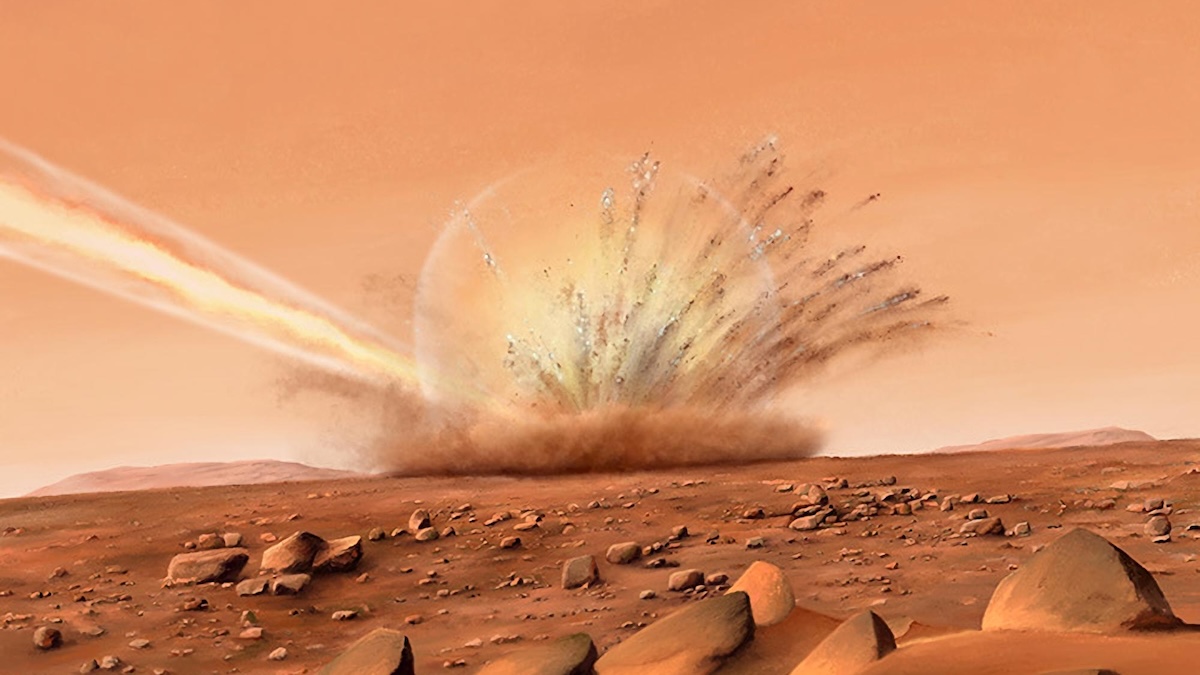
Recent investigations into extremophilic organisms have revealed that a subset of these resilient life forms can endure ejection from planetary surfaces, such as Mars, propelled by asteroid impacts. These organisms not only withstand the immense pressures generated by direct impacts but also possess the capacity to survive interplanetary voyages, despite the myriad challenges inherent in such journeys. Survival is facilitated when these microbes are encased within ejected material.
The researchers posed the question: “Impacts generate very high stresses for short times, resulting in extreme pressures and high rates of loading. Can microorganisms survive such extreme conditions?”
To address this, they chose to study the extremophile known as Deinococcus radiodurans, an organism already recognized for its resilience in the harsh environment of space. This particular microbe has been a focal point for extensive research into extremophiles.
It stands as the most radiation-resistant life form identified to date, capable of surviving frigid temperatures, desiccation, vacuum conditions, and even highly acidic environments. Its comprehensive resistance to a spectrum of environmental hazards has led to its classification as a polyextremophile.
Through meticulously designed laboratory experiments, the research team subjected D. radiodurans to intense, short-duration pressures simulating impact events. Following this exposure, they meticulously quantified the survival rates, analyzed the mechanisms of damage repair among the survivors, and examined their molecular responses to the simulated impacts.
“We kept trying to kill it, but it was really hard to kill.” – Lily Zhao, Johns Hopkins University
The RNA isolated from the surviving specimens underwent detailed analysis. This examination revealed a correlation between increasing pressure and heightened biological stress within the organism. Nevertheless, a significant proportion of the samples demonstrated robust survival across several experimental parameters.
The authors documented: “We demonstrated that the extremophile D. radiodurans has remarkably high survivability and viability after being subjected to pressures of up to 3 GPa. As the pressure increases, D. radiodurans exhibited indicators of increased biological stress, as determined by the transcriptional analysis of impacted samples.”
The researchers concluded: “Our results suggested that microorganisms can survive much more extreme conditions than previously thought, potentially surviving conditions that result in the formation of ejecta that can move across planetary systems.”
“Life might actually survive being ejected from one planet and moving to another,” remarked senior author K.T. Ramesh, an engineer specializing in the mechanical behavior of materials under extreme conditions. “This is a really big deal that changes the way you think about the question of how life begins and how life began on Earth.”
Further investigation involved observing cellular integrity post-impact using Transmission Electron Microscopy (TEM). A comparative analysis was conducted between a non-impacted control group and samples exposed to pressures of 1.4 GPa and 2.4 GPa. The findings indicated “structural and morphological changes that result from these transient pressures at the higher pressures.”
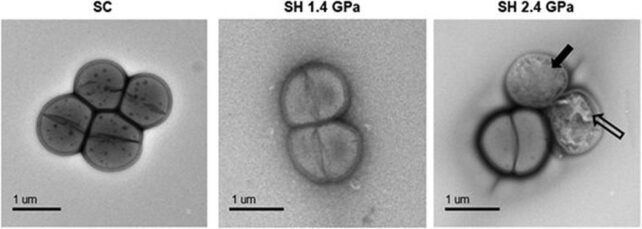
Crucially, the core finding is that D. radiodurans exhibits an exceptional capacity to withstand extreme, albeit temporary, pressures with minimal detrimental effects.
“We demonstrated that the extremophile D. radiodurans has remarkably high survivability and viability after being subjected to pressures of up to 3 GPa. As the pressure increases, D. radiodurans exhibited indicators of increased biological stress, as determined by the transcriptional analysis of impacted samples.”
Lead author Zhao stated in a press release, “We expected it to be dead at that first pressure. We started shooting it faster and faster. We kept trying to kill it, but it was really hard to kill.”
Remarkably, the experimental apparatus itself yielded to the pressure before all the D. radiodurans specimens succumbed.
Impact events on Mars can generate pressures reaching up to 5 GPa, with potential for even higher values depending on various contributing factors. Nevertheless, the demonstrated resilience of D. radiodurans up to 3 GPa offers encouraging prospects for proponents of panspermia.
“We have shown that it is possible for life to survive large-scale impact and ejection,” Zhao affirmed. “What that means is that life can potentially move between planets. Maybe we’re Martians!”
However, the implications of these discoveries extend beyond the scope of panspermia. The extraordinary ability of D. radiodurans to endure extreme pressures suggests a potential mechanism for their survival during unintentional transfers from Earth to Mars or other destinations via our robotic emissaries.
“We might need to be very careful about which planets we visit,” Ramesh advised.
The authors concluded: “These findings have important implications for our understanding of the extreme limits of life, planetary protection, the design of space missions, and the possibility of the dispersal of life throughout solar systems.”
This article was originally published by Universe Today. Read the original article.