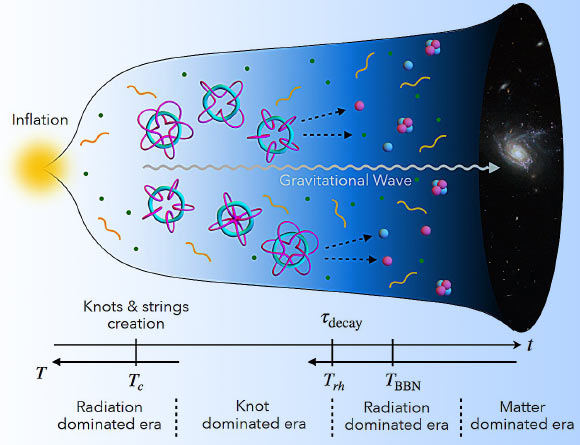
Across the landscape of modern physics and mathematics, the concept of knots holds significant relevance. A collaborative endeavor involving physicists from Japan and Germany posits the potential existence of a ‘knot-dominated epoch’ in the nascent universe. This hypothetical period would have seen knots as a predominant constituent of the cosmos, a scenario amenable to empirical verification through gravitational wave detection. Furthermore, the team proposes that the conclusion of this epoch was marked by the collapse of these knots via quantum tunneling, thereby initiating the universe’s observed matter-antimatter asymmetry.
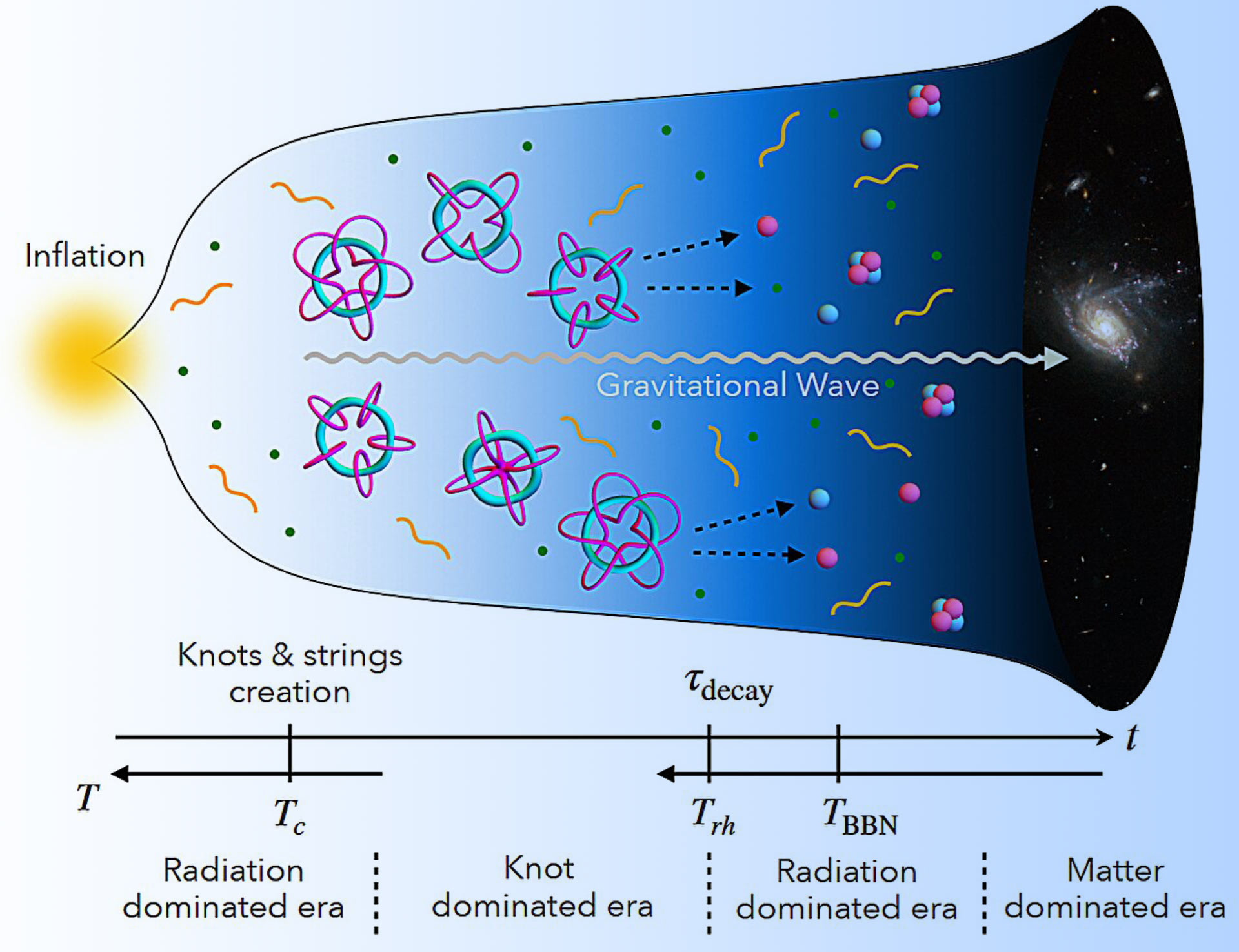
The theoretical framework introduced by Eto et al. suggests a transient period dominated by knots, when these intricately intertwined energy fields surpassed all other components in significance—a hypothesis that could be investigated via gravitational wave signatures. Image attribution: Muneto Nitta / Hiroshima University.
Mathematically defined as closed curves embedded within three-dimensional space, knots find applications far beyond their practical use in fastening; they are integral to numerous contemporary scientific disciplines, a pathway notably pioneered by Lord Kelvin.
While his foundational hypothesis positing atoms as vortices within the luminiferous aether was ultimately refuted, it served as a crucial catalyst for the advancement of knot theory and its subsequent integration into diverse branches of physics.
“Our investigation delves into one of the most profound enigmas in physics: the preponderance of matter over antimatter in our universe,” stated Professor Muneto Nitta, an esteemed physicist affiliated with Hiroshima University and Keio University.
“This inquiry is paramount as it directly addresses the fundamental question of why celestial structures like stars and galaxies, and indeed our own existence, are possible at all.”
“The prevailing cosmological model, the Big Bang, dictates that matter and antimatter should have been generated in equivalent quantities, leading to their mutual annihilation until only residual radiation remained.”
“However, the cosmos is overwhelmingly composed of matter, with virtually no detectable antimatter.”
“Theoretical calculations indicate that all observable entities, from atomic structures to galactic formations, owe their existence to a mere surplus of one matter particle for every billion matter-antimatter pairs that annihilated.”
“The Standard Model of particle physics, notwithstanding its remarkable successes, is incapable of resolving this observed deficit.”
“Its predictive capabilities fall vastly short of explaining this discrepancy.”
“Elucidating the genesis of this minute matter excess, a phenomenon known as baryogenesis, remains one of the most pressing unresolved challenges in physics.”
By amalgamating a gauged Baryon Number Minus Lepton Number (B-L) symmetry with the Peccei-Quinn (PQ) symmetry, Professor Nitta and his collaborators have demonstrated how knots could organically arise in the early universe, thereby accounting for the observed surplus of matter.
These two extensively studied extensions to the Standard Model effectively address several of its most perplexing deficiencies.
The PQ symmetry offers a resolution to the strong CP problem—the paradox of why experiments fail to detect the minuscule electric dipole moment predicted by theory for the neutron. In doing so, it introduces the axion, a leading candidate particle for dark matter.
Concurrently, the B-L symmetry provides an explanation for the mass of neutrinos, elusive particles that can traverse vast cosmic distances, including entire planets, without interaction.
Preserving the PQ symmetry as global, rather than gauging it, is crucial for maintaining the subtle axion physics responsible for resolving the strong CP problem.
In the parlance of physics, ‘gauging’ a symmetry implies its unrestricted operation at every point within spacetime.
However, this localized freedom necessitates a compensatory mechanism. To ensure theoretical consistency, nature introduces a novel force carrier to stabilize the mathematical equations.
Through the gauging of the B-L symmetry, the researchers not only ensured the presence of massive right-handed neutrinos—a prerequisite for maintaining the theory’s anomaly-free status and central to prominent baryogenesis models—but also induced a superconducting property that provided the essential magnetic framework for what could be some of the universe’s earliest knots.
As the universe underwent cooling in the aftermath of the Big Bang, its inherent symmetries fractured through a series of phase transitions. Analogous to the uneven solidification of water into ice, these transitions may have left behind linear topological defects known as cosmic strings—hypothetical fissures in spacetime that many cosmologists conjecture may still persist.
Despite possessing a diameter thinner than a proton, a mere inch of such a string could possess a mass equivalent to mountains.
As the cosmos expanded, a dynamic network of these filaments would have been stretched and intricately entangled, preserving imprints of the primordial conditions prevalent at that epoch.
The breaking of the B-L symmetry gave rise to magnetic flux tube strings, while the PQ symmetry generated flux-free superfluid vortices.
Their inherent contrast is precisely what renders them compatible.
The B-L flux tube offers a point of attachment for the Chern-Simons coupling of the PQ superfluid vortex.
In turn, this coupling enables the PQ superfluid vortex to transfer charge into the B-L flux tube, counteracting the tension that would otherwise cause the loop to sever.
The resultant structure is a metastable, topologically bound configuration identified as a knot soliton.
“Prior to our work, these two symmetries had not been investigated in conjunction,” Professor Nitta remarked.
“This serendipitous combination proved invaluable. Their integration revealed the existence of a stable knot configuration.”
While radiation experienced energy dissipation as its wavelengths expanded along with spacetime, the knots behaved analogously to matter, their energy density decaying at a significantly reduced rate.
Consequently, they rapidly surpassed all other constituents, initiating an era characterized by knot dominance, wherein their energy density, rather than that of radiation, governed the cosmos.
However, this period of supremacy was transient. The knots eventually unraveled through a process known as quantum tunneling, a phenomenon akin to phantoms passing through solid barriers, where particles traverse energy thresholds as if they were non-existent.
Their collapse precipitated the generation of heavy right-handed neutrinos, an intrinsic consequence of the B-L symmetry interwoven into their structural makeup.
These massive, ethereal particles subsequently decayed into lighter, more stable forms with a subtle predilection for matter over antimatter, thus shaping the universe we inhabit today.
“Essentially, this collapse elicits a prolific emission of particles, including right-handed neutrinos, scalar bosons, and gauge bosons, akin to a shower effect,” explained Dr. Yu Hamada, a physicist at the Deutsches Elektronen-Synchrotron and Keio University.
“Among these, right-handed neutrinos hold particular significance, as their decay mechanism can naturally engender the asymmetry observed between matter and antimatter.”
“These heavy neutrinos decay into less massive particles, such as electrons and photons, initiating a secondary cascade that re-energizes the universe.”
“In this context, they can be considered the progenitors of all matter in the present-day universe, including our own physical forms, with the knots serving as our cosmic grandparents.”
When the researchers meticulously analyzed the mathematical framework of their model—specifically, the efficiency of knot-induced right-handed neutrino production, their associated masses, and the extent of cosmic reheating following their decay—the observed matter-antimatter imbalance emerged organically from the equations.
By reformulating the equations and inputting a plausible mass of 10¹² giga-electronvolts (GeV) for the heavy right-handed neutrinos, coupled with the assumption that the knots channeled the majority of their stored energy into generating these particles, the model consistently yielded a reheating temperature approximating 100 GeV.
This specific temperature coincidentally marks the critical upper limit for the universe’s capacity to produce matter.
Any temperature below this threshold would result in the cessation of electroweak reactions, the very processes responsible for converting neutrino imbalances into matter, effectively shutting down further matter creation.
Reheating to 100 GeV would also have significantly altered the universe’s gravitational wave spectrum, shifting its dominant frequencies towards higher ranges.
Future advanced observatories, including the Laser Interferometer Space Antenna (LISA) in Europe, the Cosmic Explorer in the United States, and the Deci-hertz Interferometer Gravitational-wave Observatory (DECIGO) in Japan, hold the potential to detect this subtle alteration in the cosmic gravitational wave symphony.
“Cosmic strings are a form of topological solitons—entities characterized by properties that remain invariant irrespective of twisting or stretching,” observed Dr. Minoru Eto, a physicist associated with Yamagata University, Keio University, and Hiroshima University.
“This inherent robustness not only ensures their stability but also implies that our findings are not contingent upon the minute details of the specific model employed.”
“Although our research remains theoretical at this juncture, the fundamental topology remains unaltered. Consequently, we view this as a significant stride towards future advancements.”
Whereas Lord Kelvin initially theorized knots as the fundamental constituents of matter, the researchers contend that their findings present, for the first time, a viable particle physics model wherein knots may have played a pivotal role in the genesis of matter.
“The subsequent stage involves refining our theoretical models and computational simulations to achieve a more precise prediction of knot formation and decay, and importantly, to establish a correlation between their observable signatures and empirical data,” stated Professor Nitta.
“Specifically, upcoming gravitational wave detection initiatives such as LISA, Cosmic Explorer, and DECIGO will provide the means to ascertain whether the universe indeed traversed a knot-dominated epoch.”
The research conducted by this team is published in the esteemed journal Physical Review Letters.
_____
Minoru Eto et al. 2025. Tying Knots in Particle Physics. Phys. Rev. Lett 135, 091603; doi: 10.1103/s3vd-brsn