A recent publication within the esteemed journal iScience details a theoretical proposition by an astrophysicist affiliated with Fudan University. This proposition explores the feasibility of dispatching a minuscule spacecraft, a nanocraft, to a stellar-mass black hole situated approximately 20-25 light-years from our planet. The overarching objective of such a mission would be to scrutinize the intrinsic nature of these incredibly dense celestial objects and to probe the fundamental principles of physics under conditions of profound gravitational intensity.

“While the requisite technology does not currently exist, we may find ourselves possessing it within the next two to three decades,” stated Professor Cosimo Bambi, a distinguished astrophysicist and leading authority on black holes at Fudan University.
“The success of this mission is contingent upon overcoming two primary obstacles: identifying a black hole within a reachable proximity and engineering probes capable of enduring the rigors of such an extensive interstellar journey.”
As of the most recent astronomical observations, the nearest identified black hole to Earth is designated Gaia BH1. Discovered in September 2022, it resides at a staggering distance of 1,560 light-years.
Nevertheless, empirical evidence suggests the potential existence of numerous undiscovered black holes situated considerably nearer to our solar system.
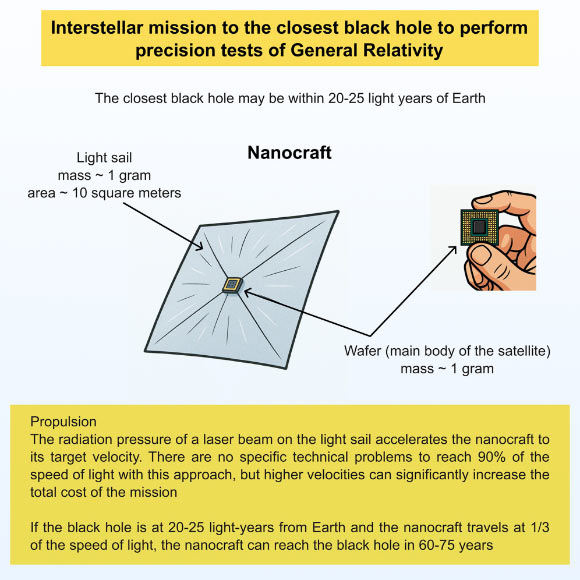
From preliminary estimations derived from fundamental astrophysical principles, it is theorized that the closest black hole to Earth might be as near as 20-25 light-years, albeit this figure is an approximation subject to substantial margins of error.
“Existing insights into stellar evolutionary pathways suggest the possibility of a black hole existing merely 20 to 25 light-years from Earth, yet its detection presents a considerable challenge,” Professor Bambi commented.
“The inherent nature of black holes, characterized by their inability to emit or reflect light, renders them practically imperceptible to conventional telescopic observation.”
“Consequently, scientific inquiry into these enigmatic objects relies on monitoring their gravitational influence on proximate celestial bodies or the phenomenon of gravitational lensing, whereby their mass bends the path of light.”
“Recent advancements in observational techniques have yielded novel methods for black hole discovery. I believe it is reasonable to anticipate the identification of a nearby black hole within the span of the next ten years.”
Once a suitable celestial target has been pinpointed, the subsequent significant challenge involves traversal.
Conventional spacecraft, propelled by chemical propulsion systems, are inherently too cumbersome and insufficiently swift to accomplish such an ambitious voyage.
Professor Bambi proposes the utilization of nanocrafts—probes weighing mere grams, comprised of a microchip and a light sail—as a viable resolution.
Terrestrial-based laser arrays would be employed to impinge photons upon the sail, thereby accelerating the craft to approximately one-third of the speed of light.
“At such a velocity, the craft would be capable of reaching a black hole situated 20 to 25 light-years away in approximately 70 years,” he elaborated.
“The transmission of collected data back to Earth would necessitate an additional two decades, culminating in a total mission duration ranging from 80 to 100 years.”
“Upon the craft’s approach to the vicinity of the black hole, researchers would be empowered to conduct critical experiments designed to elucidate some of the most profound enigmas in physics.”
“Does a black hole definitively possess an event horizon, the definitive boundary beyond which even light cannot escape its overwhelming gravitational embrace?”
“Do the established principles of physics undergo modification in the extreme gravitational environment surrounding a black hole?”
“Does Einstein’s paramount theory of general relativity remain universally valid under the most extreme conditions encountered in the universe?”
“The procurement of the necessary laser systems alone would incur an estimated cost of around one trillion euros at current market values, and the technological infrastructure for fabricating a nanocraft has not yet been developed,” Professor Bambi cautioned.
“However, projected advancements over the next thirty years may lead to a reduction in these expenditures and allow technology to mature sufficiently to realize these ambitious concepts.”
“While the proposition may initially sound extraordinarily audacious, bordering on the realm of science fiction.”
“It is noteworthy that the detection of gravitational waves was once deemed impossible due to their extreme faintness. Yet, a century later, we achieved this groundbreaking feat.”
“Similarly, the observation of black hole shadows was once considered unattainable. Now, a mere fifty years later, we possess photographic evidence of two such phenomena.”
_____
Cosimo Bambi. An interstellar mission to test astrophysical black holes. iScience, published online August 7, 2025; doi: 10.1016/j.isci.2025.113142