Leveraging observational data from the European Space Agency’s Gaia mission and NASA’s Exoplanet Archive, a cohort of researchers at Cornell University has meticulously identified 45 terrestrial exoplanets situated within the defined empirical habitable zone, alongside an additional 24 celestial bodies located within a more constrained 3D habitable zone. This curated selection provides the scientific community with an optimized directive for the ongoing quest to detect extraterrestrial existence.
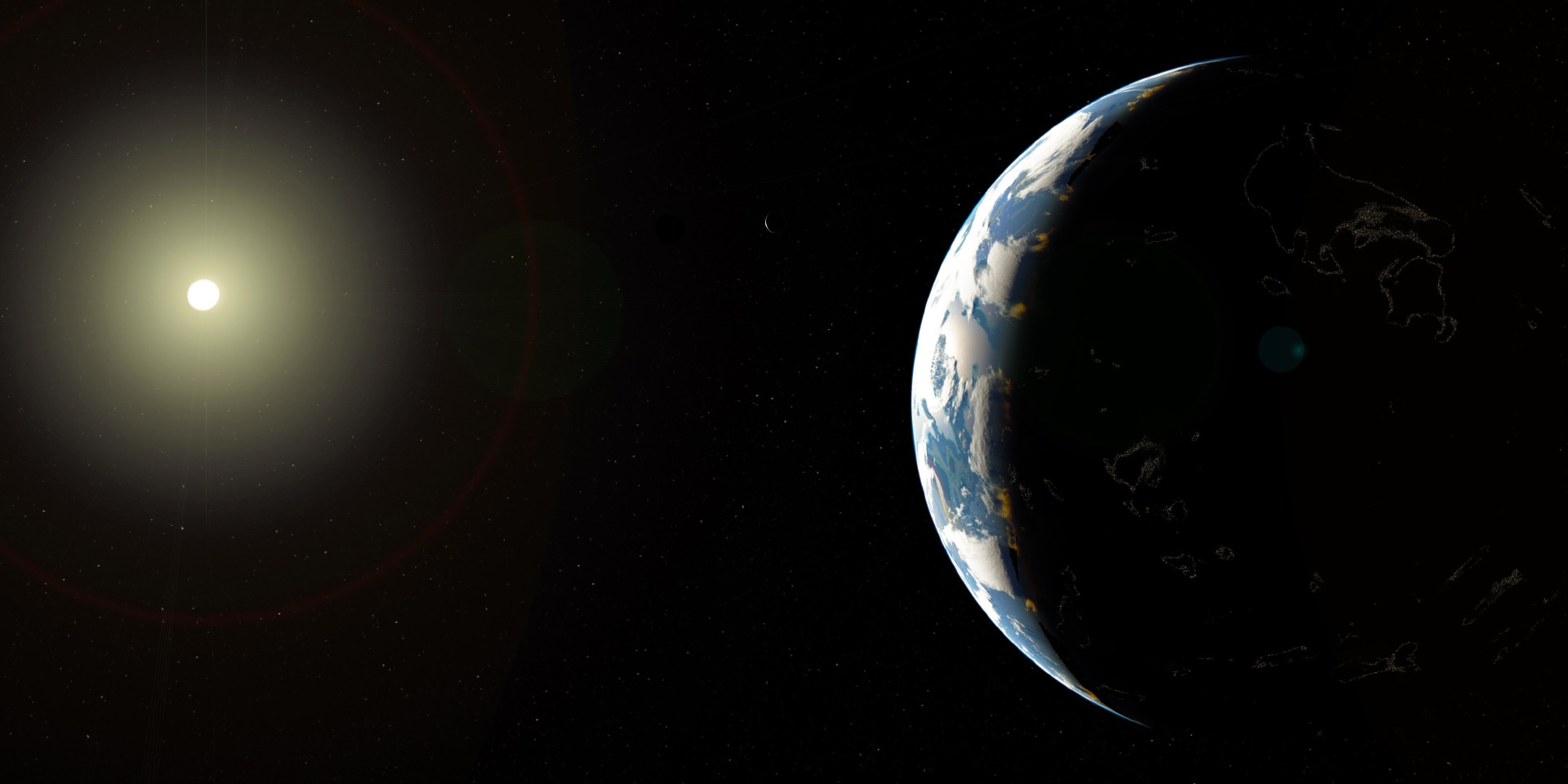
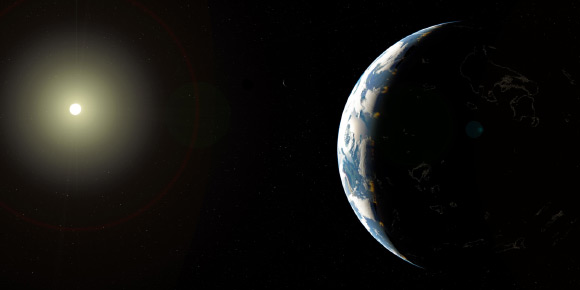
An artist’s impression of a planetary system around a slightly hotter star than our Sun. Image credit: Gillis Lowry.
“The accumulated discoveries from numerous successful ground-based and space-borne observational campaigns have propelled the registry of recognized exoplanets beyond the 6,000 mark,” stated Professor Lisa Kaltenegger of Cornell University, in conjunction with her scholarly associates.
“A facet of these astronomical findings that has received less intensive investigation is that the expanding roster of exoplanets facilitates the compilation of an observational target list capable of empirically testing the boundaries of the habitable zone.”
Within the scope of this investigation, the astronomical team precisely located 45 rocky planets that hold the potential to harbor life within the habitable zone, and an additional 24 residing in a more restricted 3D habitable zone. This latter designation reflects a more cautious estimation of the thermal tolerance a planet can withstand before its capacity for supporting habitability is compromised.
Included in this compendium are several widely recognized exoplanets such as Proxima Centauri b, TRAPPIST-1f, and Kepler 186f, in addition to lesser-known entities like TOI-715b.
Amongst the cataloged celestial bodies, the TRAPPIST-1d, e, f, and g planets, situated approximately 40 light-years from Earth, and LHS 1140 b, located 48 light-years away, present particularly compelling subjects of interest. The definitive presence of liquid water on these planets is contingent, in part, upon their ability to retain an atmospheric envelope.
The planets receiving stellar illumination analogous to the solar radiation experienced by present-day Earth are the transiting worlds TRAPPIST-1e, TOI-715b, Kepler-1652b, Kepler-442b, Kepler-1544b, alongside Proxima Centauri b, Gliese 1061d, Gliese 1002b, and Wolf 1069b, whose gravitational influence causes their host stars to exhibit a detectable wobble.
Furthermore, the authors express their anticipation that the exoplanets identified near the outer margins of the habitable zone will contribute valuable insights into the precise demarcation of habitability limits and validate or challenge existing scientific hypotheses regarding these boundaries.
“While the conceptual framework of the habitable zone has been in development since the 1970s, contemporary observational endeavors are paramount to ascertain whether certain foundational assumptions necessitate revision,” commented Professor Kaltenegger.
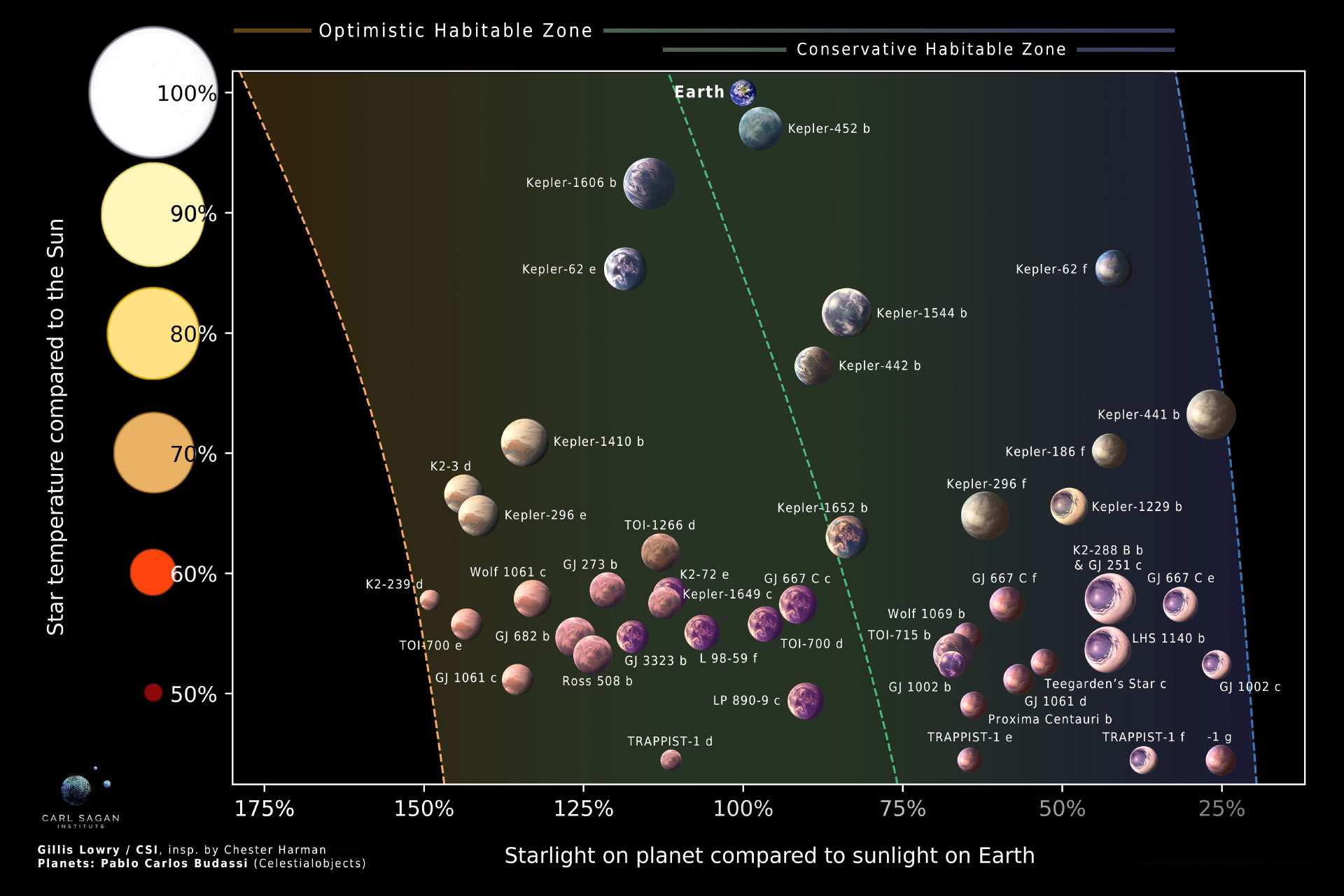
A diagram depicting habitable zone boundaries across star type with rocky exoplanets. Image credit: Gillis Lowry / Pablo Carlos Budassi.
Additionally, exoplanets characterized by unconventional elliptical orbital paths around their parent stars can illuminate the significance of variable thermal influxes upon a world, thereby aiding in resolving the question of whether a planet must maintain a consistent position within the habitable zone or if periodic excursions into and out of this zone permit sustained habitability.
The transiting planets that offer the potential to scrutinize the innermost boundary of habitability encompass K2-239d, TOI-700e, K2-3d, as well as Wolf 1061c and Gliese 1061c, which generate observable stellar wobbles.
TRAPPIST-1g, Kepler-441b, and Gliese 1002c are poised to explore the outermost edge of habitability, a region characterized by extreme cold.
“Although definitive pronouncements regarding the factors enhancing the likelihood of life are challenging to make, identifying prime observational targets represents the foundational imperative—thus, the objective of our endeavor was to delineate the most promising candidates for scrutiny,” articulated Gillis Lowry, a postgraduate researcher at San Francisco State University.
The research team has also designated the most suitable exoplanets for examination utilizing a variety of observational methodologies, thereby maximizing the probability for scientists to detect biosignatures should they exist on these distant worlds.
The resultant catalog is intended to serve as a navigational aid for astronomers directing their observations with instruments such as the NASA/ESA/CSA James Webb Space Telescope, the forthcoming Nancy Grace Roman Space Telescope, the Extremely Large Telescope, the Habitable Worlds Observatory, and the proposed Large Interferometer For Exoplanets (LIFE) initiative.
“The direct observation of these diminutive exoplanets represents the sole avenue for confirming the presence of atmospheres and, consequently, for determining whether astronomical models of habitable zone limitations require recalibration,” Lowry emphasized.
The academic contribution from the team has been formally published today in the esteemed journal, the Monthly Notices of the Royal Astronomical Society, accessible via the provided hyperlink.
_____
Abigail Bohl et al. 2026. Probing the limits of habitability: a catalogue of rocky exoplanets in the habitable zone. MNRAS 547 (3): stag028; doi: 10.1093/mnras/stag028