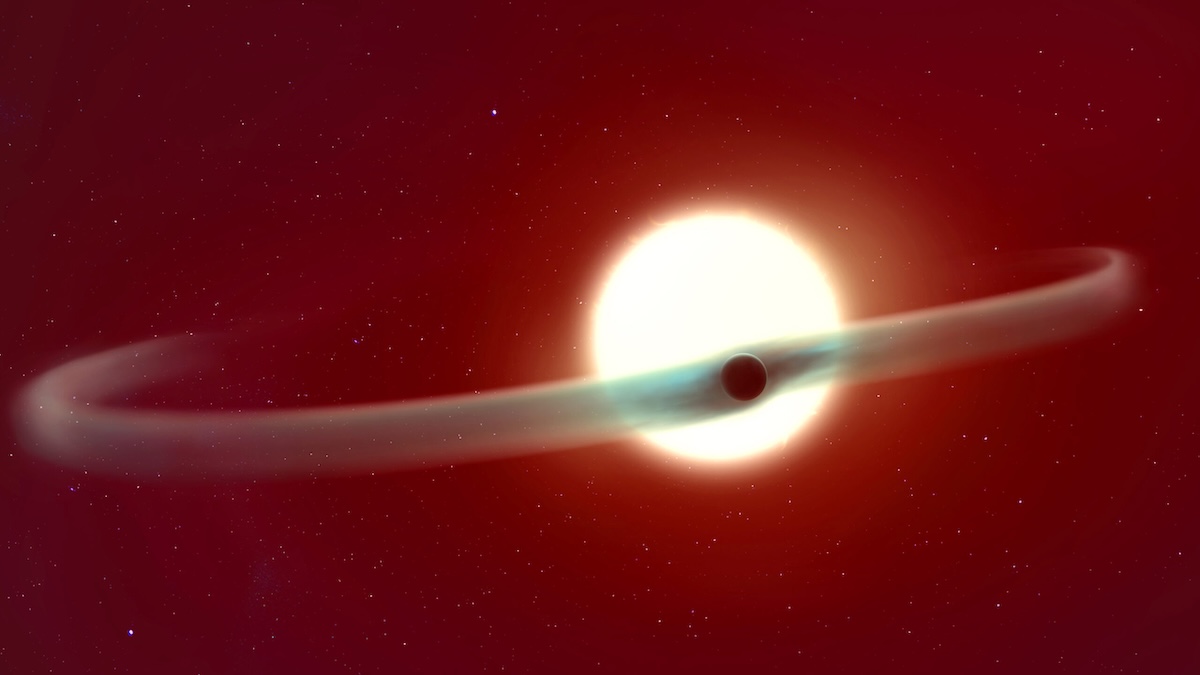
Located approximately 880 light-years from Earth, an exceptionally volatile exoplanet is gradually dissipating its atmosphere into the cosmos, forming two colossal helium streams that extend over halfway around its parent star.
This phenomenon represents a groundbreaking observation, as reported by the authors of a recent scientific investigation. While astronomers have previously identified exoplanets with escaping atmospheres, these instances were typically brief observations captured only as the celestial bodies transited in front of their host stars.
However, in this instance, researchers successfully maintained continuous surveillance of an exoplanet’s atmospheric expulsion across its entire orbital path. This comprehensive monitoring has illuminated the process, providing insights into its mechanisms, the fate of the released gases, and its potential implications for planetary development.
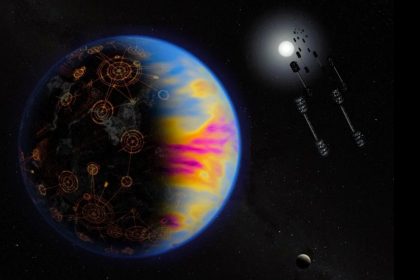
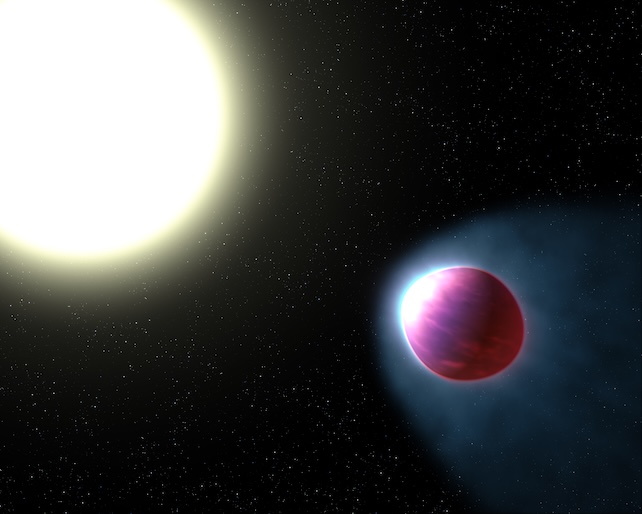
The focus of their inquiry is the celestial body designated WASP-121b, also identified as Tylos. This extreme exoplanet is already renowned for its peculiar characteristics, including the presence of clouds composed of vaporized metals, precipitation of rubies and sapphires, and the most rapid atmospheric jet stream known to scientific understanding.
It is classified as an ultra-hot Jupiter, a category of gas giants discovered outside our solar system that share similarities with Jupiter, but orbit significantly closer to their host stars, resulting in substantially higher temperatures.
Tylos orbits its star at such proximity that it completes a full revolution in a mere 30 hours, meaning a single year on Tylos is comparable in duration to a single day on Earth.
This proximity undoubtedly places it in a precarious position relative to its parent star. The intense radiation bathing the planet heats its atmosphere to thousands of degrees, fostering extreme conditions that permit numerous anomalies, including the exodus of lighter atmospheric constituents like hydrogen and helium into space.
While atmospheric escape can transpire rapidly under specific circumstances, it often proceeds as a protracted process, with minuscule quantities of gases gradually dissipating. Nevertheless, even a slow leakage can profoundly alter a planet’s dimensions and elemental composition over protracted periods, potentially influencing its developmental trajectory.
Our understanding of atmospheric escape has largely been derived from data gathered during planetary transits, which may only endure for a few hours. This methodology offers a limited perspective on the events unfolding throughout an exoplanet’s orbital cycle.
In the recent research endeavor, scientists observed Tylos for almost 37 consecutive hours utilizing the JWST’s Near-Infrared Imager and Slitless Spectrograph. This sustained observation yielded an unprecedented volume of data, encompassing more than a single complete orbit.
The researchers analyzed Tylos’ orbital trajectory for signs of helium absorption at infrared wavelengths, a recognized indicator of atmospheric escape. The planet’s surrounding helium haze was discovered to extend considerably beyond its physical confines, encompassing nearly 60 percent of its orbital path.
This represents the most extensive continuous observation of atmospheric escape recorded to date, revealing “a persistent and large-scale outflow,” as the researchers articulated.
Curiously, Tylos is not expelling gas in a singular stream. Helium atoms were observed to form two distinct plumes: one trailing the planet and another extending in front of it. Both streams are immense, collectively spanning an area exceeding 100 times the diameter of Tylos.
“We were remarkably astonished to witness the duration of the helium outflow,” stated lead author Romain Allart, an astronomer affiliated with the Trottier Institute for Research on Exoplanets and Université de Montréal.
“This finding elucidates the intricate physical processes that shape exoplanetary atmospheres and their interactions with their stellar environments,” Allart further commented. “We are only beginning to comprehend the true complexity of these distant worlds.”
The existence of two distinct helium tails presents a scientific conundrum for astronomers. Current computational models are adept at explaining single streams of gas venting from planets, but they encounter difficulties in replicating the formation of dual tails extending in divergent directions.
The researchers propose that stellar radiation and the solar wind might be responsible for directing one tail to follow behind the planet, while the star’s gravitational influence could be drawing the leading tail inward, causing the stream to curve forward of Tylos in its orbit.

Further investigation is imperative to ascertain how these and other forces influence atmospheric outflows, and to facilitate the development of novel 3D simulations that more accurately depict the underlying physics.
Beyond offering an explanation for Tylos’ bifurcated helium tails, a profound understanding of atmospheric loss could unlock broader mysteries surrounding planetary evolution. This includes discerning whether such gaseous expulsions can transmute massive gas giants into smaller, Neptune-like planets, or even into entirely denuded, rocky remnants.
“This constitutes a genuine paradigm shift,” Allart asserted. “We are now compelled to re-evaluate our methodologies for simulating atmospheric mass loss, moving beyond a simplistic flow model to incorporate a 3D geometry interacting with its star. This is crucial for comprehending planetary evolution and the potential transformation of gas giants into bare rock.”