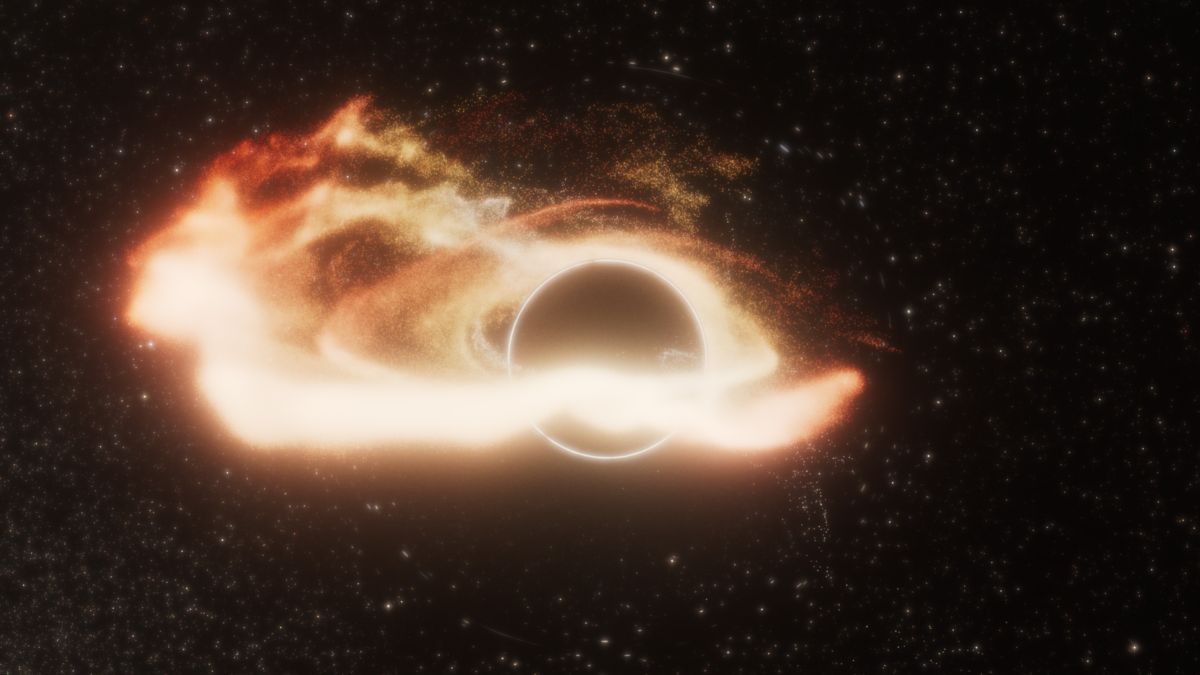
An intense emission of X-rays originating from a cosmic epoch 8 billion years in the past may constitute the inaugural definitive observation of a white dwarf star being disintegrated by a black hole.
This cosmic occurrence, characterized as “unprecedented” in a study spearheaded by Dongyue Li and Wenda Zhang from the Chinese Academy of Sciences, is detailed in their publication. The analysis posits that the abrupt luminous surge—classified among the most potent X-ray bursts ever documented—is most plausibly attributed to the tidal fragmentation of a white dwarf by one of the universe’s most enigmatic entities: an intermediate-mass black hole.
“Our sophisticated computational simulations demonstrate that the confluence of the immense gravitational forces exerted by an intermediate-mass black hole and the extreme density of a white dwarf can precipitate jet energies and temporal scales of evolution that align remarkably well with the gathered observational evidence,” stated Jinhong Chen, an astrophysicist at the University of Hong Kong and co-lead author of the study.
White dwarfs rank among the most compact celestial bodies known to exist, surpassed only by neutron stars and black holes. They emerge when stars with masses up to approximately eight times that of our Sun conclude their life cycles, expelling their outer atmospheric envelopes and leaving behind a dense remnant nucleus, comparable in size to Earth but possessing a mass up to 1.4 times that of the Sun.
The extreme density of white dwarfs means that only black holes within a specific and limited mass spectrum are capable of tearing them apart in a manner that produces observable tidal disruption events. Stellar-mass black holes would typically generate flares of shorter duration and lesser intensity, whereas most supermassive black holes would likely engulf a white dwarf entirely before any significant fragmentation could occur.
Intermediate-mass black holes, characterized by masses ranging from several hundred to tens of thousands of solar masses, occupy this critically narrow mass range. However, prior to this discovery, no observed flares had been definitively associated by astronomers with an interaction between a white dwarf and an intermediate-mass black hole.
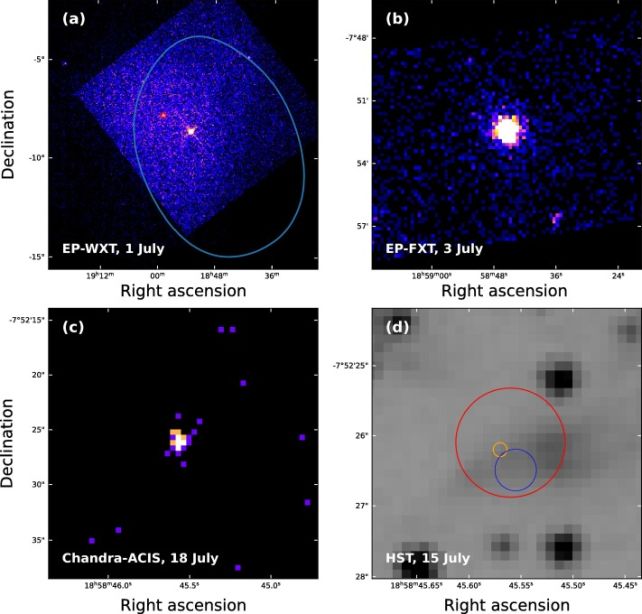
This situation changed when the Einstein Probe detected a brilliant X-ray flare emanating from a distant galaxy in July 2025. This event, designated EP250702a, achieved a formidable peak intensity before gradually diminishing, with its progression meticulously monitored by numerous observational instruments. Approximately one day subsequent to the initial detection of the X-ray emission, NASA’s Fermi Gamma-Ray Space Telescope registered a gamma-ray burst.
“This early X-ray signature is of paramount importance,” explained Li. “It signifies that this was not a conventional gamma-ray burst.”
Over a period of roughly 20 days, the signal exhibited rapid transformations, waning from its peak luminosity by over a hundredfold and shifting from high-energy (hard) X-rays to lower-energy (soft) X-rays. Furthermore, its occurrence was noted in the peripheral regions of its host galaxy—an area typically populated by older stellar populations, rather than the nascent, massive stars that undergo supernova explosions.
Through a meticulous examination of multi-spectrum data pertaining to EP250702a and its comparison with various theoretical astrophysical mechanisms, the research team identified one particular hypothesis as standing out significantly from the alternatives.
“The proposed model involving an intermediate-mass black hole interacting with a white dwarf provides the most coherent explanation for its rapid temporal evolution and its immense energy output,” commented Lixin Dai, an astronomer at the University of Hong Kong.
Should this interpretation be substantiated, the observed flare could represent the first irrefutable evidence of a white dwarf being subjected to such a disruptive process, concurrently offering a novel method for detecting these elusive intermediate-mass black holes in action.