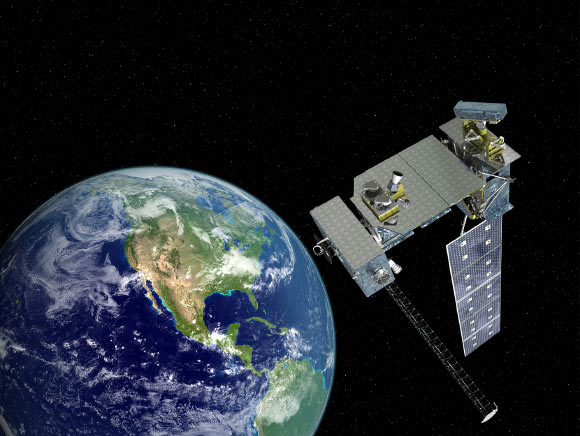
Utilizing data meticulously gathered by sensors aboard the U.S. Department of Defense Space Test Program Satellite 6 (STP-Sat6) while in geostationary orbit, researchers have established a direct correlation between the frequency of electrical discharges experienced by a spacecraft and the density of electrons in its immediate vicinity. This crucial revelation promises to enhance our understanding of strategies for safeguarding spaceborne equipment.

STP-Sat6. Image credit: Northrop Grumman.
Spacecraft environment discharges, or SEDs, manifest as fleeting electrical breakdowns with the potential to inflict damage upon sophisticated internal electronics and communication arrays.
While the existence of SEDs has been acknowledged by the scientific community for some time, the precise relationship between ambient electrons in the space environment and these discharges has remained elusive.
“To elucidate this connection, it was imperative to equip a single spacecraft with two distinct types of sensors: one capable of monitoring electron quantity and activity, and another designed to detect radio frequency signals,” explained Dr. Amitabh Nag, a member of the research team at Los Alamos National Laboratory.
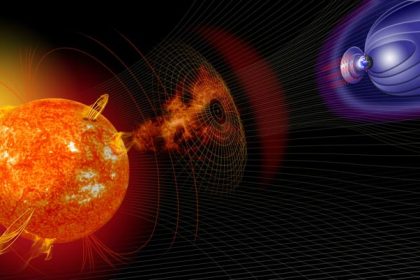
These SED phenomena are typically precipitated by disparities in surface charging, an effect arising from the accumulation of electrons on a spacecraft’s exterior while in orbit.
Analogous to the buildup of static electricity experienced on Earth—where friction from movement across a carpet, for instance, can lead to an energy surge that results in a noticeable spark upon contact with a conductive surface, such as a doorknob—electrical discharges in the space environment occur when accumulated energy on a spacecraft reaches a critical voltage threshold, leading to its rapid release.
The STP-Sat6 satellite is equipped with both of these indispensable sensors, affording researchers a singular opportunity to concurrently analyze radio frequency and electron activity data.
“We were able to ascertain the rate at which SEDs were being registered by the radio frequency sensor and juxtapose this with the observed activity levels of electron particles within a specified voltage spectrum,” stated Dr. Nag.
“Our findings indicated a clear correlation: periods of heightened SED occurrence coincided with surges in electron activity.”
The research team meticulously examined over a year’s worth of data from the dual-sensor system, cataloging more than 270 instances of high-rate SED events and several hundred episodes characterized by significant electron activity.
In approximately three-quarters of these instances, peaks in electron activity were observed to precede the onset of SED events by an interval ranging from 24 to 45 minutes.
This observed temporal lag suggests that the incremental buildup of electrical charge originating from low-energy electrons plays a pivotal role in rendering the spacecraft susceptible to electrostatic discharges.
“We noted that as electron activity escalates, particularly within the energy range of 7.9 to 12.2 keV, the spacecraft begins to amass a net electrical charge,” Dr. Nag elaborated.
“This charging process continues until a critical threshold is reached, at which point SEDs are triggered.”
“This predictive lead time offers the potential for developing forecasting tools to proactively mitigate associated risks.”
“Prospectively, future missions could incorporate real-time monitoring of low-energy electrons to anticipate and respond to charging events before they can adversely affect operational continuity.”
The findings of this study have been published in the esteemed journal Advances in Space Research.
_____
Amitabh Nag et al. 2025. Radio frequency transients correlated with electron flux measured on-board the STP-Sat6. Advances in Space Research 76 (6): 3692-3699; doi: 10.1016/j.asr.2025.07.026