Prior research has established that an extremophile bacterium species, specifically Deinococcus radiodurans, possesses the resilience to endure the radiation, frigid temperatures, and arid conditions inherent in interplanetary travel. Subsequent investigations have revealed that Deinococcus radiodurans exhibits a remarkable capacity to withstand the extreme transient pressures encountered during impact-induced ejection from Mars. Consequently, the possibility arises for such life forms to traverse between celestial bodies within our Solar System, facilitated by significant asteroid impacts.

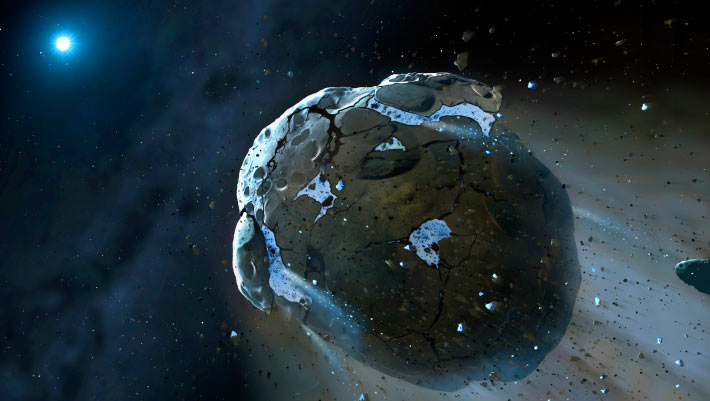
This is an artist’s impression of an asteroid. Image credit: Mark A. Garlick, Space-art.co.uk / University of Warwick / University of Cambridge.
The surfaces of the majority of celestial bodies within the Solar System are characterized by the presence of impact craters. Among the most heavily cratered astronomical entities are the Moon and Mars.
It is a well-established scientific fact that asteroid collisions can propel matter across the vastness of space; indeed, Martian meteorites have been discovered on Earth.
However, a persistent question has been whether biological entities could also be dispatched into space by the force of an asteroid impact.
Enclosed within ejected debris, these life forms might potentially reach another planet – a concept referred to as the lithopanspermia hypothesis.
In the scope of the recent research, Kaliat (K.T.) Ramesh, a scientist at Johns Hopkins University, along with his colleagues, meticulously recreated the environmental conditions under which a microorganism could be propelled into space due to impact forces.
The team subjected Deinococcus radiodurans to pressures reaching up to 3 GPa (equivalent to 30,000 times atmospheric pressure) by positioning the bacterial cells between two steel plates and subsequently impacting this assembly with a third steel plate.
Through the analysis of gene expression patterns across varying pressure levels, biological stress markers within the bacteria were discernible.
Specimens exposed to 2.4 GPa began to exhibit signs of membrane rupture; however, the intrinsic structure of the bacterium’s cell envelope played a crucial role in the survival of approximately 60% of the microorganisms.
Analysis of transcription profiles indicated that, post-impact, the bacteria actively prioritized the repair of cellular damage.

Deinococcus radiodurans. Image credit: USU / Michael Daly.
“While the existence of life on Mars remains unconfirmed, if present, it is highly probable that such life would possess analogous capabilities,” stated Professor Ramesh.
“It is conceivable that life could indeed endure the process of being expelled from one planet and successfully transit to another.”
“This finding carries significant implications, fundamentally altering our understanding of the origins of life and its emergence on Earth.”
“Our studies have provided empirical evidence demonstrating that life can persevere through large-scale impacts and subsequent ejection,” commented Dr. Lily Zhao, also affiliated with Johns Hopkins University.
“This breakthrough suggests that life has the potential for interplanetary migration. Perhaps we are indeed of Martian origin!”
The findings of this research were disseminated this week in the esteemed journal PNAS Nexus.
_____
Lily Zhao et al. 2026. Extremophile survives the transient pressures associated with impact-induced ejection from Mars. PNAS Nexus 5 (3): pgag018; doi: 10.1093/pnasnexus/pgag018