Our galactic center has yielded a groundbreaking scientific revelation: the identification of the most substantial sulfur-containing compound ever observed beyond our planet, carrying profound implications for elucidating the cosmic genesis of life.
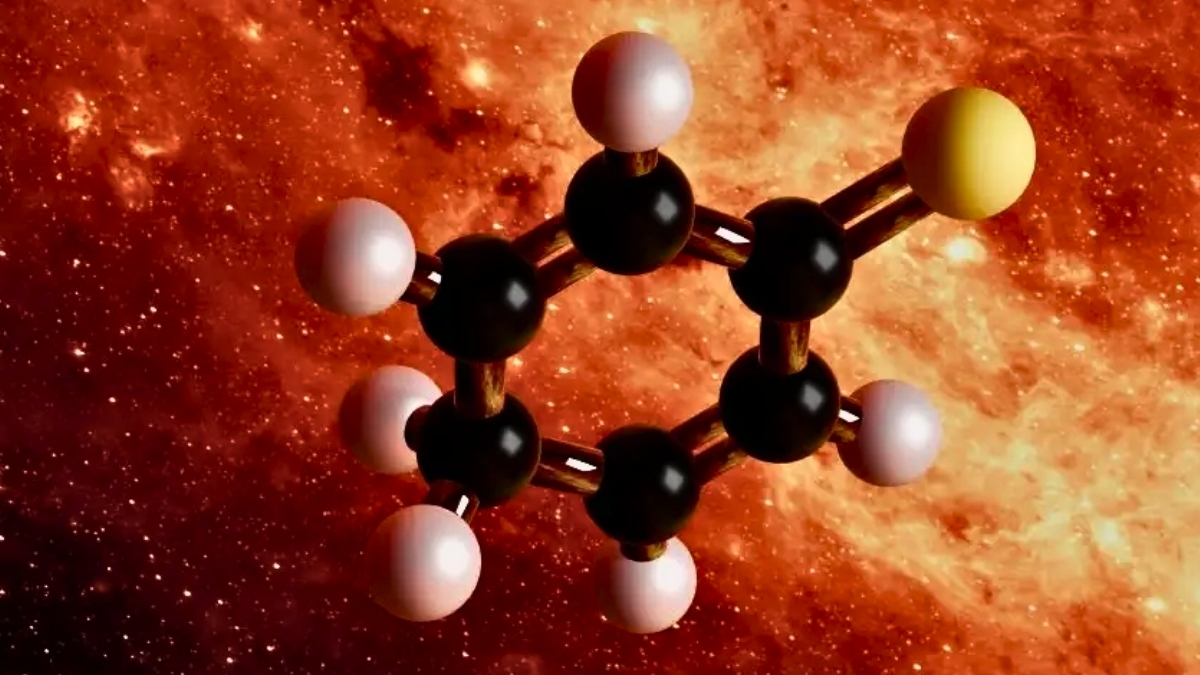
This specific chemical entity, designated as thiepine, or more formally 2,5-cyclohexadiene-1-thione (C₆H₆S), is a cyclic hydrocarbon incorporating sulfur, typically generated through biochemical processes.
During a meticulous investigation of the molecular cloud G+0.693–0.027, a stellar nursery situated approximately 27,000 light-years from Earth near the Milky Way’s core, astrophysicists associated with the Max Planck Institute for Extraterrestrial Physics (MPE) and the CSIC-INTA Centro de Astrobiología (CAB) achieved the inaugural detection of this intricate molecule within the interstellar medium.
Through a synergistic approach that integrated astronomical observations with controlled laboratory experiments, the research team substantiated the presence of this thirteen-atom, six-membered cyclic structure within a celestial environment analogous to the nebulae from which nascent star systems emerge.
The endeavor involved the laboratory synthesis of the molecule. This was accomplished by exposing liquid thiophenol (C₆H₅SH), a structurally related hydrocarbon, to an electrical discharge of 1,000 volts. Subsequent analysis of the resultant products was conducted using a specially designed spectrometer.
This advanced instrumentation facilitated the precise measurement of the radio-frequency emissions emanating from the thiepine molecules generated in the experiment.
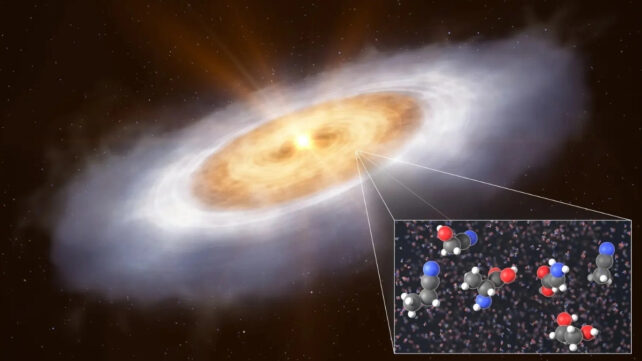
The spectral data acquired from these laboratory-generated molecules were then juxtaposed with observational data meticulously gathered by CAB astronomers utilizing the IRAM 30-meter and the Yebes 40-meter radio telescopes situated in Spain.
Prior to this discovery, interstellar space had only revealed relatively diminutive sulfur compounds, comprising six atoms or fewer, which nevertheless play pivotal roles in the functionality of proteins and enzymes.
Larger sulfur-containing molecules, such as thiepine, had remained elusive, leaving a discernible chasm between the organic chemistry found in meteoritic samples and the chemistry observed in the vast expanse of space. The recently identified thiepine molecule exhibits a structural kinship with compounds prevalent in meteorites.
This finding unequivocally establishes, for the first time, a tangible link between astrochemistry and the fundamental chemistry of terrestrial life.
“This marks the inaugural definitive detection of a complex, cyclic molecule containing sulfur within interstellar space—a pivotal advancement toward comprehending the chemical continuum connecting the cosmos with the primordial constituents of life,” affirms lead investigator Mitsunori Araki, a researcher affiliated with MPE.
“Our findings indicate that a thirteen-atom molecule, structurally analogous to those found in comets, is already present in a nascent, starless molecular cloud. This substantiates the notion that the chemical foundations for life are laid long before stellar formation commences,” adds co-author Valerio Lattanzi, a scientist at MPE.
This pivotal discovery strongly suggests that a multitude of other complex sulfur-bearing molecular species likely await identification within the interstellar medium.
Furthermore, these findings lend substantial support to recent research emanating from Aarhus University and the Institute for Nuclear Research, which demonstrated the spontaneous formation of peptides—another vital component of life—in interstellar environments.
Collectively, these revelations posit that the origins of life are interwoven with cosmic processes and are considerably more pervasive than previously theorized.
This report was originally disseminated by Universe Today. Access the original publication here.