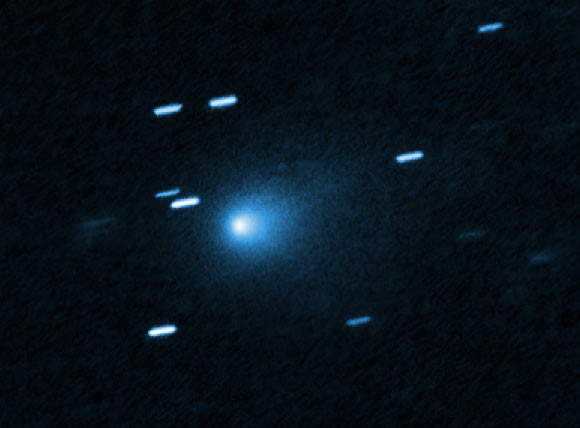
A comprehensive study has been finalized by planetary scientists affiliated with the Southwest Research Institute, outlining the feasibility of a spacecraft mission designed to conduct a flyby of an interstellar comet. This endeavor promises to yield significant revelations regarding the characteristics of celestial bodies originating from outside our planetary system. The recent identification of the interstellar comet 3I/ATLAS served as a critical validation point for the mission concept, confirming that 3I/ATLAS could have been intercepted and thoroughly examined by the proposed spacecraft.

Hubble captured this image of 3I/ATLAS on July 21, 2025, when the comet was 446 million km (277 million miles) from Earth. Image credit: NASA / ESA / David Jewitt, UCLA / Joseph DePasquale, STScI.
The year 2017 marked a significant astronomical event with the detection of 1I/‘Oumuamua, the initial interstellar object observed within our Solar System.
This groundbreaking discovery was soon followed by the identification of 2I/Borisov in 2019, and subsequently, 3I/ATLAS this year, which garnered considerable global attention as the third officially recognized visitor from beyond our solar neighborhood.
“These novel types of celestial bodies present humanity with an unprecedented opportunity to conduct close-up investigations of objects that originated in star systems other than our own,” stated lead author Dr. Alan Stern, a distinguished planetary scientist at Southwest Research Institute.
“A reconnaissance mission involving a flyby of an interstellar comet could furnish unparalleled insights into the composition, structural makeup, and overall properties of these entities, thereby substantially broadening our comprehension of how solid bodies form in extrasolar environments.”
Scientific projections indicate that a substantial number of interstellar objects originating from beyond our solar system traverse the region within Earth’s orbital path annually, with estimates suggesting as many as 10,000 passing within Neptune’s orbit each year.
Dr. Stern and his research team meticulously addressed the distinctive engineering hurdles and established the financial requirements and necessary instrumentation for undertaking an interstellar comet mission.
While the highly eccentric orbits and elevated velocities characteristic of these objects make continuous observation through orbiting infeasible with current technologies, the study convincingly demonstrated that flyby reconnaissance is both achievable and economically viable.
“The trajectory exhibited by 3I/ATLAS falls within the interceptable parameters of the mission architecture we have designed, and the scientific data that could be acquired during such a flyby would be truly revolutionary,” commented Dr. Matthew Freeman of Southwest Research Institute.
“The proposed mission would involve a high-velocity, head-on encounter designed to gather an extensive array of valuable scientific information, and it could also serve as a foundational model for subsequent missions targeting other interstellar comets.”
The researchers meticulously defined the principal, overarching scientific objectives for a mission focused on an interstellar comet.
Ascertaining the physical attributes of the celestial body would provide critical data for understanding its formation history and subsequent evolutionary trajectory.
A detailed analysis of the interstellar comet’s composition could shed light on its genesis and elucidate the transformative effects of evolutionary forces acting upon the comet since its inception.
An additional, crucial objective involves a thorough investigation into the nature of the object’s coma, which is the tenuous atmosphere that escapes from its central nucleus.
To facilitate the exploration of potential mission trajectories, the research team developed sophisticated software capable of generating a representative, synthetic population of interstellar comets. Subsequently, it calculated the most efficient, minimum-energy trajectory from Earth to intersect the path of each simulated comet.
The computations performed by this software indicated that a low-energy rendezvous trajectory is indeed feasible, and in a significant number of instances, would necessitate fewer launch resources and less in-flight velocity adjustment compared to many existing solar system missions.
Leveraging this software, the scientists precisely calculated the trajectory that the envisioned spacecraft would have needed to follow from Earth to successfully intercept 3I/ATLAS.
Their findings unequivocally confirmed the mission’s capability to reach 3I/ATLAS.
“The highly promising nature of 3I/ATLAS’s appearance serves to further bolster the rationale behind our proposed interstellar comet mission,” remarked Dr. Mark Tapley, an expert in orbital mechanics at Southwest Research Institute.
“We have conclusively demonstrated that encountering these interstellar comets does not demand technologies or launch capabilities beyond those already successfully employed by prior NASA missions.”