A groundbreaking theoretical construct has been put forth by physicists affiliated with the Center of Applied Space Technology and Microgravity at the University of Bremen and the Transylvanian University of Brașov. This novel framework has the potential to fundamentally alter our comprehension of the Universe’s accelerating expansion, possibly rendering the enigmatic concept of dark energy redundant. Their hypothesis posits that this acceleration might not stem from an unknown cosmic force, but rather be an intrinsic characteristic of spacetime’s very geometry.
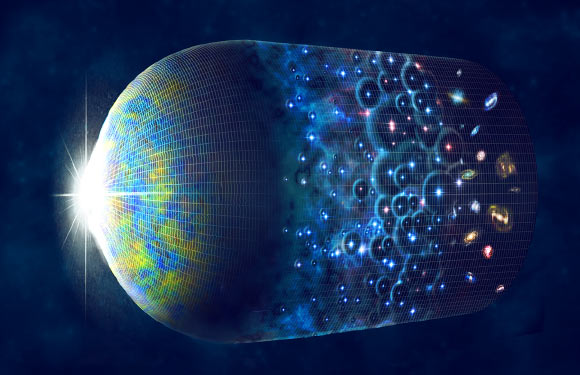
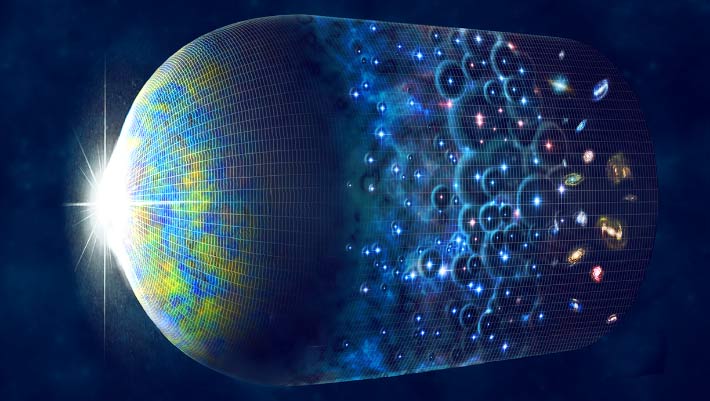
This is an artist’s depiction illustrating the progression of the cosmos, commencing with the Big Bang on the left, followed by the emergence of the Cosmic Microwave Background. The initial stars mark the end of the cosmic dark ages, preceding the formation of galaxies. Image provided by M. Weiss / Harvard-Smithsonian Center for Astrophysics.
For a span exceeding two decades and a half, the scientific community has been confronted with a puzzling observation: contrary to gravitational expectations, the Universe’s expansion is not decelerating but is, in fact, accelerating.
During the 1990s, astrophysical observations of distant Type Ia supernovae led astronomers to infer this acceleration, a finding that consequently spurred the widespread proposition of dark energy – a hypothetical, pervasive, and undetectable entity believed to be the driving force behind cosmic acceleration.
Despite its pivotal role within the prevailing cosmological model, the true physical nature of dark energy remains profoundly obscure.
In their recent research, Dr. Christian Pfeifer and his collaborators assert that the observed expansion of the Universe could potentially be elucidated, at least partially, by refining the fundamental geometric framework employed in the description of gravity.
Central to contemporary cosmology is Einstein’s overarching theory of general relativity, which elegantly elucidates the manner in which matter and energy dictate the curvature and structure of spacetime.
Furthermore, the chronological development of the Universe itself is mathematically modeled utilizing the Friedmann equations, which are themselves derived from Einstein’s seminal theory.
The innovative solution presented by the research team is predicated on an augmentation of Einstein’s theory, specifically an extension known as Finsler gravity.
This theoretical construct, meticulously developed over recent years, serves to generalize the very geometry of spacetime, thereby enabling a more granular and intricate depiction of how matter, particularly in gaseous forms, interacts under the influence of gravitational forces.
In contrast to general relativity, which operates on a precisely defined geometric structure, Finsler gravity accommodates a more elaborate and adaptable spacetime geometry.
By employing this advanced theoretical lens, the authors of the study meticulously re-evaluated the mathematical expressions that govern the Universe’s expansionary behavior.
When articulated within the theoretical confines of Finsler geometry, the revised Friedmann equations inherently predict an accelerated expansion of the Universe, even in the absence of any matter and without the necessity of postulating an additional constituent such as dark energy.
Put simply, the phenomenon of acceleration emerges organically from the intrinsic geometric properties of spacetime itself.
“This represents a compelling indicator that we might be capable of accounting for the accelerated expansion of the Universe, at least in part, without recourse to dark energy, by grounding our understanding in a more generalized spacetime geometry,” stated Dr. Pfeifer.
It is important to clarify that this proposition does not assert the complete eradication of dark energy, nor does it immediately invalidate the established Standard Model of cosmology.
Rather, it suggests that a portion, if not a significant amount, of the effects currently attributed to dark energy might originate from a more profound and sophisticated understanding of gravitational principles.
“This novel geometric perspective on the dark energy challenge introduces exciting new avenues for enhancing our comprehension of the fundamental laws governing the cosmos,” Dr. Pfeifer elaborated.
The scholarly contribution from this research group has been formally published in the Journal of Cosmology and Astroparticle Physics and can be accessed via the following link.
_____
Christian Pfeifer et al. 2025. From kinetic gases to an exponentially expanding Universe — the Finsler-Friedmann equation. JCAP 10: 050; doi: 10.1088/1475-7516/2025/10/050