A novel approach to quantifying the universe’s expansion rate, commonly known as the Hubble constant, has been devised by astrophysicists affiliated with the University of Illinois and the University of Chicago. This groundbreaking technique capitalizes on the subtle, persistent background murmur of gravitational waves. As gravitational-wave observatories attain greater sensitivity in the foreseeable future, this methodology holds the potential to profoundly reshape our comprehension of cosmic evolution and contribute to the resolution of a pivotal ongoing debate within contemporary astrophysics.
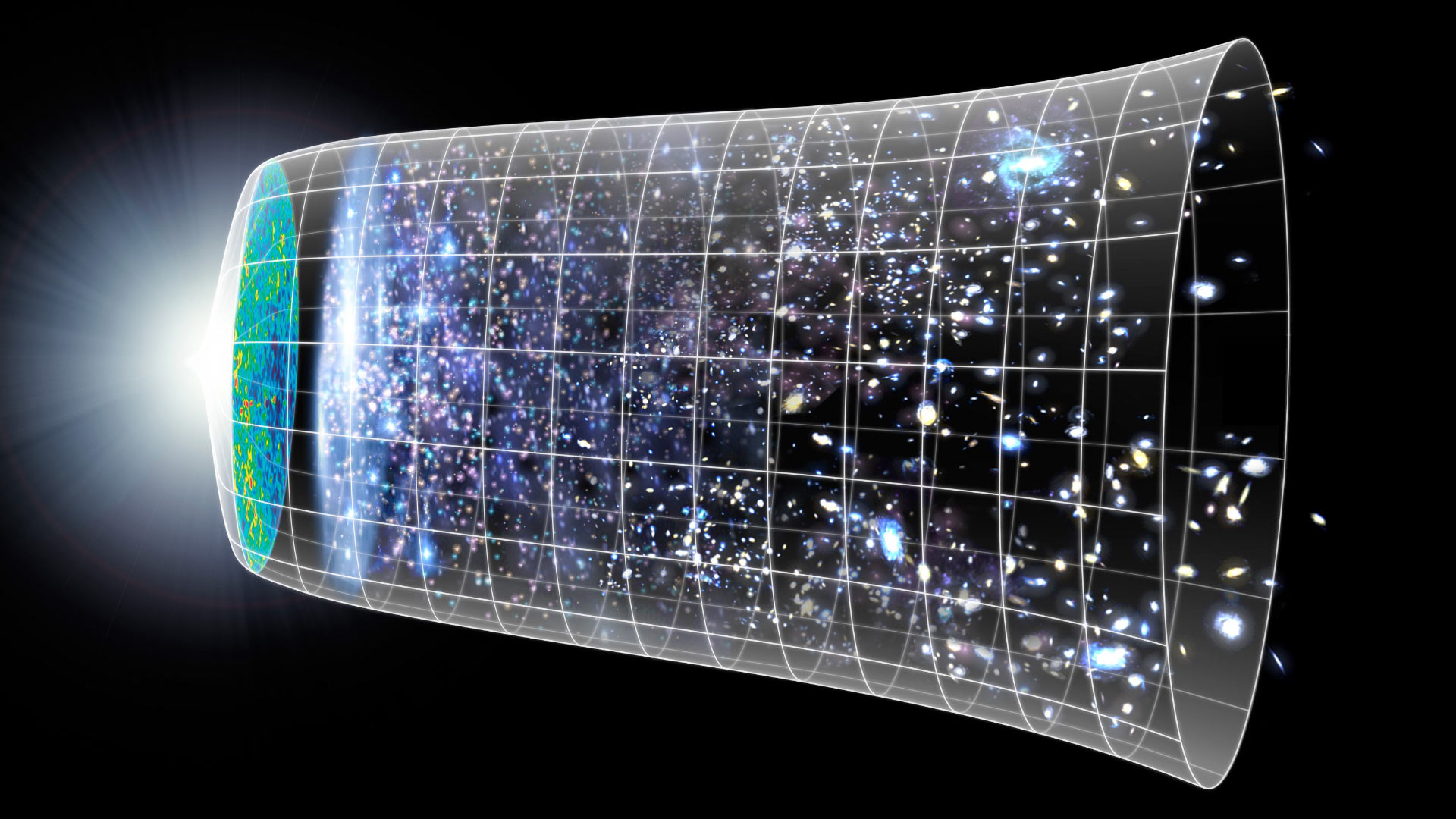
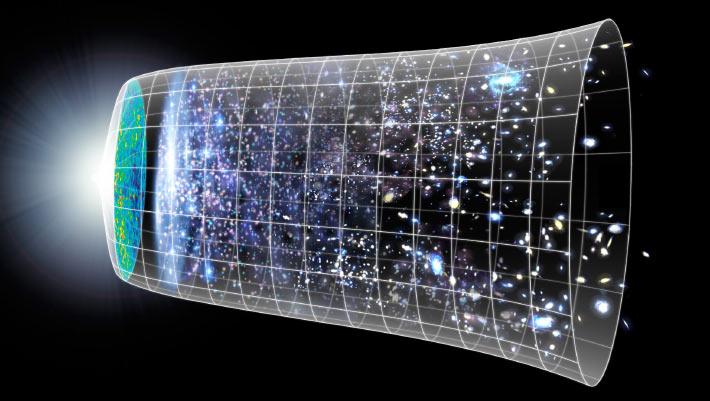
Schematic of the expansion of the Universe from the Big Bang to the present day. Image credit: NASA / EFBrazil.
“The significance of this discovery cannot be overstated; securing an independent measure of the Hubble constant is crucial for addressing the prevailing Hubble tension,” articulated Nicolás Yunes, a professor at the University of Illinois.
“Our proposed technique offers an inventive pathway to elevate the precision of Hubble constant estimations derived from gravitational wave data.”
Professor Yunes and his research associates have put forth a gravitational-wave-centric methodology that harnesses the faint, pervasive ‘background hum’ generated by innumerable distant collisions of black holes to refine estimates of the Hubble constant.
In contrast to conventional measurement strategies, this innovative method taps directly into the fabric of spacetime itself – specifically, the ripples known as gravitational waves. These cosmic tremors carry invaluable information regarding immense cosmic distances and the rate at which celestial bodies are receding from one another.
The astrophysicists have designated this innovative approach the ‘stochastic siren’ method.
“By analyzing individual black hole merger events, we can ascertain the frequency of these occurrences across the cosmos,” explained Bryce Cousins, a graduate student at the University of Illinois.
“Based on these observed rates, we surmise the existence of a substantial number of unobserved events, collectively termed the gravitational-wave background.”
“The advent of an entirely novel instrument for cosmological exploration is a rare occurrence,” commented Daniel Holz, a professor at the University of Chicago.
“Our findings demonstrate that by examining the ambient gravitational-wave hum emanating from merging black holes in remote galaxies, insights into the universe’s age and its constituent components can be gleaned.”
“This represents a thrilling and entirely novel avenue of research, and we eagerly anticipate applying our developed techniques to forthcoming datasets. This will aid in refining our understanding of the Hubble constant and other fundamental cosmological parameters.”
As gravitational wave detectors continue to improve in sensitivity over the ensuing years, the stochastic siren method is poised to become an indispensable pillar of precision cosmology.
The detection of the gravitational-wave background is projected to occur within the next six years.
Prior to such a definitive detection, this methodology can still provide incremental constraints on higher values of the Hubble constant as upper limits on the background noise tighten. This offers an supplementary avenue for probing the Hubble tension, even in the absence of a complete detection.
“This development should facilitate the future application of this technique as we persist in enhancing detector sensitivity, refining our understanding of the gravitational-wave background, and potentially achieving its direct detection,” stated Cousins.
“By integrating this newfound data, we anticipate achieving more accurate cosmological results and moving closer to resolving the persistent Hubble tension.”
The comprehensive findings of the research team are slated for publication in the esteemed journal Physical Review Letters and can be accessed via the following link: work.
—–
Bryce Cousins et al. 2026. Stochastic Siren: Astrophysical gravitational-wave background measurements of the Hubble constant. Phys. Rev. Lett, in press; doi: 10.1103/4lzh-bm7y