The standard framework of modern cosmology, the Lambda-CDM (ΛCDM) model, has long served as the cornerstone for comprehending the Universe’s large-scale architecture. This paradigm posits that a staggering 95% of the cosmos comprises elusive substances: dark matter, accounting for approximately 25%, and dark energy, making up about 70%. Dark energy, often embodied by the cosmological constant (Λ), is theorized to be the driving force behind the Universe’s accelerating expansion, maintaining a consistent energy density throughout cosmic history. However, emergent findings from the Dark Energy Survey (DES) suggest a potential divergence from this long-held tenet, indicating that dark energy’s influence might not be static but rather evolves over time.
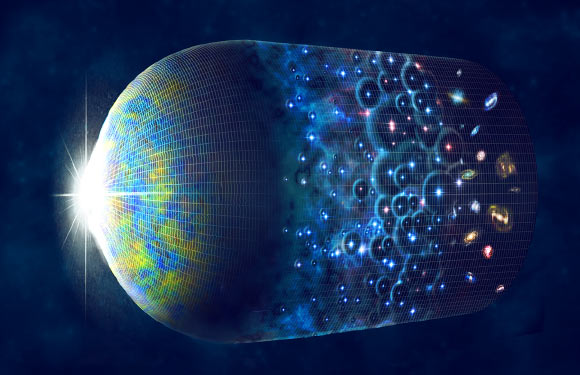
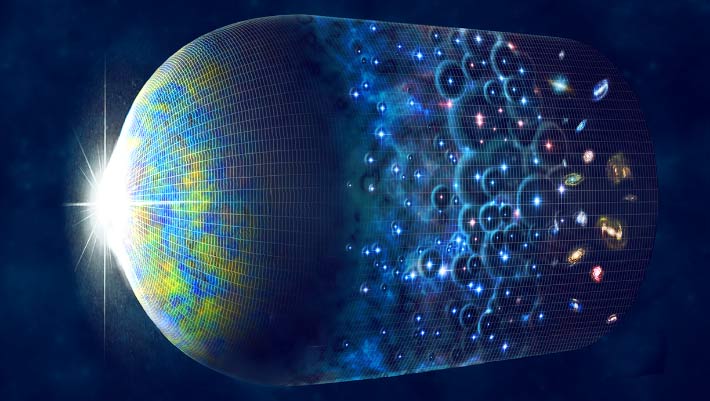
This artist’s impression shows the evolution of the Universe beginning with the Big Bang on the left followed by the appearance of the Cosmic Microwave Background. The formation of the first stars ends the cosmic dark ages, followed by the formation of galaxies. Image credit: M. Weiss / Harvard-Smithsonian Center for Astrophysics.
The Dark Energy Survey (DES) utilized the sophisticated 570-megapixel Dark Energy Camera (DECam), a technological marvel fabricated by the Department of Energy, which was affixed to NSF’s Víctor M. Blanco 4-m telescope situated at the Cerro Tololo Inter-American Observatory, a facility operated under the auspices of NSF NOIRLab.
Over a six-year duration, spanning 758 observational nights, the dedicated researchers of the DES meticulously charted a vast expanse of the celestial sphere, covering an area equivalent to nearly one-eighth of the entire sky.
This ambitious undertaking deploys a multifaceted array of observational methodologies, including the precise measurement of supernovae, detailed analysis of galaxy distribution, and the examination of subtle gravitational lensing effects, all aimed at unraveling the mysteries of dark energy.
Two fundamental datasets derived from the DES — Baryon Acoustic Oscillations (BAO) and the distance characterization of Type Ia supernovae — are instrumental in tracing the historical trajectory of the Universe’s expansion.
BAO represents a cosmic yardstick, imprinted by sound waves propagating through the primordial Universe, with characteristic peaks spaced approximately 500 million light-years apart.
By meticulously measuring these BAO peaks across various epochs of cosmic evolution, astronomers gain the ability to discern the extent to which dark energy has influenced the stretching of cosmic scales over time.
“Upon scrutinizing data from 16 million galaxies, the DES investigation revealed that the observed BAO scale is, in fact, 4% smaller than what the ΛCDM model predicts,” remarked Dr. Santiago Avila, an esteemed astronomer affiliated with the Centre for Energy, Environmental and Technological Research (CIEMAT).
Type Ia supernovae function as cosmological standard candles, distinguished by their consistent intrinsic luminosity.
Consequently, their observable brightness, when correlated with information pertaining to their host galaxies, empowers scientists to compute cosmic distances with a high degree of precision.
In the year 2024, the DES consortium unveiled an unprecedentedly comprehensive and detailed collection of supernova data, yielding exceptionally accurate determinations of intergalactic distances.
These newly acquired findings, amalgamating data from both supernovae and BAO measurements, independently corroborate the anomalous observations previously detected within the 2024 supernova dataset.
By integrating the measurements procured by the DES with data from the Cosmic Microwave Background, the research team has been able to infer the fundamental properties of dark energy, and these results strongly suggest a temporally varying nature for this enigmatic force.
Should these findings withstand further scrutiny and validation, it would signify that dark energy, conventionally represented by the unchanging cosmological constant, is in reality a dynamic entity requiring the development of novel theoretical frameworks.
“This particular finding is quite compelling as it points towards physical phenomena that lie beyond the accepted standard model of cosmology,” stated Dr. Juan Mena-Fernández, a distinguished researcher from the Subatomic Physics and Cosmology Laboratory.
“If subsequent observational data lend further support to these discoveries, we might be on the precipice of a profound scientific paradigm shift.”
While the current evidence is not yet conclusive, forthcoming analyses that incorporate additional data streams from the DES, such as galaxy clustering patterns and weak lensing signatures, hold the potential to bolster the strength of these indications.
Remarkably, analogous trends have begun to surface from other significant cosmological investigations, including the Dark Energy Spectroscopic Instrument (DESI), generating a palpable sense of anticipation within the scientific community.
“These outcomes are a testament to years of dedicated collaborative endeavor aimed at extracting profound cosmological insights from the DES datasets,” commented Dr. Jessie Muir, a researcher based at the University of Cincinnati.
“There remains a considerable amount to be discovered, and it will undoubtedly be fascinating to observe how our comprehension evolves as new measurements become accessible.”
The scientific manuscript detailing the team’s findings has been submitted for publication in the esteemed journal Physical Review D and is also accessible via the preprint server arXiv.
_____
T.M.C. Abbott et al. (DES Collaboration). 2025. Dark Energy Survey: implications for cosmological expansion models from the final DES Baryon Acoustic Oscillation and Supernova data. Physical Review D, in press; arXiv: 2503.06712