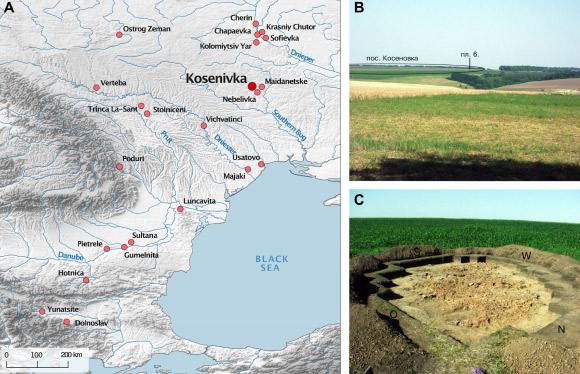
A recent investigation, detailed in a publication in the journal PLoS ONE, involved archaeologists scrutinizing remarkable human skeletal remains unearthed from the Kosenivka site in Ukraine, a prominent location associated with the Middle Trypillia period (approximately 3700-3600 BCE).
The Trypillia culture, also recognized as the Cucuteni-Trypillia culture, emerged in Ukraine during the 5th millennium BCE, extending its influence between the Seret and Bug rivers, with notable branches southward into present-day Romania and Moldova, and eastward towards the Dnieper River.
This civilization is distinguished by its sophisticated advancements in agriculture, metallurgy, ceramics, architectural design, and societal structure.
Within Trypillian society, a matriarchal system prevailed, wherein women held leadership roles within households, were primarily responsible for agricultural pursuits, and engaged in the production of pottery, textiles, and apparel.
The male members of the community were tasked with responsibilities such as hunting, the management of domestic livestock, and the crafting of tools.
“Despite the substantial volume of artifacts bequeathed by the Trypillia people, the discovery of human remains has been notably infrequent,” observed Dr. Katharina Fuchs of Kiel University and her research associates.
“Consequently, numerous aspects of this ancient population’s existence remain largely unknown.”
The research team focused their attention on a Trypillia cultural settlement situated near Kosenivka, Ukraine.
This particular site is exceptional due to the presence of human skeletal remains, discovered within several residential structures.
Among the debris of a single dwelling, fifty fragments of human bone were retrieved, representing at least seven distinct individuals—including infants, adults, males, and a female—who were likely former residents of the habitation. Intriguingly, the remains of four of these individuals exhibited significant signs of thermal alteration.
Through meticulous analysis of the carbon and nitrogen isotopes present in both the bone samples and the accompanying botanical and faunal remnants found at the site, the researchers deduced that animal protein constituted less than 10% of the dietary intake of the inhabitants.
This finding aligns with observations of wear patterns on teeth recovered from the location, which suggest a diet predominantly composed of grains and other plant-based materials.
The conclusion that Trypillian diets were primarily plant-based lends credence to theories postulating that cattle within these societies were predominantly utilized for field fertilization and milk production, rather than for their meat.
“Skeletal remains serve as invaluable biological records,” stated Dr. Fuchs.
“Although reconstructing the intricacies of Trypillian societies and their living conditions within the earliest urban-like communities of Eastern Europe continues to present challenges, our investigation at the Kosenivka site unequivocally demonstrates the immense value that even minute bone fragments can offer.”
“By integrating novel osteological, isotopic, archaeobotanical, and archaeological data, we are able to provide an extraordinary glimpse into the lives—and potentially the demise—of these individuals.”
The scientific team also explored potential explanations for the observed thermal damage, considering possibilities such as accidental conflagration or an uncommon funerary practice.
The thermally altered bone fragments were predominantly discovered in the central area of the dwelling, and prior research had suggested that the inhabitants of this particular site perished in a house fire.
Upon microscopic examination of the bone fragments, the study’s authors concluded that the burning likely occurred in close proximity to the time of death.
In the scenario of an accidental fire, the researchers posited that certain individuals might have succumbed to carbon monoxide poisoning, even if they had attempted to escape the blaze.
Radiocarbon dating indicated that one of the individuals died approximately one century after the presumed fire event. The demise of this individual cannot be directly attributed to the fire but remains otherwise unexplained.
The presence of unhealed cranial trauma in two other individuals raises the possibility that interpersonal violence may have contributed to their deaths.
A comprehensive review of human skeletal remains associated with the Trypillian culture revealed that less than 1% of deceased individuals were cremated, and even more rarely were they interred within residential structures.
“Collectively, our findings underscore the substantial explanatory potential that remains dormant within the scarce and often poorly preserved bioarchaeological records of the Cucuteni-Trypillia phenomenon,” the researchers concluded.
_____
K. Fuchs et al. 2024. Life and death in Trypillia times: Interdisciplinary analyses of the unique human remains from the settlement of Kosenivka, Ukraine (3700-3600 BCE). PLoS ONE 19 (12): e0289769; doi: 10.1371/journal.pone.0289769