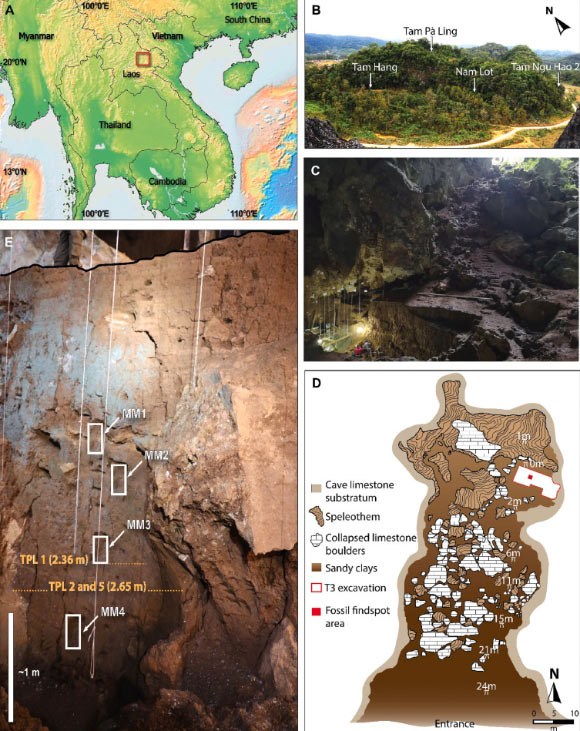
The discovery of fossilized remains at Tam Pà Ling (Cave of Monkeys) in northeastern Laos has provided substantial evidence for some of the earliest recorded instances of Homo sapiens habitation in the mainland Southeast Asian region.

Archaeological investigations at Tam Pà Ling, situated in northeastern Laos. Image courtesy of Hernandez et al., doi: 10.1016/j.quascirev.2024.108982.
“By employing a methodology termed microstratigraphy, we successfully reconstructed the historical environmental conditions within the cave and pinpointed indicators of human activities both within and in the vicinity of Tam Pà Ling,” stated Vito Hernandez, a doctoral candidate at Flinders University.
“This analytical approach also facilitated the precise determination of the circumstances surrounding the deposition of some of the most ancient modern human fossils unearthed in Southeast Asia, found deep within the cave’s confines.”
Microstratigraphy empowers researchers to meticulously examine soil samples at their most granular level, thereby revealing structures and features that retain information regarding past ecological settings and even subtle traces of human and animal interactions that might have been previously overlooked during excavation due to their minute scale.
The skeletal remains of humans unearthed by the investigating archaeologists were interred within the Tam Pà Ling cave between 86,000 and 30,000 years ago.
However, prior to this investigation, a thorough examination of the geological strata enveloping these fossils had not been undertaken to elucidate their depositional history or the prevailing environmental conditions of that epoch.
The latest discoveries indicate that the environmental conditions within the cave underwent considerable shifts, transitioning from a mild climate characterized by persistent moisture to periods of seasonal aridity.
“This alteration in the regional environment had a direct impact on the cave’s internal morphology and consequently influenced how geological deposits, including human fossils, accumulated within the cavern,” commented Dr. Mike Morley from Flinders University.
“The mechanism by which early Homo sapiens became situated deep within the cave has been a subject of prolonged academic conjecture; however, our analysis of the sediments suggests that the fossils were transported into the cave via loose material and debris that had accumulated over time, likely eroded from the adjacent hillsides and carried by water during periods of intense precipitation.”
The research team also identified discernible microscopic residues of charcoal and ash within the cave’s sedimentary layers, suggesting either the occurrence of wildfires in the surrounding area during drier intervals or the potential use of fire by individuals visiting the cave, either within its confines or at its entrance.
“This line of inquiry has furnished our team with unparalleled insights into the migratory patterns of our ancient progenitors as they navigated the dynamically evolving forest landscapes of Southeast Asia, particularly during epochs marked by regional climatic instability,” observed Dr. Fabrice Demeter, a paleoanthropologist affiliated with the University of Copenhagen.
These findings were officially published on October 10th in the esteemed journal Quaternary Science Reviews.
_____
V.C. Hernandez et al. Investigating Late Pleistocene-Holocene (52-10 ka) microstratigraphy, fossil taphonomy, and depositional environments at Tam Pà Ling cave (northeastern Laos). Quaternary Science Reviews, officially released online on October 10, 2024; doi: 10.1016/j.quascirev.2024.108982