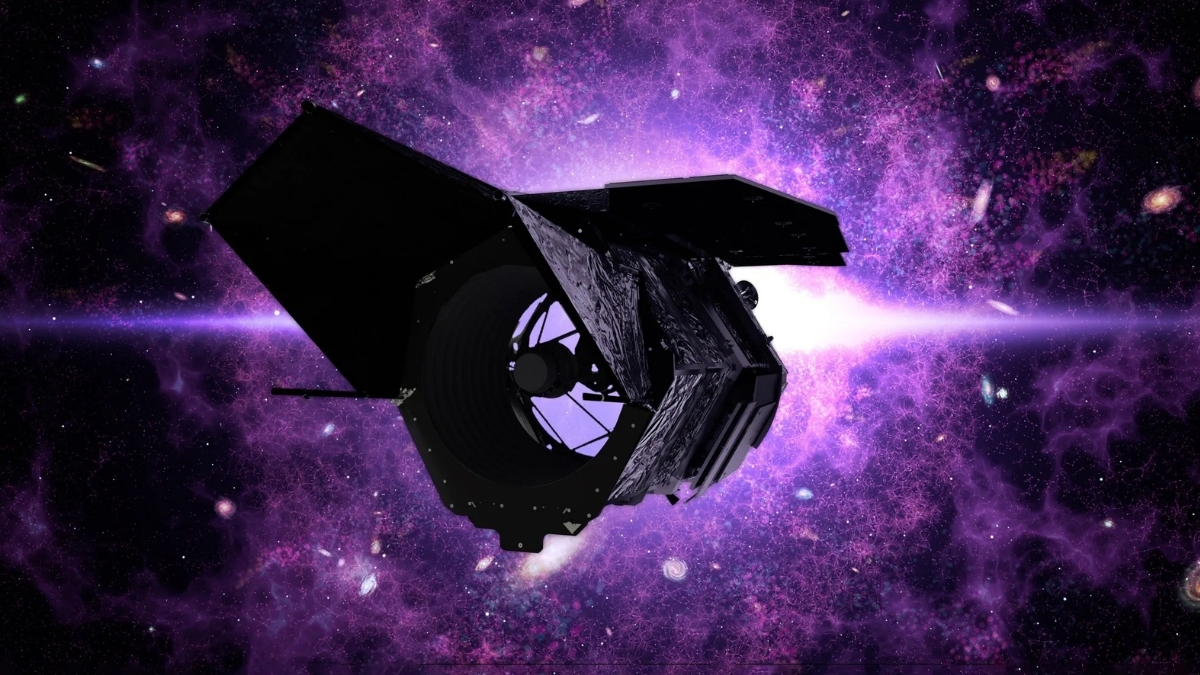
For those captivated by the ongoing revelations from our universe, November 25th marked a significant milestone. On this date, NASA finalized the assembly of the Nancy Grace Roman Space Telescope.
The integration of the two principal components of this formidable observatory concluded within the pristine environment of a large clean room at the Goddard Space Flight Center. This achievement positions the telescope favorably for its projected launch, with a timeframe as early as Autumn 2026.
The Roman is an infrared-capable telescope destined to become a cornerstone of astronomical observation. Its scientific payload comprises a duo of sophisticated instruments: the Wide-Field Instrument (WFI) and the Coronagraph Instrument (CGI).
The WFI affords an observational perspective that dwarfs Hubble’s by a factor of 100. Concurrently, its coronagraph capability will enable the suppression of starlight, thereby facilitating detailed observations of exoplanets and the protoplanetary disks surrounding them.
Its primary scientific directives encompass the investigation of dark energy, the compilation of a comprehensive exoplanet catalog, the identification of primordial black holes, and the direct imaging and spectral analysis of nearby exoplanets utilizing its coronagraph.
“The culmination of the Roman observatory’s assembly represents a pivotal moment for the agency,” stated NASA Associate Administrator Amit Kshatriya.
“Groundbreaking scientific endeavors are intrinsically linked to meticulous engineering, and this team has, through a systematic process of integration and validation, delivered an observatory poised to expand our cosmic comprehension.”
“As the Roman transitions into its final testing phase post-integration, our focus remains steadfast on precise execution and ensuring a successful launch in service to the global scientific community.”
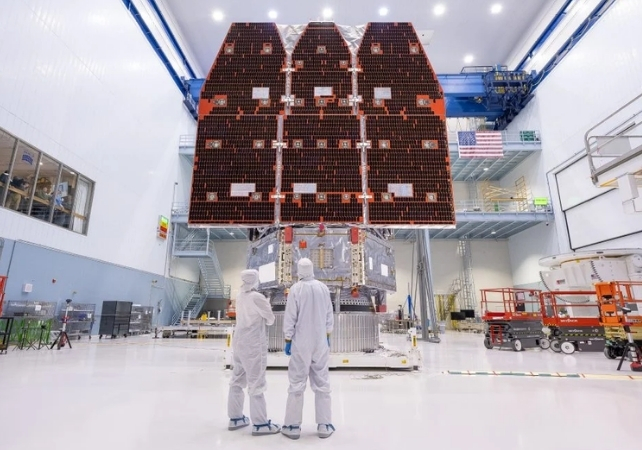
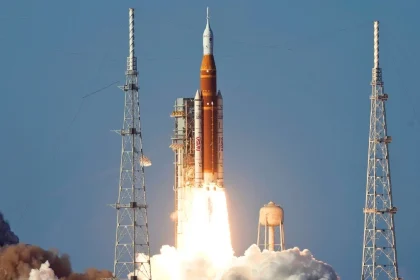
Prior to its relocation to the Kennedy Space Center in Florida for launch preparations, the telescope will undergo rigorous validation processes. The current target date for liftoff is May 2027, when a SpaceX Falcon Heavy rocket is slated to propel it into orbit, en route to the Sun-Earth L2 Lagrange point.
However, the possibility of an earlier readiness by Autumn 2026 exists, which would represent a remarkable achievement. Highly complex undertakings, such as the development of space telescopes, are frequently susceptible to budget overruns and schedule delays.
By way of illustration, the Hubble Space Telescope was initially slated for deployment in the mid-1980s but ultimately launched in 1990. (It bears noting that the launch sequence was partially impacted by the Challenger disaster).
Furthermore, the protracted journey of the James Webb Space Telescope (JWST) to completion is widely known. Its launch occurred over a decade beyond its initial schedule, yet the enduring quality of its discoveries has arguably justified the extended waiting period.
Regardless of whether its launch occurs months ahead of schedule or not, the Roman telescope is poised to yield groundbreaking discoveries.
“With the Roman observatory’s construction now complete, we stand at the precipice of unimaginable scientific revelations,” remarked Julie McEnery, Roman’s senior project scientist at NASA Goddard.
“Within the mission’s initial quinquennial period, it is anticipated to unveil over 100,000 distinct worlds, hundreds of millions of stars, and billions of galaxies. We are poised to acquire an immense volume of novel insights into the cosmos with remarkable speed following Roman’s deployment.”
The advent of new observational instruments consistently leads to novel insights about the universe, and these discoveries extend beyond the scientific community. They resonate with individuals possessing a keen intellectual curiosity about life’s profound questions. Such revelations can subtly reframe our perception of our own existence, thereby broadening our understanding of the natural world and our place within it.
The Nancy Grace Roman Space Telescope is designed for a primary mission duration of five years. A key distinction from some other infrared telescopes is its absence of fluid-based cooling systems, thus eliminating concerns about coolant depletion.
Propellant, however, represents a limiting factor, analogous to the JWST. These spacecraft utilize onboard fuel to maintain their orbital trajectories and execute pointing maneuvers. While the planned five-year mission should suffice for Roman to achieve its primary scientific objectives, the possibility of an extended operational lifespan, mirroring that of other successful missions, exists.
Throughout its five-year operational period, the telescope is projected to identify tens of thousands of supernovae, thousands of exoplanets detected via microlensing, and hundreds of exoplanetary systems in the process of formation.
This enumeration represents only a partial glimpse of its anticipated discoveries. Novel missions invariably yield unforeseen results, the nature of which is inherently difficult to predict in advance.
One of the Roman’s paramount scientific pursuits concerns dark energy, the enigmatic force driving the universe’s accelerating expansion. A more profound comprehension of this phenomenon necessitates an expansive view of the cosmos, a capability meticulously engineered into the Roman through its WFI, a 288-megapixel camera.
The sole avenue for deciphering dark energy involves the meticulous examination of vast celestial regions to detect its subtle influences. The mapping of the universe’s large-scale structure and tracing its evolutionary trajectory through the development of galaxy clusters are also integral facets of this dark energy objective.
Other observatories would require decades, if not centuries, to accomplish what the Roman will achieve within a five-year timeframe. In fact, the Roman will image an area of the sky in five years equivalent to what Hubble surveyed in its initial three decades. Its primary mission will generate an astonishing 20,000 terabytes (or 20 petabytes) of data.
“Within our collective lifetimes, a profound cosmic enigma has emerged: the accelerating expansion of the universe. There is an intrinsic aspect of space and time that remains elusive to our current understanding, and the Roman was conceived to elucidate it,” stated Nicky Fox, associate administrator, Science Mission Directorate, NASA Headquarters in Washington.
“With the Roman now standing as a complete observatory, keeping the mission on track for a potentially early launch, we have achieved a significant step toward comprehending the universe in an unprecedented manner. I am immensely proud of the teams that have brought us to this juncture.”
The telescope’s secondary instrument, the Coronagraph Instrument (CGI), is also engineered to address a persistent scientific quandary.
The pursuit of exoplanets has experienced considerable refinement in recent years. Beyond the broad discovery of planetary bodies, scientists are increasingly focused on identifying Earth-like planets with the potential for habitability. However, these worlds are often obscured by the intense glare of their host stars. The CGI has been specifically designed to overcome this challenge.
While numerous telescopes, including Hubble, are equipped with coronagraphs, the Roman’s instrument represents a significant technological leap, being the first active coronagraph to be deployed in space. It features an advanced configuration of masks, filters, and adaptive mirrors, engineered to evaluate these technologies across diverse observational modes.
“The fundamental question, ‘Are we alone?’ carries profound implications, and developing instruments capable of assisting in its resolution is an equally substantial undertaking,” commented Feng Zhao, the Roman Coronagraph Instrument manager at NASA’s Jet Propulsion Laboratory in Southern California.
“The Roman Coronagraph is poised to advance us considerably toward this objective. It is truly remarkable to have the opportunity to test this cutting-edge hardware in the space environment aboard such a powerful observatory as Roman.”
The prodigious volume of data that the Roman will yield is comparable to that generated by other contemporary astronomical observatories. These extensive datasets will, ideally, be permanently accessible to researchers, informing studies across a multitude of astronomical disciplines.
“I am inclined to believe that Dr. Roman would view her namesake telescope with immense pride and be profoundly excited by the mysteries it is destined to unravel in the years ahead.”
The contemporary global landscape may appear fraught with challenges, a condition that has been a recurring feature throughout human history. The sentiment encapsulated in the adage, “This too shall pass,” attributed to medieval Sufi poets, warrants reflection.
One holds hope for a more promising future, one where political leadership actively champions and comprehends the pivotal role of scientific advancement in fostering societal progress.
Perhaps the Nancy Grace Roman Space Telescope’s early launch in Autumn 2026 will coincide with a reawakened appreciation for and interest in astronomy.
This content was originally disseminated by Universe Today. Access the original publication.