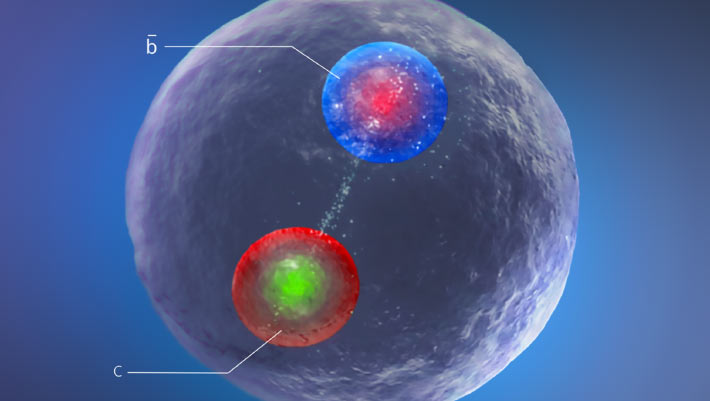
Within CERN’s Large Hadron Collider (LHC) facility, researchers affiliated with the ATLAS Collaboration have successfully detected the Bc*+ meson. This particle represents an excited state of the Bc+ meson, with both entities being composed of a charm quark and a bottom antiquark.
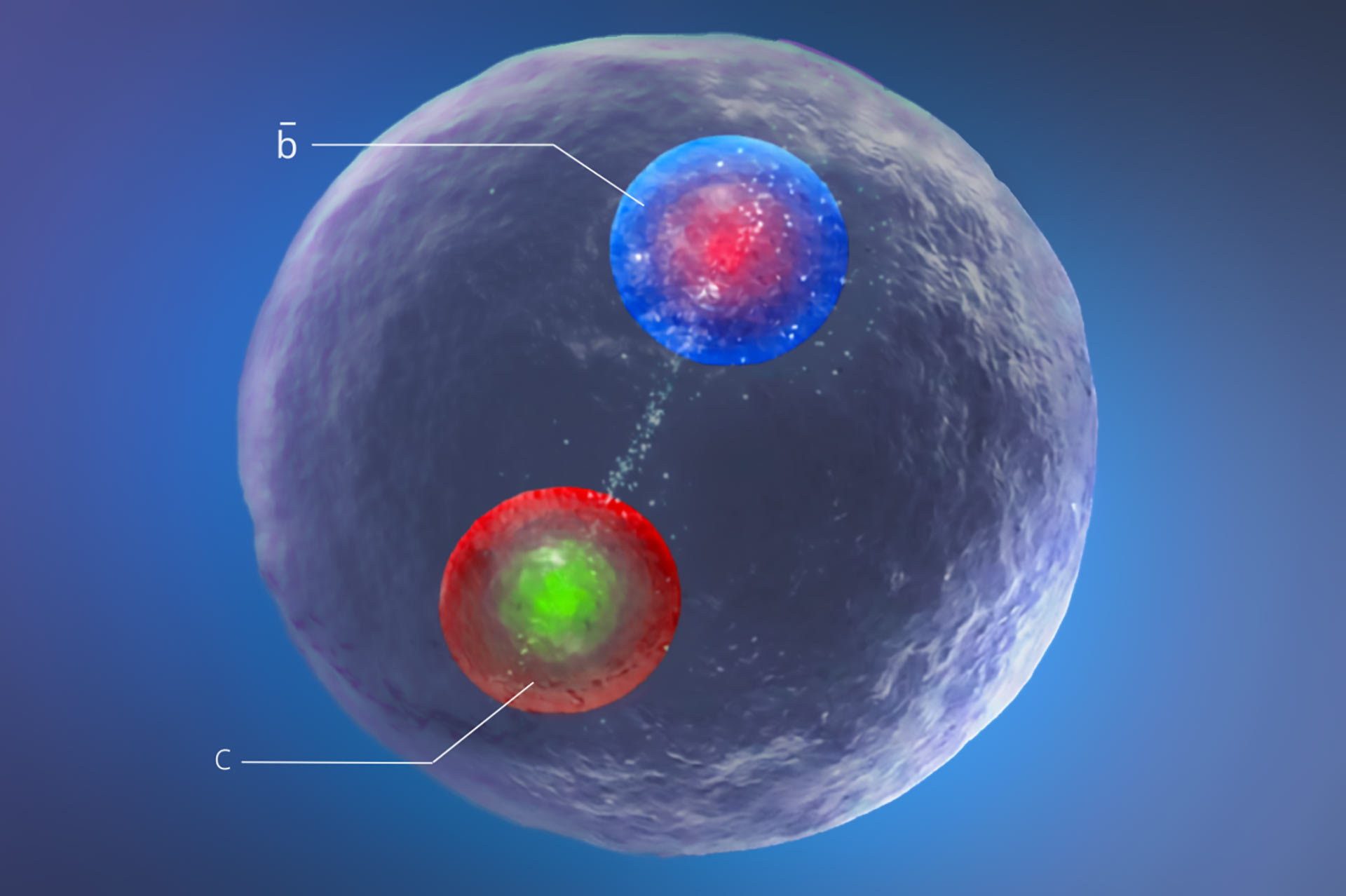
An artist’s impression of the Bc*+ meson. Image credit: Daniel Dominguez / CERN.
Protons and neutrons, fundamental constituents of matter, fall under a broad category of particles known as hadrons. Hadrons are complex particles assembled from quarks, held together by the potent strong nuclear force.
These particles are categorized into two distinct groups: baryons, which comprise three quarks such as protons and neutrons, and mesons, formed by a quark-antiquark pair.
Despite extensive investigation over many years, numerous facets of the strong nuclear force remain incompletely understood, particularly the mechanisms by which it binds quarks within hadrons.
Mesons originating from heavy quarks, like charm or bottom quarks, can serve as invaluable experimental platforms for validating theoretical frameworks that describe these phenomena.
Mesons of the Bc+ variety hold particular fascination for physicists due to their unique composition, featuring two distinct types of heavy quarks: a charm quark and a bottom antiquark.
In high-energy proton-proton collisions orchestrated at the LHC, the ATLAS physicists succeeded in producing an excited manifestation of the Bc+ meson, designated as the Bc*+.
The research team has indicated that the Bc*+ meson undergoes a rapid decay, transforming into a Bc+ meson alongside a photon.
The definitive identification of the Bc*+ meson by researchers hinges on the observation of this resultant photon in conjunction with the decay products of the Bc+ meson, effectively serving as the conclusive evidence.
However, a significant hurdle arises from the fact that the predicted mass of the Bc*+ meson only marginally exceeds that of the Bc+ meson. This minimal mass differential implies that the photon emitted during the decay carries an exceedingly small amount of energy.
Consequently, this low energy level renders the photon undetectable through conventional detection methodologies.
Instead of employing standard photon identification protocols, the scientific team resorted to an alternative approach: observing the photon’s transformation into an electron-positron pair within the ATLAS tracking detector. This process leaves behind tracks of charged particles situated in close proximity, originating from a shared point spatially offset from the primary proton-proton collision.
These detected tracks can exhibit transverse momenta as low as 100 MeV, a value substantially less than what is typically analyzed in ATLAS investigations.
To successfully reconstruct these low-energy photons and subsequently identify the Bc*+ meson, the authors were compelled to implement a specialized track reconstruction methodology.
The calculated discrepancy in mass between the Bc*+ meson and the Bc+ meson has been determined to be 64.5 ± 1.4 MeV.
“This observed value aligns with the range of theoretical predictions, although it shows a slight divergence from the most contemporary, high-precision theoretical calculations,” stated the physicists.
“This finding furnishes critical new data for theoretical models concerned with the masses of particles incorporating heavier quarks, thereby contributing to a more profound understanding of the strong nuclear force.”
The collaborative research is slated for publication in the esteemed journal Physics Review Letters and can be accessed pre-publication at arXiv:2605.16228.
_____
ATLAS Collaboration. 2026. Observation of a Bc*+ meson with the ATLAS detector. Physics Review Letters, in press; arXiv: 2605.16228