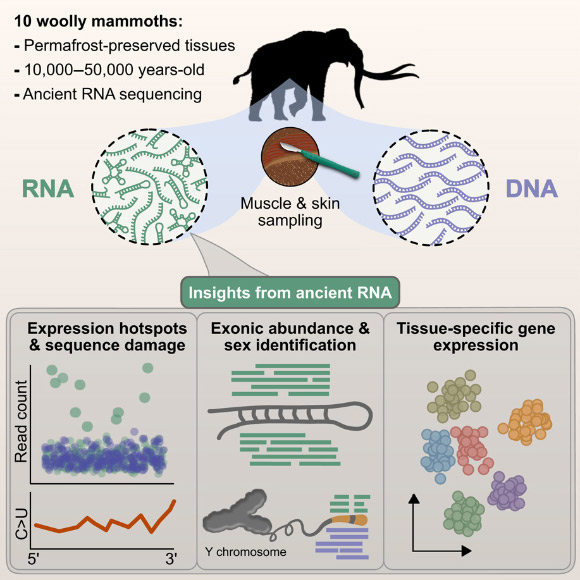
Researchers have successfully isolated and analyzed ancient RNA from permafrost-preserved remains of ten woolly mammoths. One of these specimens, dating back 39,000 years, now holds the distinction of possessing the oldest ancient RNA sequences ever cataloged.
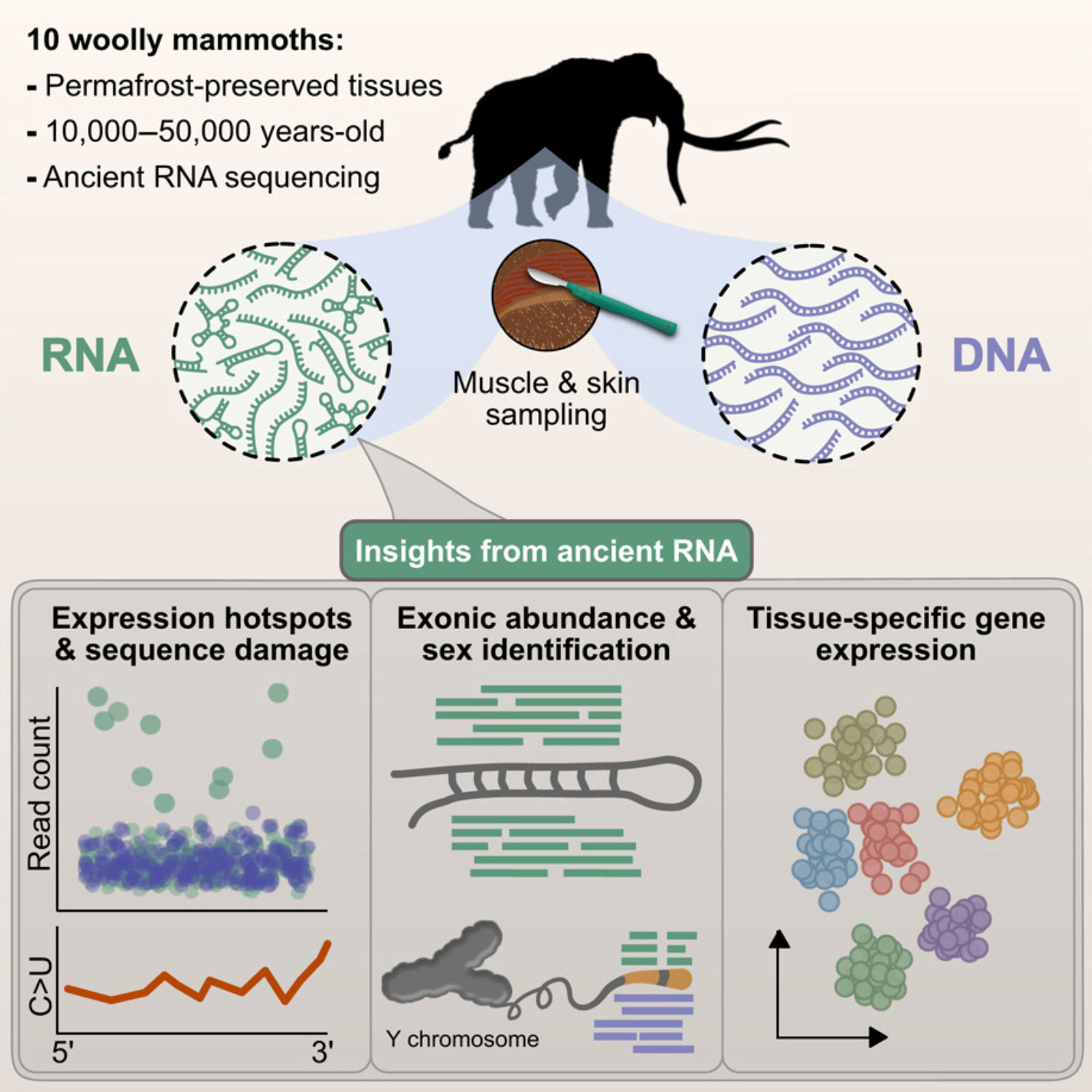
Mármol-Sánchez et al. discovered ancient RNA molecules within Late Pleistocene woolly mammoth tissues. Image attribution: Mármol-Sánchez et al., doi: 10.1016/j.cell.2025.10.025.
The process of sequencing prehistoric genetic material and examining gene activation is crucial for comprehending the biology and evolutionary trajectory of long-extinct fauna.
For an extended period, scientists have been engaged in deciphering mammoth DNA to reconstruct their genomes and understand their evolutionary lineage.
However, RNA, the messenger molecule that indicates which genes are actively expressed, had previously remained inaccessible.
“Through RNA analysis, we can obtain direct empirical evidence of gene activation, thus providing insights into the terminal physiological states of mammoths that roamed the planet during the last glacial period,” stated Dr. Emilio Mármol, a principal investigator at the Globe Institute.
“This specific type of information cannot be gleaned solely from DNA analysis.”
For this pioneering investigation, Dr. Mármol and his research associates procured permafrost-preserved tissues from ten woolly mammoths, whose age was determined to be from the Late Pleistocene epoch. These specimens were unearthed from paleontological sites in northeastern Siberia, spanning areas from the Central Indigirka region to the Oyogos Yar coast and the New Siberian Islands.
“We gained access to remarkably well-preserved mammoth tissues recovered from the Siberian permafrost, with the anticipation that they would still contain viable RNA molecules, effectively frozen in time,” Dr. Mármol commented.
“Previously, we had extended the boundaries of DNA recovery to over a million years ago,” remarked Professor Love Dalén, an esteemed researcher at Stockholm University and the Centre for Palaeogenetics.
“Our objective now was to ascertain whether we could push the frontiers of RNA sequencing even further back in time than had been accomplished in prior research endeavors.”
The investigative team was successful in identifying tissue-specific patterns of gene expression within the 39,000-year-old muscle tissue samples derived from Yuka, a juvenile mammoth.
Out of the more than 20,000 protein-coding genes present in the mammoth’s genetic blueprint, not all were found to be active.
The RNA molecules that were detected encode for proteins essential for muscle contraction and metabolic regulation under duress.
Furthermore, the scientists identified a diverse array of RNA molecules responsible for regulating gene activity within the mammoth muscle specimens.
“Non-protein-coding RNAs, such as microRNAs, were among our most significant discoveries,” shared Dr. Marc Friedländer, a researcher affiliated with the Wenner-Gren Institute at Stockholm University.
“The muscle-specific microRNAs we identified in the mammoth tissues offer direct proof of gene regulation occurring in real-time during ancient periods. This represents an unprecedented scientific achievement.”
The specific microRNAs that were characterized also served to corroborate the mammoth origin of the retrieved genetic material for the study’s authors.
“We detected rare genetic anomalies within particular microRNAs that served as definitive evidence of their mammoth provenance,” stated Dr. Bastian Fromm, a researcher at the Arctic University Museum of Norway.
“We even identified novel genes solely based on RNA evidence, an undertaking that had never before been attempted with such ancient biological samples.”
“RNA molecules possess the capacity for survival over considerably longer durations than was previously believed.”
“Our findings conclusively demonstrate that RNA molecules can persist for substantially longer periods than previously surmised,” Professor Dalén affirmed.
“This discovery not only enables us to investigate gene activation in various extinct species but also opens the possibility of sequencing RNA viruses, such as influenza and coronaviruses, preserved within Ice Age remnants.”
The findings were officially disseminated on November 14, 2025, within the esteemed scientific journal Cell.
_____
Emilio Mármol-Sánchez et al. Ancient RNA expression profiles from the extinct woolly mammoth. Cell, published online November 14, 2025; doi: 10.1016/j.cell.2025.10.025