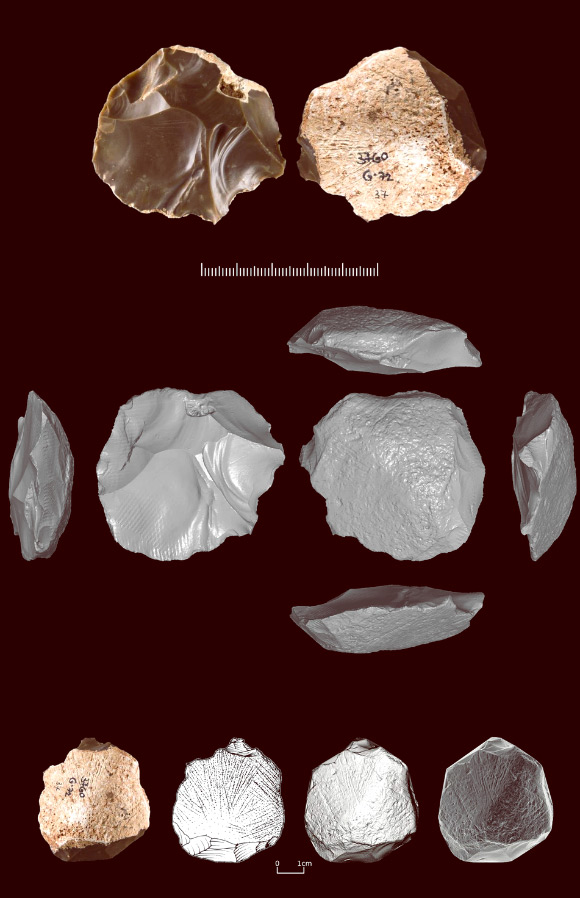
Recent scholarly investigations have involved the meticulous examination of five inscribed lithic objects originating from the Levantine Middle Paleolithic era. These specimens encompass two Levallois cores bearing incised markings unearthed from Manot and Qafzeh caves, a flaked stone plaquette originating from the Quneitra excavation, and a flake cùng với a cortical blade recovered from Amud Cave. The outcomes of this analysis underscore the deliberate nature of the etchings, furnishing pivotal perspectives into the evolution of abstract cognition and the sophisticated cultural tapestry of Middle Paleolithic communities.

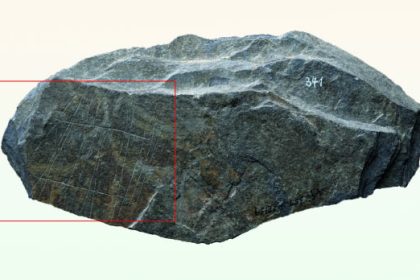
The engraved cortical Levallois core from Manot Cave. Image credit: E. Ostrovsky / M. Smelansky / E. Paixão / L. Schunk.
Prior to this contemporary research, the intentionality behind Middle Paleolithic incised lithic artifacts was widely presumed, yet it lacked robust empirical substantiation.
A significant segment of the archaeological community had previously posited that these superficial markings were primarily utilitarian, generated through the actual use of tools or resulting from natural abrasion.
A prevailing skepticism existed regarding the presence of abstract or symbolic cognition in early hominins. The established understanding was that behaviors involving symbolism, such as artistic expression or abstract representation, emerged considerably later in the trajectory of human development and were specifically attributed to anatomically modern humans.
The present scientific endeavor serves to challenge this prevailing viewpoint, presenting compelling evidence for deliberate, symbolic engravings predating the global dispersal of modern humans.
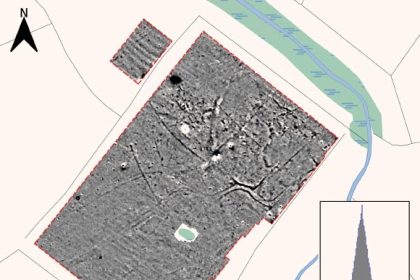
Within the framework of this investigation, Dr. Mae Goder-Goldberger, an accomplished archaeologist affiliated with Hebrew University and Ben Gurion University, alongside her collaborators, directed their attention to artifacts sourced from pivotal Levantine locations. These included Manot Cave, Amud Cave, Qafzeh Cave, and the open-air site of Quneitra.
By employing sophisticated three-dimensional surface analysis techniques, the research team meticulously scrutinized the geometric characteristics and the arrangement of the incised lines. This rigorous approach facilitated the differentiation between carefully executed engravings and superficial marks resulting from practical functional wear.
The analytical findings revealed striking distinctions: artifacts originating from Manot, Qafzeh, and Quneitra exhibit meticulously crafted engravings characterized by geometric configurations that exhibit concordance with the inherent surface topography. This concordance strongly implies an intentional, aesthetic, and symbolic purpose behind their creation.
In stark contrast, the incisions observed on lithic items from Amud Cave are shallow, lack any discernible pattern, and are entirely consistent with their functional application as abrasive implements.
“The capacity for abstract thought represents a fundamental pillar in the evolutionary progression of human cognitive abilities,” stated Dr. Goder-Goldberger.
“The meticulously executed engravings discovered on these ancient artifacts unequivocally demonstrate a proficiency for symbolic representation, thereby suggesting the existence of a society possessing advanced conceptual faculties.”
“The methodological framework we implemented not only elucidates the deliberate nature of these etchings but also, for the initial occasion, establishes a standardized approach for the comparative study of analogous artifacts, thereby substantially enhancing our comprehension of Middle Paleolithic societal structures,” remarked Dr. João Marreiros, a distinguished archaeologist associated with the Leibniz-Zentrum für Archäologie, Johannes Gutenberg University, and the University of Algarve.
“While the engraved artifacts recovered from Qafzeh, Quneitra, and Manot can be interpreted as distinct manifestations within their respective chronological and geographical contexts, the shared attributes of the engravings themselves, coupled with the discernible similarities in the organization of their patterns, strongly imply predetermined actions undertaken with clear intent.”
“These groundbreaking discoveries serve to deepen our understanding of symbolic behaviors and offer indispensable insights into the cognitive and cultural advancement of our early hominin ancestors.”
“This research constitutes a significant stride forward in unraveling the extent of symbolic behavior exhibited by our forebears, effectively bridging the conceptual divide between mundane tool utilization and the sophisticated realm of abstract expression.”
The research findings, documented by the investigative team, have been formally published in the esteemed journal Archaeological and Anthropological Sciences. The relevant publication can be accessed via the provided link.
_____
M. Goder-Goldberger et al. 2025. Incised stone artefacts from the Levantine Middle Palaeolithic and human behavioural complexity. Archaeol Anthropol Sci 17, 27; doi: 10.1007/s12520-024-02111-4