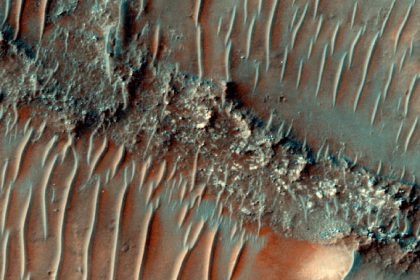
Recent orbital analyses indicate that the most recent volcanic activity on Mars was not characterized by isolated, singular extrusions; instead, protracted magmatic conduits underlying Pavonis Mons, a prominent Martian shield volcano, progressively altered lava fields through distinct eruptive episodes and evolving geochemical compositions, thereby furnishing novel perspectives on the planet’s internal geological processes and the mechanisms by which terrestrial planets construct and modify their crusts.
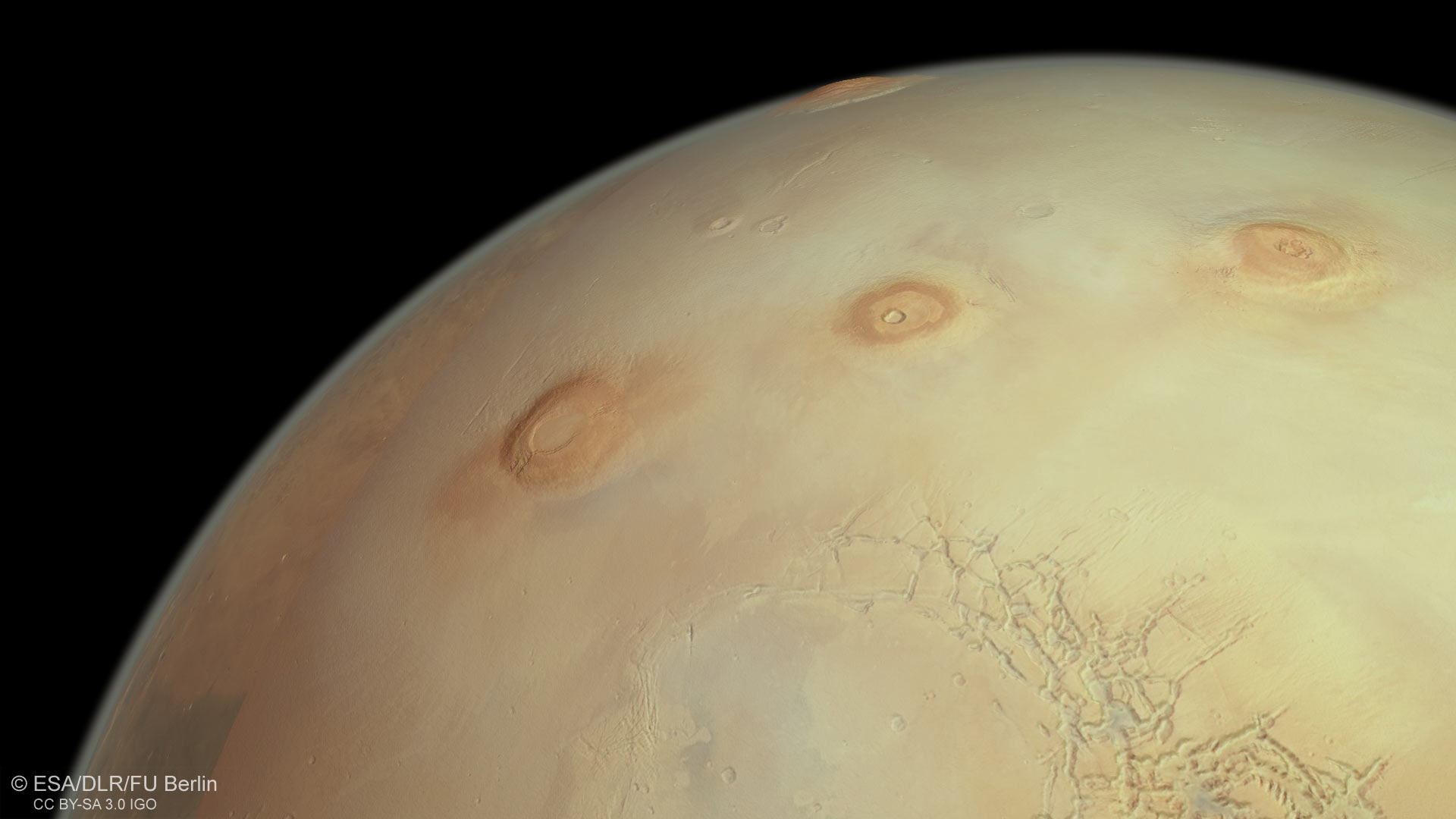
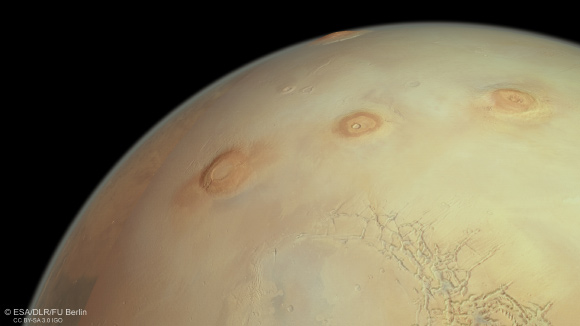
This perspective view from ESA’s Mars Express shows three of Mars’ famously colossal volcanoes (from left to right): Arsia, Pavonis and Ascraeus Mons. Image credit: ESA / DLR / FU Berlin.
What might appear as a singular effusive event frequently stems from intricate subterranean processes involving the migration, metamorphosis, and protracted evolution of molten rock.
To achieve a comprehensive understanding of volcanic behavior, planetary geoscientists examine the eruptive materials found at the surface, which serve as indicators of the concealed magmatic reservoirs fueling volcanic phenomena.
The groundbreaking investigation, spearheaded by Bartosz Pieterek, a researcher affiliated with Adam Mickiewicz University, demonstrates that this inherent complexity is also a feature of the Martian geological environment.
Through the integration of high-resolution surface cartography with remote sensing data pertaining to mineralogy, the research team meticulously delineated the volcanic and magmatic developmental trajectory of a volcanic edifice situated south of Pavonis Mons, achieving an unparalleled level of granular detail.
“Our findings strongly suggest that even during the most recent epoch of Martian volcanism, the subsurface magmatic systems remained dynamic and intricate,” stated Dr. Pieterek.
“The edifice did not undergo a solitary eruption; rather, it underwent transformation over extended durations as subsurface conditions fluctuated.”
The study elucidates that this volcanic system underwent a developmental progression through multiple effusive phases, exhibiting a transition from initial fissure-driven lava emplacement to subsequent localized vent activity that ultimately contributed to the formation of cone-shaped structures.
Despite observable distinctions in these lava flows at the planetary surface, they originated from a unified subterranean magmatic source.
Each distinct eruptive phase left an imprinted mineralogical signature, enabling the scientific cohort to trace the temporal evolution of the magma.
“These variations in mineral composition attest to the evolving nature of the magma itself,” observed Dr. Pieterek.
“This likely reflects modifications in the depth of magma origin and the duration of its subterranean storage prior to expulsion.”
“Given the current impossibility of direct sampling of Martian volcanoes, studies of this nature offer invaluable insights into the structural architecture and evolutionary history of the planet’s interior.”
“The discoveries underscore the profound capacity of orbital observational techniques to unveil the latent intricacies of volcanic systems, not only on Mars but also on other rocky celestial bodies.”
The findings were formally presented in the esteemed journal Geology on January 29, 2026.
_____
Bartosz Pieterek et al. Spectral evidence for magmatic differentiation within a Martian plumbing system. Geology, published online January 29, 2026; doi: 10.1130/G53969.1