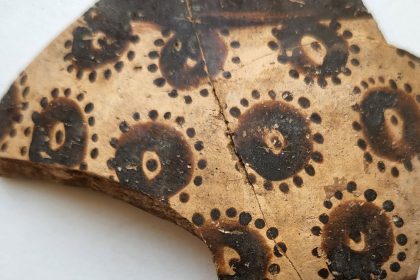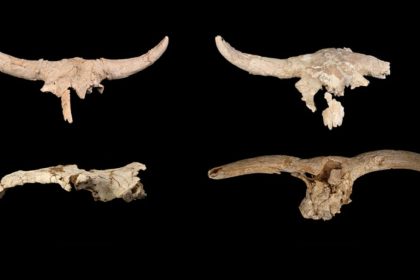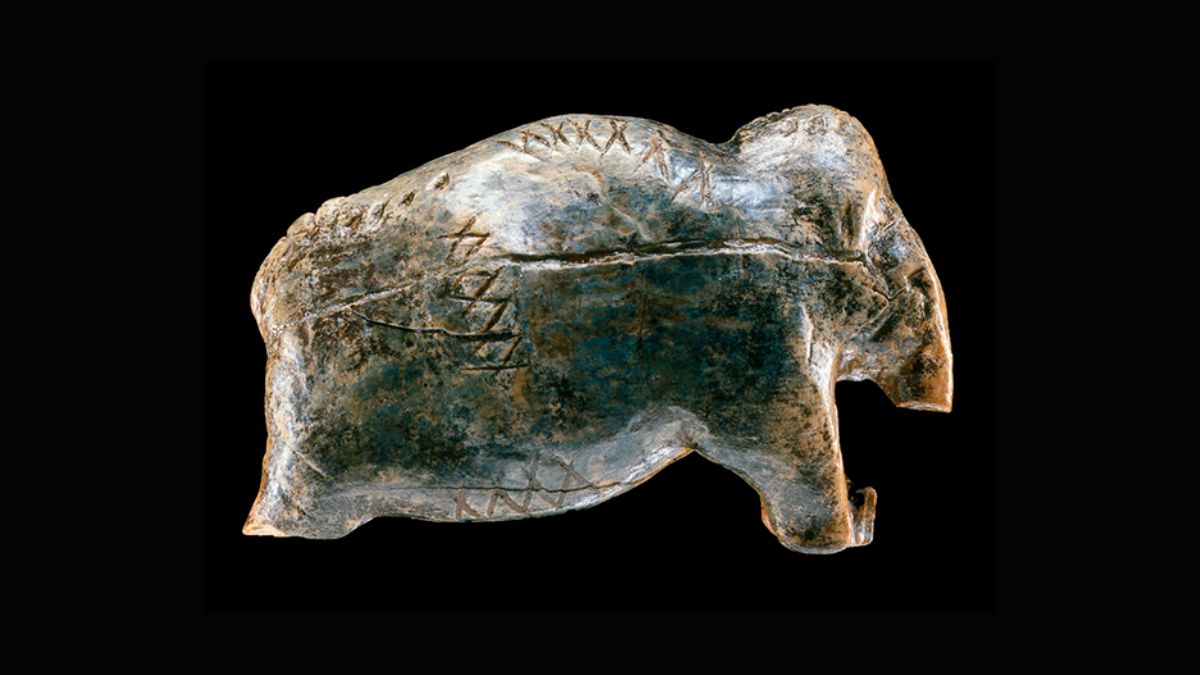
A comprehensive examination has revealed that thousands of etchings found on Paleolithic artifacts indicate early modern humans were employing systematic symbolic communication as far back as 40,000 years ago.
The markings, attributed to individuals of the Aurignacian culture and dating between 43,000 and 34,000 years ago, are not sufficiently complex to be classified as writing in its most stringent definition, as they do not directly correlate with spoken language.
However, the arrangement of these markings on various objects exhibits a discernable structure, comparable to the earliest known protocuneiform systems that surfaced approximately 5,300 years ago.
These findings suggest they may represent an ancestral stage of writing, according to the recent revelations from the research conducted by linguist Christian Bentz from Saarland University in Germany and archaeologist Ewa Dutkiewicz affiliated with the Berlin State Museums.
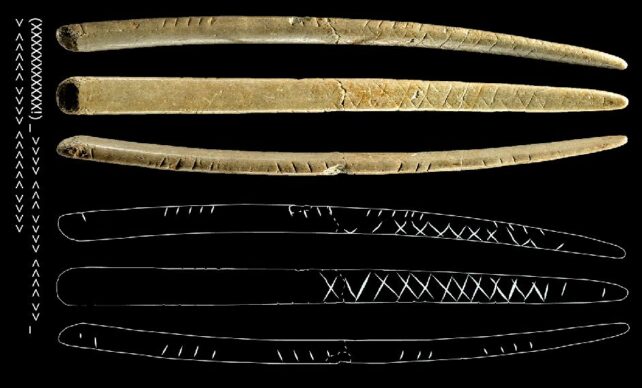
This does not imply that these symbols encapsulated numerical values or abstract concepts in the manner of protocuneiform.
Rather, as articulated by Bentz and Dutkiewicz, the markings “demonstrate that the initial hunter-gatherer populations migrating into Europe were already utilizing sign sequences of comparable intricacy in a purposeful, organized, and conventional fashion – many tens of thousands of years prior to the emergence of true writing.”
A defining characteristic of humanity is our capacity for developing shared symbolic frameworks that facilitate the retention and transmission of information, whether this manifests as a written language, notations etched onto bone, or the collection of emojis within a mobile messaging application.
Numerous such systems have been lost to the passage of time. The physical artifacts themselves may have deteriorated to the point of being unrecognizable, or the cultural understanding required to interpret them may have vanished. This presents a significant challenge in pinpointing the genesis of – or the methodology behind – humanity’s initial use of external marks for information storage.
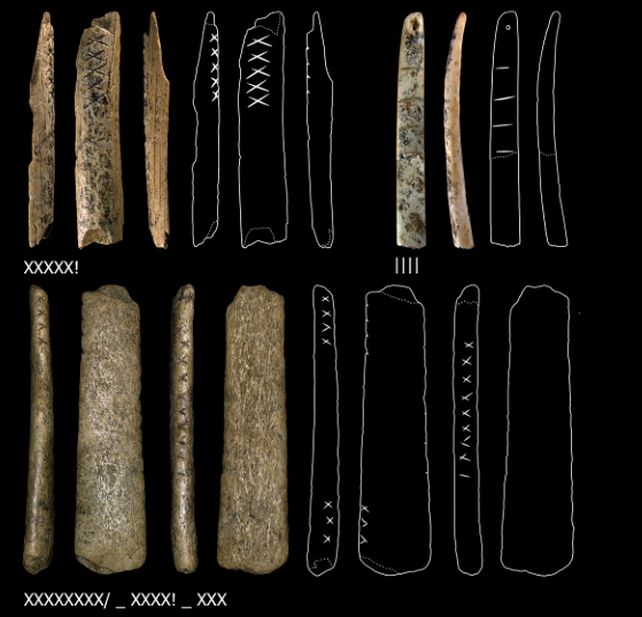
While the precise meaning of these specific symbols remains undecipherable, the observed patterns in their application can shed light on their function. Bentz and Dutkiewicz employed a statistical analysis focused on 260 movable artifacts originating from the Aurignacian culture, which inhabited a region of caves in present-day southern Germany.
These included statuettes and other objects meticulously crafted from ivory, bone, and antler. Many were embellished with various markings such as dots, lines, chevrons, crosses, zigzags, star shapes, and cross-hatched designs.
Across the entirety of the examined artifacts, the investigators documented over 3,000 individual markings, categorizing them and noting the type of object on which each was found. This compilation formed the foundation for their statistical investigations.
Using algorithms and information-theoretic models, they sought to identify patterns in the arrangement of these markings. The research team quantified aspects such as recurrence frequencies, the variety of symbol types, and entropy – a statistical measure indicating the informational capacity of a sequence. These metrics are frequently utilized in the examination of linguistic structures and nascent writing systems.
The outcomes of this analysis strongly suggest that the carvings were far from arbitrary.
The symbols appeared in deliberate, reproducible sequences exhibiting discernible structure. Distinct types of objects displayed unique patterning: for instance, figurines bore sequences with an information density – a greater degree of structured variability within a sequence – approximately 15 percent higher than that found on tools.
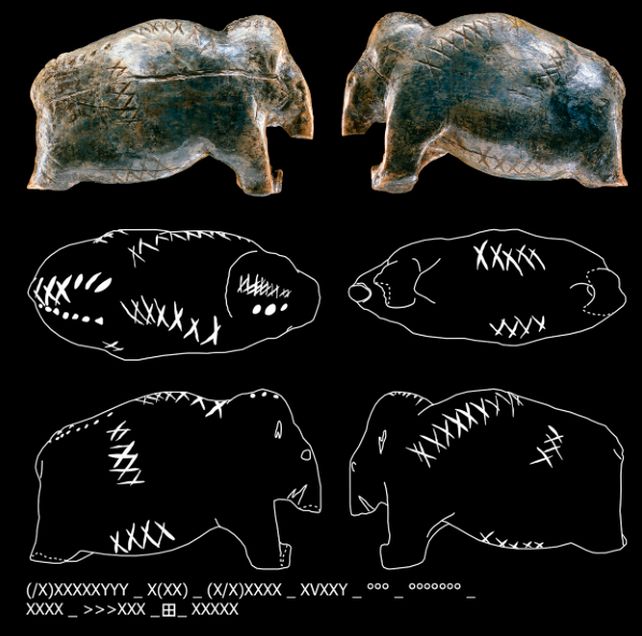
Tools, in turn, presented a density about 10 percent greater than that observed on tubes or flute-like implements, and approximately 15 percent greater than that on personal adornments.
These observed patterns remained consistent over a period of approximately 10,000 years, suggesting they served a stable, shared communicative purpose rather than mere aesthetic embellishment. The researchers are unequivocal in stating that this function was not for the transcription of spoken language; the observed patterns diverge significantly from those characteristic of writing, the earliest known examples of which emerged about 5,000 years ago.
The research posits that the Aurignacian symbols represent a form of human intercommunication, even though their precise significance is now obscured. While the exact nature of their meaning may remain elusive, the findings strongly indicate that humans were engaged in storing and structuring information tens of thousands of years before the advent of the earliest recognized writing systems.
“It continues to be challenging – or indeed impossible – to definitively prove that Aurignacian sign systems fulfilled the same numero-ideographic roles as protocuneiform. Furthermore, a stark contrast exists between them: Protocuneiform evolved into a fully developed writing system representing the Sumerian language within the subsequent millennium,” the researchers noted.
“Conversely, the sign sequences from the Swabian Aurignacian maintained stability in their information density for 10,000 years before disappearing.”
These groundbreaking findings have been published in the Proceedings of the National Academy of Sciences.