Centuries ago, early Homo sapiens embarked on a perilous expedition, traversing hundreds of kilometers of frozen terrain across the Bering Strait into the uncharted territories of the Americas. A recent scientific investigation now posits that these pioneering people transported an unexpected genetic endowment with them—a specific allele of the MUC19 gene, acquired from Denisovans, which may have facilitated human adaptation to the rigors of their new continental environment.

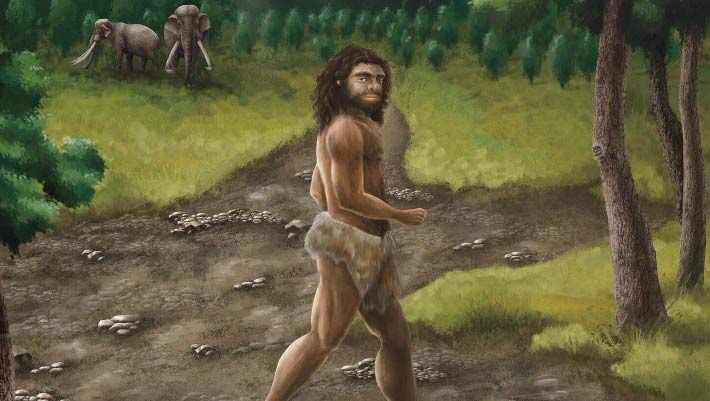
An artist’s concept of a Penghu Denisovan walking under the bright Sun during the Pleistocene of Taiwan. Image credit: Cheng-Han Sun.
Contemporary human genomes harbor a minor complement of ancestral genetic sequences, a historical remainder from past admixture events with Neanderthals and Denisovans.
While the majority of these genetic remnants are phenotypically inert, certain archaic variants found within modern populations have been subjected to positive natural selection, potentially playing a crucial role in adapting to novel ecological settings as humanity expanded its reach across the globe.
Populations in the Americas were confronted with a profusion of unfamiliar landscapes, creating conditions conducive to natural selection favoring archaic genetic contributions within these new environmental contexts.
In this novel research endeavor, a consortium of scientists, spearheaded by researchers from the University of Colorado, Boulder, and Brown University, directed their attention toward a particular gene, designated MUC19. This gene is implicated in the synthesis of proteins that constitute the salivary and mucosal linings of the respiratory and digestive tracts.
Their findings indicate that a Denisovan variant of the MUC19 gene is discernible in present-day Latin American individuals with Indigenous American heritage, as well as in genetic material recovered from specimens unearthed at archaeological sites spanning North and South America.
The prevalence of this specific gene within modern human demographics suggests that it experienced significant selective pressures, implying that it conferred a survival or reproductive advantage upon its carriers.
The precise nature of this advantageous effect remains indeterminate. However, given the gene’s involvement in immune system functions, it is plausible that it enhanced the capacity of these populations to combat novel pathogens encountered during their migratory journey into the Americas millennia ago.
“From an evolutionary perspective, this discovery underscores how ancient interbreeding can yield consequences that persist into the present day,” stated Professor Emilia Huerta-Sánchez of Brown University.
“Biologically speaking, we have identified a gene that appears to be adaptive, yet its precise function has not yet been fully elucidated.”
“We anticipate that this will stimulate further investigation into the actual biological role of this gene.”
Limited information exists regarding Denisovans, a hominin group that inhabited Asia from approximately 300,000 to 30,000 years ago. Our knowledge is primarily derived from a few fragmented fossil remains discovered in Denisova Cave in Siberia, two mandibular fragments found in Tibet and Taiwan, and a remarkably complete skull unearthed in China this year.
Genetic material extracted from a finger fossil discovered in Siberia has enabled scientists to examine shared genes between Denisovans and contemporary humans.
Previous studies established that a specific gene variant, EPAS1, inherited from Denisovans, may have been instrumental in the adaptation of Sherpas and other Tibetan populations to high-altitude environments.
For the current investigation, the researchers conducted a comparative analysis between Denisovan genetic data and modern genomes compiled through the 1,000 Genomes Project, a comprehensive survey of global genetic diversity.
They ascertained that the Denisovan-derived MUC19 gene is present at elevated frequencies within Latino populations exhibiting Indigenous American genetic ancestry.
Furthermore, they examined the gene’s presence in the genetic material of 23 individuals excavated from archaeological sites in Alaska, California, Mexico, and other locations across the Americas.
The Denisovan-derived variant was also found at high frequencies within these ancient individuals.
Employing multiple independent statistical methodologies, the authors demonstrated that the Denisovan MUC19 gene variant achieved unusually high frequencies in ancient Indigenous American communities and in present-day populations of Indigenous descent. Moreover, the gene is situated within an exceptionally long segment of archaic DNA, both of which are indicative of significant natural selection that propelled its widespread occurrence.
Their research also revealed that the gene was likely transmitted through admixture from Denisovans to another archaic hominin group, the Neanderthals, who subsequently interbred with modern humans.
“These findings underscore the profound impact of interbreeding in introducing novel and potentially beneficial genetic variation into the human evolutionary lineage,” remarked Professor Huerta-Sánchez.
“Typically, the emergence of genetic novelty is a gradual evolutionary process.”
“However, these interbreeding events provided a rapid mechanism for incorporating a substantial amount of new genetic diversity.”
“In this particular instance, this newly acquired reservoir of genetic variation appears to have aided modern humans during their migration into the Americas, possibly by bolstering their immune system.”
“There is a clear indication that this gene offered an advantage to these populations—and its utility may persist or emerge again in the future.”
“We are hopeful that the recognition of this gene’s significance will foster new research into its functional properties, thereby uncovering novel biological mechanisms, particularly given that it encodes genetic variants that alter the protein sequence.”
This investigation was published in the esteemed scientific journal Science. The associated publication can be accessed via the following link: study.
_____
Fernando A. Villanea et al. 2025. The MUC19 gene: An evolutionary history of recurrent introgression and natural selection. Science 389 (6762); doi: 10.1126/science.adl0882