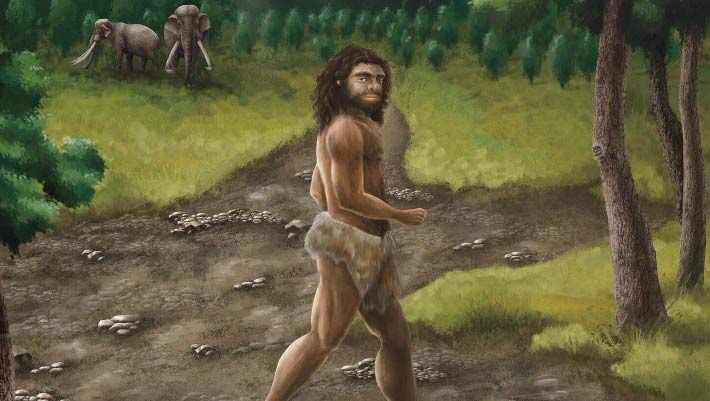
A scientific contingent spearheaded by researchers from the Max Planck Institute for Evolutionary Anthropology has successfully reconstructed a high-fidelity genome sequence from a Denisovan individual. This groundbreaking achievement was made possible by analyzing DNA extracted from an ancient molar discovered at Denisova Cave. The molar belonged to a male who inhabited the region approximately 200,000 years ago, a temporal span more than double that of the sole Denisovan individual whose genome had been previously sequenced. This newly elucidated genome is compelling scientists to reassess their understanding of the timelines and geographical distributions of early human group interactions, movements, and intermingling across the Asian continent.
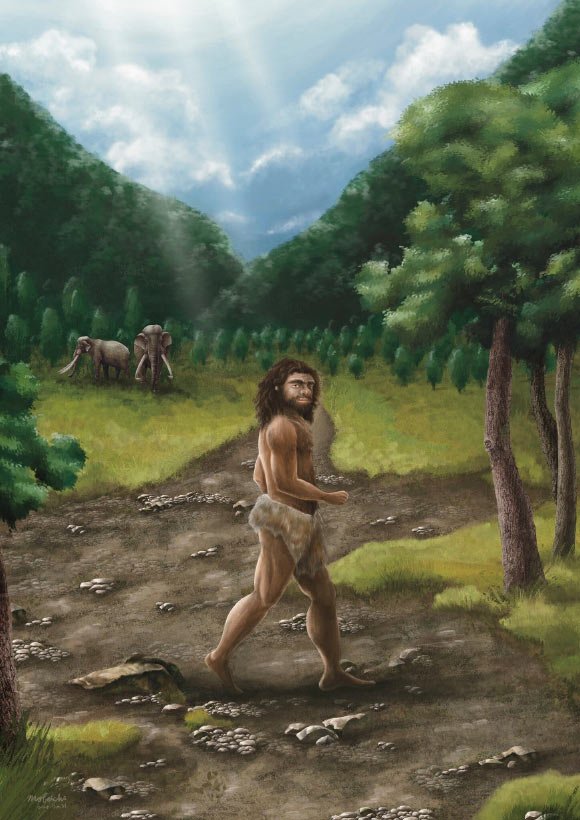
An artist’s concept of a Penghu Denisovan walking under the bright Sun during the Pleistocene of Taiwan. Image credit: Cheng-Han Sun.
Dr. Stéphane Peyrégne, a specialist in evolutionary genetics affiliated with the Max Planck Institute for Evolutionary Anthropology, along with his associates, successfully extracted the genomic blueprint of a Denisovan from a molar fragment. This artifact was recovered from Denisova Cave, situated in the Altai Mountains of southern Siberia—the very location where Denisovans were initially identified in 2010 through the genetic analysis of a finger bone.
This archaeological site has since evolved into a pivotal locus for research into human evolution, yielding evidence of repeated inhabitation by Denisovans, Neanderthals, and even a hybrid child resulting from interbreeding between these two extinct human groups.
“The initial identification of Denisovans, an extinct hominin lineage, was predicated on ancient DNA analyses performed on Denisova 3, a finger phalanx unearthed at Denisova Cave in Siberia’s Altai Mountains in 2008,” stated Dr. Peyrégne and his co-authors.
“Subsequent examination of the nuclear genome derived from this specimen established that Denisovans constituted a sister group to Neanderthals, another now-extinct human population that resided in Western Eurasia during the Middle and Late Pleistocene epochs.”
“While a dozen fragmented skeletal remains and a single cranium have subsequently been associated with Denisovans based on DNA or protein analysis, only Denisova 3 has provided a genome of exceptional quality.”
The recently analyzed tooth is attributed to a male Denisovan who lived approximately 200,000 years ago, a period predating the exodus of anatomically modern humans from Africa.
“In 2020, a complete left upper molar was discovered within layer 17, one of the deepest cultural strata identified in the South Chamber of Denisova Cave. Radiometric dating using optically stimulated luminescence placed this layer between 200,000 and 170,000 years ago,” the researchers elaborated.
“Designated as Denisova 25, this molar exhibits dimensions comparable to other molars recovered from Denisova Cave—specifically Denisova 4 and Denisova 8. Furthermore, it is larger than the molars of Neanderthals and most other hominins from the Middle Pleistocene and later periods, thereby suggesting its potential attribution to a Denisovan individual.”
“Two sample fragments, weighing 2.7 mg and 8.9 mg respectively, were meticulously extracted by drilling a single aperture at the cemento-enamel junction of the tooth. An additional twelve subsamples, ranging from 4.5 mg to 20.2 mg, were meticulously obtained by gently abrading the outer surface of one of the tooth’s roots using a dental drill.”
Benefiting from the remarkably well-preserved state of the ancient DNA, the research team was able to meticulously reconstruct the genome of Denisova 25 with high coverage. This achievement renders its quality equivalent to that of the genome sequenced from the Denisova 3 woman, who lived approximately 65,000 years ago.
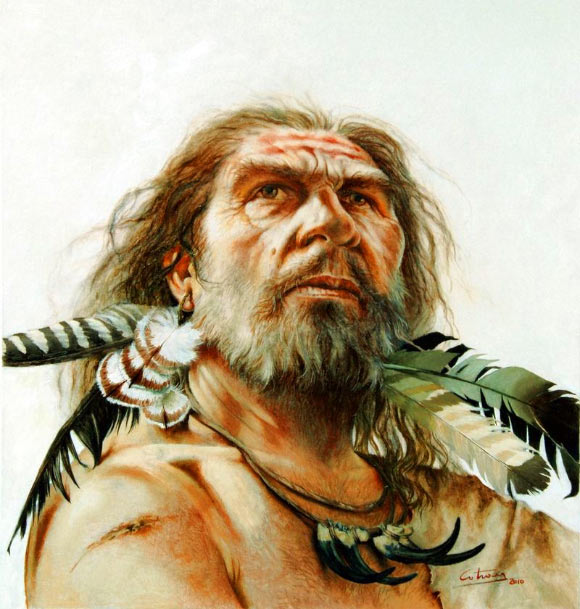
Denisovans were probably dark-skinned, unlike the pale Neandertals. The picture shows a Neanderthal man. Image credit: Mauro Cutrona.
A comparative analysis of these two distinct Denisovan genomes has revealed that this ancient hominin group was far from being a monolithic, unchanging population. Instead, the findings suggest the presence of at least two divergent Denisovan lineages that inhabited the Altai region at different historical junctures, with one population apparently supplanting another over millennia.
Moreover, the older Denisovan individual possessed a greater proportion of Neanderthal DNA than the more recent specimen. This observation underscores the recurrent nature of interbreeding between these archaic human groups, indicating that such encounters were not isolated incidents but rather a persistent feature of life in Ice Age Eurasia.
Even more significantly, the research cohort identified compelling evidence of admixture between Denisovans themselves and an even more ancient, ‘super-archaic’ hominin lineage. This ancestral group diverged from the human evolutionary tree prior to the split that gave rise to the ancestors of Denisovans, Neanderthals, and modern humans.
“The availability of this second Denisovan genome has illuminated the recurring instances of interbreeding between Neanderthals and Denisovans within the Altai region,” the researchers stated. “Furthermore, it suggests that these admixed populations were eventually succeeded by Denisovans originating from other geographical areas, supporting the hypothesis that Denisovans had a broad distribution and that the Altai may have represented the periphery of their territorial range.”
The Denisova 25 genome also offers crucial insights that help resolve a persistent enigma concerning the presence of Denisovan genetic contributions in contemporary human populations.
Present-day populations residing in Oceania, certain regions of South Asia, and East Asia all exhibit traces of Denisovan DNA, albeit not of a uniform genetic signature.
Through the meticulous comparison of Denisovan genetic segments found within thousands of modern human genomes, the scientists have pinpointed at least three distinct ancestral Denisovan sources.
One lineage, genetically proximate to the more recently sequenced Denisovan genome, has left its genetic imprint across a wide expanse of East Asia and extending beyond.
A second, more distantly related Denisovan population contributed genetic material independently to both the ancestors of Oceanic peoples and to populations in South Asia.
Crucially, the absence of this deeply divergent Denisovan ancestry in East Asian populations suggests that their forebears followed a separate migratory pathway into Asia, likely from a more northerly origin. Conversely, the ancestors of Oceanic peoples appear to have traversed South Asia at an earlier point in time.
“Segments of Neanderthal-like DNA are shared across all human populations, including those in Oceania, which aligns with a single dispersal event out of Africa,” the scientists noted. “However, the independent flow of Denisovan genes points towards multiple migratory waves into Asia.”
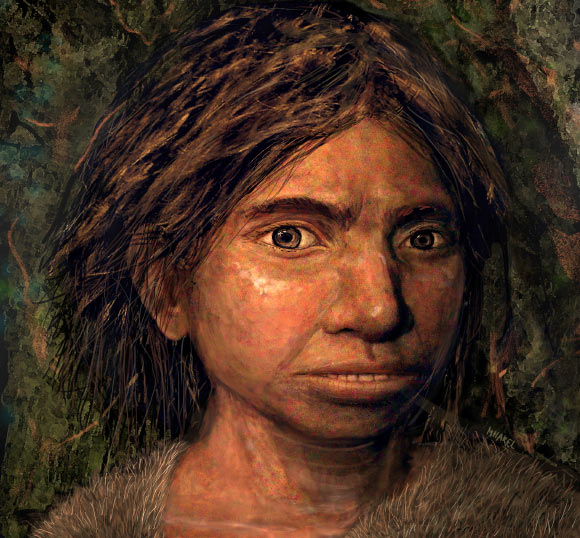
A portrait of a juvenile female Denisovan based on a skeletal profile reconstructed from ancient DNA methylation maps. Image credit: Maayan Harel.
The research team posits that certain Denisovan genetic variants likely conferred advantageous traits, which subsequently became prevalent in modern human populations through the mechanism of natural selection.
Leveraging the genetic data from both Denisovan individuals, the researchers have identified numerous genomic regions in extant human populations that appear to have been shaped by Denisovan introgression, with notable prevalence observed in Oceania and South Asia.
Furthermore, distinct genetic alterations attributable to Denisovans offer intriguing glimpses into the potential physical characteristics of these ancient humans.
A number of mutations exclusive to Denisovans have been found to impact genes associated with cranial morphology, mandibular prognathism, and facial features—traits that correlate with the sparse fossil evidence currently attributed to Denisovans.
One specific regulatory variant is located in proximity to the FOXP2 gene, which plays a critical role in brain development, speech, and language acquisition in contemporary humans. This finding provokes novel inquiries into Denisovan cognitive abilities, although the researchers prudently caution that genetic indicators cannot serve as a definitive substitute for direct fossil or archaeological evidence.
“The impact of introgressed Denisovan alleles on the phenotypes of modern humans may also offer insights into Denisovan biology,” the researchers commented.
“By utilizing alleles that have been correlated with specific phenotypes in modern humans, we have identified sixteen distinct associations involving eleven Denisovan alleles. These associations pertain to traits such as stature, blood pressure regulation, monocyte count, and levels of cholesterol, hemoglobin, and C-reactive protein.”
“Additionally, we have identified 305 expression quantitative trait loci (eQTLs) and 117 alternative splicing QTLs that influence gene expression across nineteen different human tissues. The most pronounced effects were observed in eQTLs within the thyroid, tibial artery, testes, and muscle tissues.”
“These molecular correlations can be exploited to further investigate phenotypes that are not discernible from the fossil record. This refined catalogue provides a more robust foundation for exploring Denisovan traits, their adaptive strategies, and their susceptibility to diseases, some of which may have been inherited by present-day humans through admixture.”
A preliminary version of the research team’s findings was released as a preprint on the scientific pre-publication server bioRxiv.org on October 20, 2025.
_____
Stéphane Peyrégne et al. 2025. A high-coverage genome from a 200,000-year-old Denisovan. bioRxiv, doi: 10.1101/2025.10.20.683404