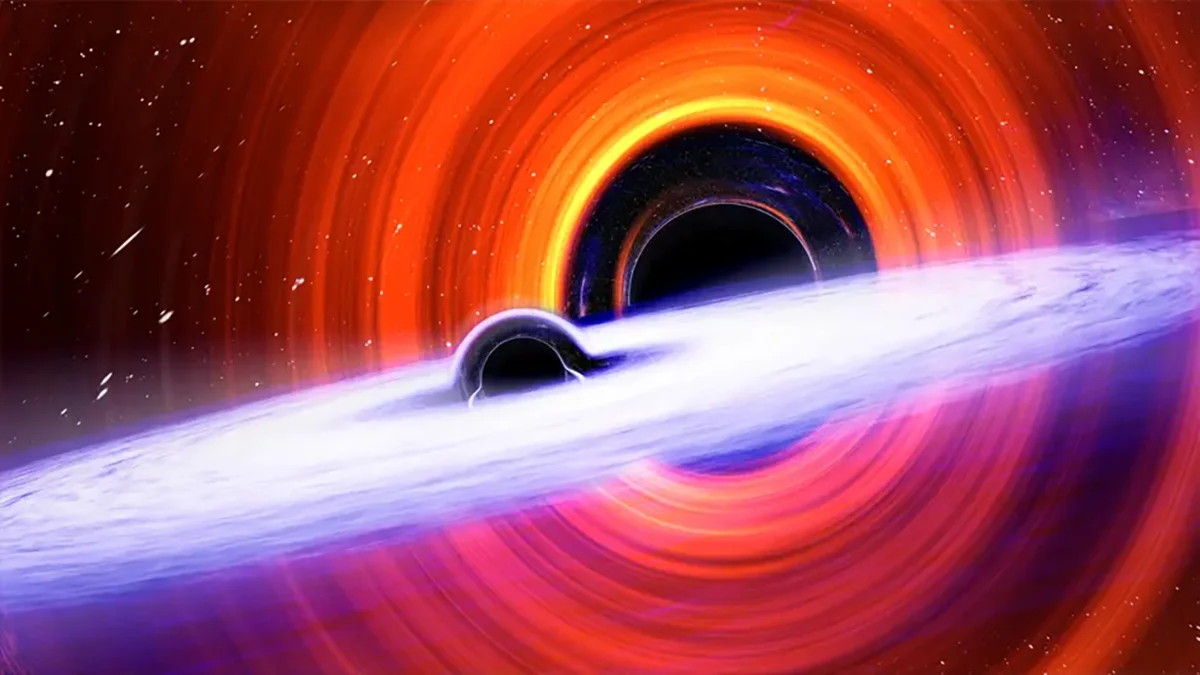
Unique celestial entities, designated as primordial black holes (PBHs), are hypothesized to have originated from extremely dense regions of subatomic particles in the universe’s nascent moments, mere seconds after the Big Bang. A recent scientific report indicates what might represent the inaugural direct detection of such an object.
While definitive validation of this finding could necessitate years of further analysis, the very prospect is profoundly exhilarating.
The genesis of conventional black holes is typically attributed to the catastrophic implosion of a supernova star. However, scholars have long posited that PBHs could have existed from the universe’s earliest epochs, independent of stellar evolution. These entities have historically remained within the realm of theory, yet a growing corpus of contemporary evidence now subtly suggests their actual presence.
In a significant development, astrophysicists Alberto Magaraggia and Nico Cappelluti, affiliated with the University of Miami, have identified an additional candidate PBH candidate through observations made by the Laser Interferometer Gravitational-Wave Observatory (LIGO), an instrument with facilities situated in Washington and Louisiana.
LIGO’s primary function is to detect gravitational waves, which are essentially undulations in the fabric of spacetime, often elicited by the cataclysmic merger of two black holes. A specific signal registered by LIGO and subsequently scrutinized by these researchers pointed towards a cosmic event involving the collision of two objects, one of which possessed a mass less than that of our Sun – a characteristic potentially indicative of a PBH.
“The most prevalent black holes emerge from the remnants of a supernova, marking the demise of a colossal star,” explains Cappelluti. “Consequently, their masses typically span a broad spectrum, ranging from multiples of the Sun’s mass to figures encompassing billions of solar masses.”
Conversely, primordial black holes are anticipated to exhibit significantly reduced mass profiles.
“We hold the conviction that our research will contribute to substantiating the actual existence of [PBHs],” states Cappelluti.
While further in-depth examination of the signal, designated S251112cm, is essential for definitive confirmation, the researchers contend that the presence of a subsolar mass PBH represents the most plausible explanation.

Magaraggia and Cappelluti also conducted calculations concerning the theoretical prevalence of PBHs throughout the cosmos and the anticipated frequency of their detection by LIGO. These projections aligned remarkably well with the observational data gathered by LIGO since its inception of gravitational wave detection in 2015.
“We embarked on an endeavor to ascertain the potential quantity of primordial black holes within the universe and the number that LIGO could reasonably be expected to register,” communicates Magaraggia.
“Our results are indeed encouraging. We surmise that black holes with masses less than that of the Sun, akin to the entity potentially observed by LIGO, should inherently be infrequent, which is consistent with the rarity of such events detected to date.”
Similar to their more commonplace counterparts, PBHs are incapable of emitting light, rendering their observation exceedingly challenging. Furthermore, they are believed to be diminutive in size compared to other black holes, with some possibly comparable to asteroids.
Compounding the inherent difficulties of astronomical observation spanning billions of years, the task of identifying these objects becomes akin to searching for a minuscule item within an immense cosmic collection. Nevertheless, should they be successfully identified and cataloged, PBHs could potentially offer insights into another enigmatic cosmic phenomenon: dark matter.
Like PBHs, dark matter remains a hypothetical construct. However, astrophysicists propose that it constitutes approximately 85 percent of the universe’s total mass and plays a crucial role in the gravitational cohesion of celestial structures. Although dark matter itself is invisible, indirect indications of its existence can be inferred from observable alterations in the behavior of space and time.
It is theorized by experts that PBHs might account for a substantial portion of the universe’s dark matter. Their initial abundance is thought to have been staggeringly high, originating from infinitesimally small dimensions and subsequently expanding to pervade the vast expanse of space.
Further detections of PBHs are imperative for corroborating their existence. This prospect is anticipated to improve with ongoing enhancements to facilities like LIGO and the deployment of novel instruments, such as the European Space Agency’s Interferometer Space Antenna (LISA), a gravitational wave observatory scheduled for launch in 2035.
“LIGO has captured what constitutes compelling evidence for the proliferation of these black hole types, yet we will require the detection of at least one additional such signal, or indeed several, to achieve the definitive confirmation necessary to establish their reality,” asserts Cappelluti.
“What is unequivocally clear is that their existence cannot be dismissed.”