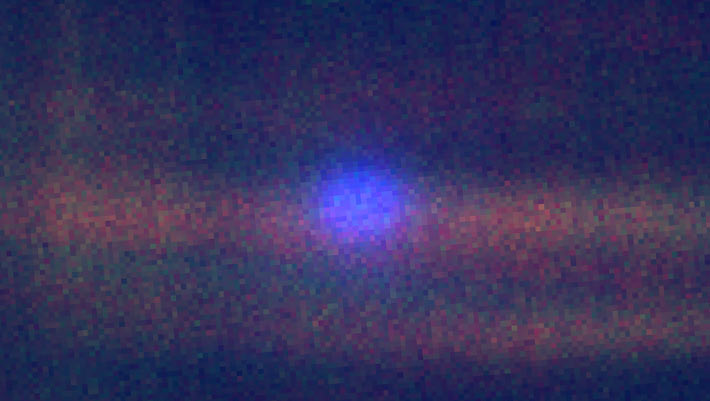
Utilizing the Ultraviolet Spectrograph (UVS) onboard NASA’s Europa Clipper mission, researchers have successfully observed 3I/ATLAS, marking the third confirmed celestial body of interstellar origin to traverse our Solar System. While terrestrial and Martian observatories faced significant positional limitations due to the object’s proximity to the Sun, Europa Clipper, en route to Jupiter, secured a distinct observational perspective.
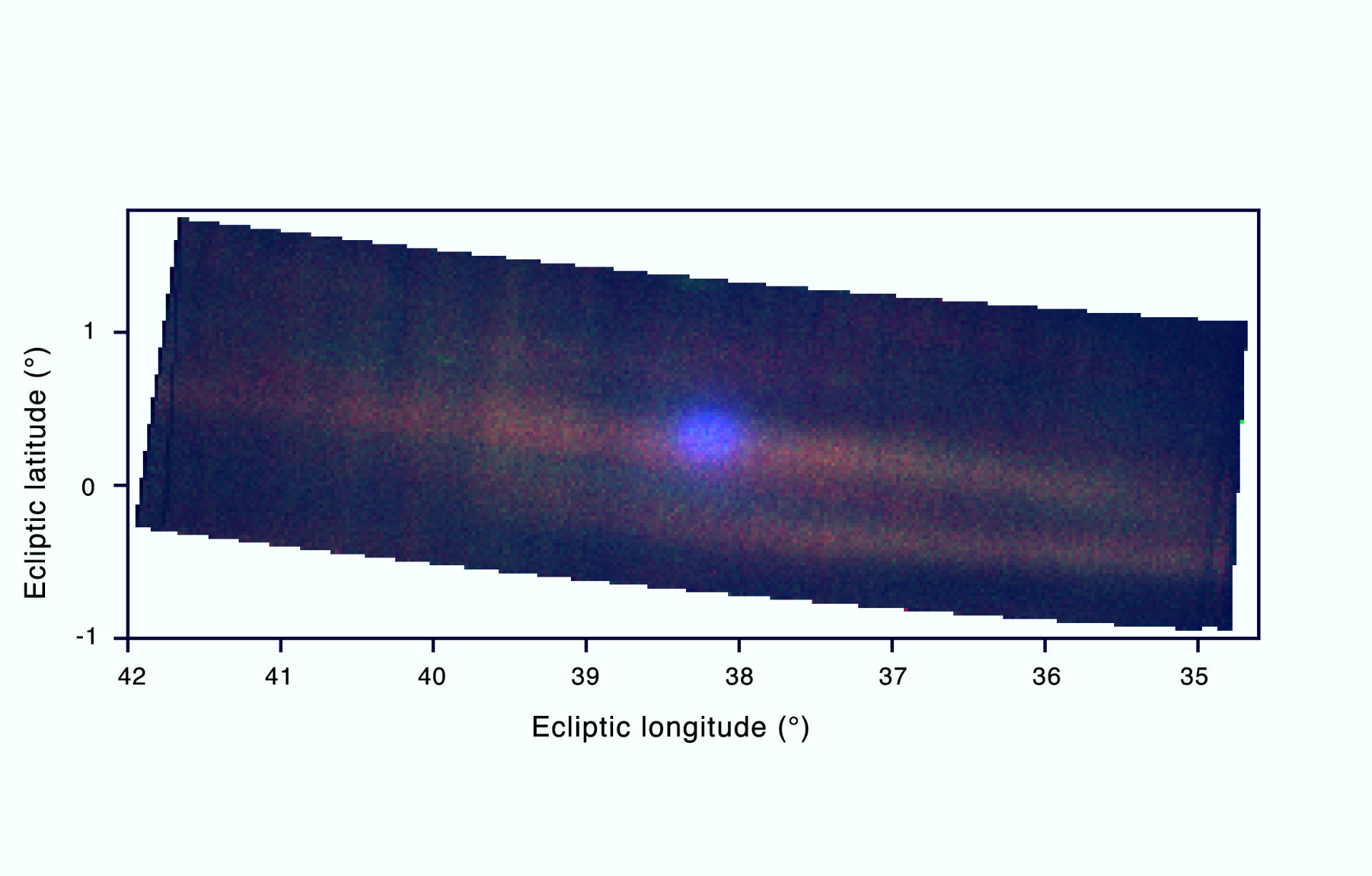
This composite image of the interstellar comet 3I/ATLAS was captured on November 6, 2025 by the UVS instrument on board NASA’s Europa Clipper spacecraft from a distance of around 164 million km (103 million miles). Image credit: NASA / JPL-Caltech / SwRI.
Launched in 2024, Europa Clipper is projected to enter the Jovian system in 2030, where it will engage in extensive orbital maneuvers around Jupiter and conduct 49 close encounters with its moon, Europa.
The UVS instrument is designed to capture ultraviolet light for the purpose of analyzing the atmospheric composition of Europa and its surface ice materials.
“The chance to examine another celestial body during our transit to Jupiter was an unforeseen but welcome development,” stated Dr. Kurt Retherford, principal investigator for Europa-UVS and a researcher at the Southwest Research Institute.
“Our examinations have yielded an unparalleled and detailed perspective of the comet.”
The discovery of 3I/ATLAS was credited to the NASA-supported ATLAS survey telescope, situated in Rio Hurtado, Chile, on July 1, 2025.
At the time of its detection, the interstellar comet was positioned at a heliocentric distance of 4.51 astronomical units (AU), exhibiting an eccentricity of 6.13.
Within a seven-day period following its identification, analysts at NASA’s Jet Propulsion Laboratory had precisely determined its trajectory through the Solar System.
The Europa Clipper team recognized an opportune moment to observe 3I/ATLAS in November 2025, a period when solar interference largely obscured Earth-based observations, though Martian-based views were still favorable.
During this interval, the spacecraft effectively bridged the observational gap between the limited September views from Mars and subsequent Earth-based assessments.
With the comet’s orbital path taking it between Europa Clipper and the Sun, the spacecraft’s unique position facilitated an extraordinary perspective for the UVS team.
Comets are characterized by dust tails that trail behind them and plasma tails that extend away from the Sun.
Europa-UVS’s distinctive sunward orientation provided a singular view of the comet’s tails, essentially observing from ‘behind’ them and directing its gaze toward the comet’s nucleus and coma.
“We anticipate that this novel perspective, combined with data from terrestrial observatories and other space probes, will contribute significantly to a more comprehensive understanding of tail geometries,” commented Dr. Thomas Greathouse, co-deputy principal investigator for Europa-UVS and also affiliated with the Southwest Research Institute.
The UVS instrument detected the presence of oxygen, hydrogen, and dust-related signatures, corroborating the substantial evidence indicating that 3I/ATLAS experienced a phase of intense outgassing activity shortly after its closest approach to the Sun.
“Europa-UVS possesses a remarkable capacity for measuring fundamental spectral transitions from atomic and molecular species,” elaborated Dr. Retherford.
“We are able to discern gases emanating from the comet and observe water molecules undergoing dissociation into hydrogen and oxygen atoms.”
This inherent ability allows Europa Clipper to conduct precise measurements and analyses of these atomic constituents, thereby offering deeper insights into the comet’s internal processes and makeup.
“Characterizing the comet’s composition and quantifying the ease with which these gases are liberated can furnish a clearer picture of the comet’s origin and its evolutionary trajectory during its passage from distant galactic regions to our Solar System,” stated Dr. Tracy Becker, co-deputy principal investigator for Europa-UVS and also associated with the Southwest Research Institute.
“What are the underlying chemical mechanisms at play, and how might we decipher the comet’s genesis within its native Solar System?”
“Were these formative processes akin to our current hypotheses for the formation of our own Solar System? These are profoundly significant inquiries.”