An extensive re-examination of historical telemetry captured by the Near Infrared Mapping Spectrometer (NIMS) aboard NASA’s Galileo spacecraft has yielded the inaugural confirmation of ammonia-bearing chemical constituents on Jupiter’s frozen satellite Europa. This discovery furnishes novel insights into its subterranean ocean and recent geological dynamism.
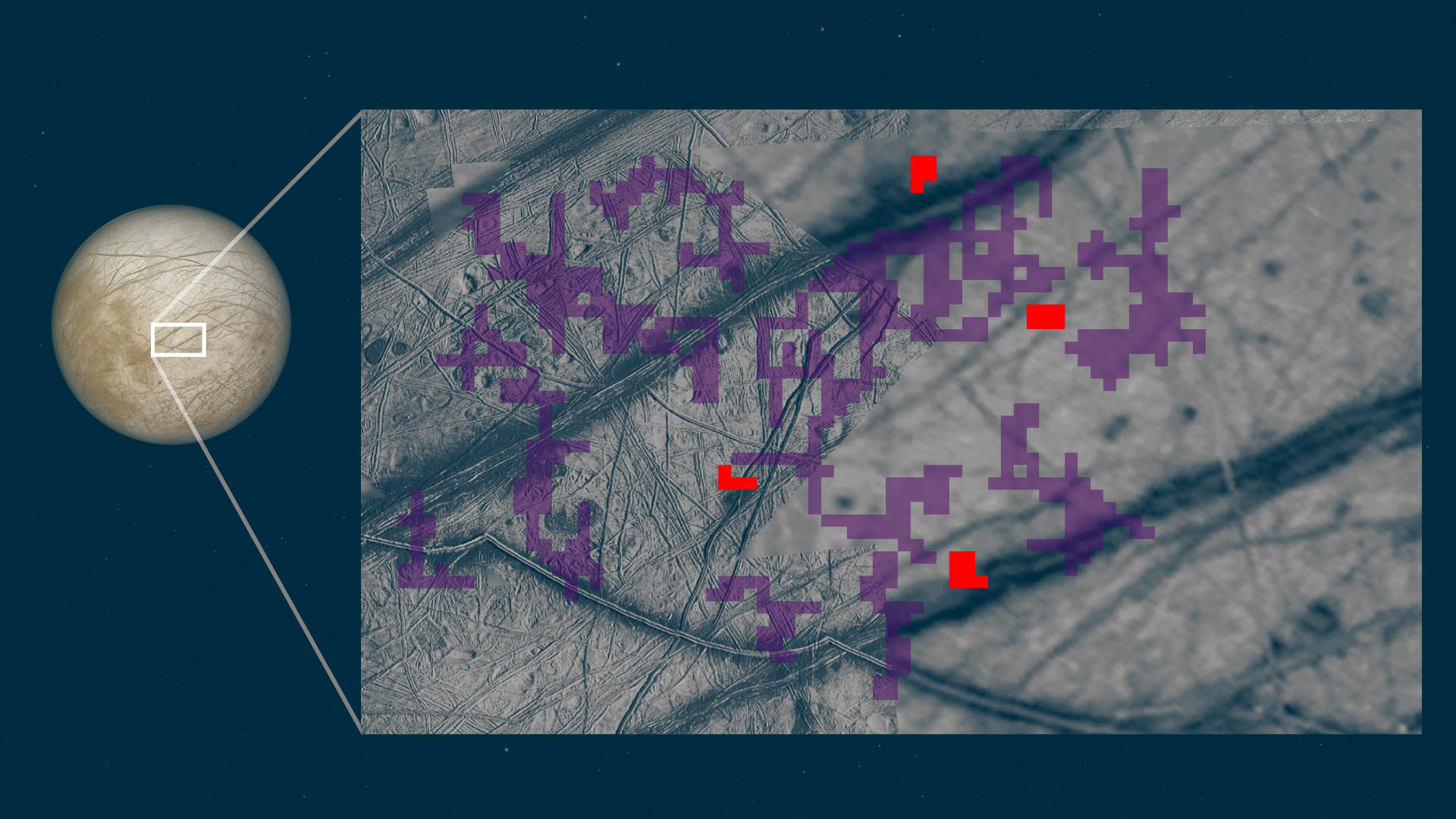
In this composite image, red pixels indicate regions on Europa’s surface where ammonia-bearing compounds were identified; purple signifies the absence of such detection. Image attribution: NASA / JPL-Caltech.
“The identification of ammonia (NH3) or compounds incorporating ammonia, such as ammonia hydrate, salts, or minerals, on the icy celestial bodies within our Solar System holds considerable import for comprehending their geological evolution, potential for supporting life, and astrobiological implications,” stated Dr. Al Emran, an investigator at NASA’s Jet Propulsion Laboratory and lead author of the study.
“On Jupiter’s moon Europa, the existence of ammonia or ammonia-derived species is particularly critical for delineating the ocean’s chemical composition, evaluating its habitability potential, and reconstructing the satellite’s primordial atmosphere.”
“Ammonia functions as an antifreeze; its substantial presence can reduce the freezing threshold of liquid water by as much as 100 Kelvin, potentially facilitating the sustained existence of subsurface oceans on icy worlds.”
“Although the direct linkage between Europa’s subsurface ocean and its surface remains undetermined, the detection of ammonia compounds could imply such a connection, given that these substances are prone to degradation under space radiation.”
In his recently published research featured in the Planetary Science Journal, Dr. Emran reports the observation of a distinctive ammonia absorption signature at a wavelength of 2.20 microns within near-infrared spectral readings of Europa’s surface.
This signature was discerned from data acquired during Galileo’s NIMS instrument surveys of Europa, conducted during orbital flybys in the 1990s.
Ammonia hydrate and ammonium chloride emerge as the most probable chemical entities accountable for the observed spectral feature.
Ammonia’s inherent instability when exposed to intense cosmic radiation renders its manifestation on Europa’s surface noteworthy.
According to the findings presented in the paper, the persistence of ammonia-containing materials suggests their translocation from Europa’s deep interior ocean or shallow subsurface layers to the surface during the moon’s relatively recent geological epoch, potentially through effusive cryovolcanic processes or analogous geological mechanisms.
The analytical findings also extend to broader implications for Europa’s internal architecture.
The presence of ammoniated chemical species aligns with the hypothesis of a thinner ice crust and a chemically reduced, alkaline subsurface ocean.
Serving as an antifreeze agent, ammonia possesses the capacity to lower the freezing point of water ice, thereby aiding in the preservation of liquid water oceans beneath frigid crustal layers.
“Undetected within the data were subtle spectral indications of ammonia in proximity to fractures traversing the moon’s frozen exterior, from which liquid water laden with dissolved ammonia complexes would be anticipated to ascend,” Dr. Emran commented.
“These compounds may have ascended to the surface via cryovolcanic activity occurring in the geologically recent past.”
“This is attributable to ammonia’s significant capacity to depress the freezing point of water, effectively acting as a cryoprotective substance.”
While ammonia-bearing molecules have been identified on other icy bodies in the outer Solar System—encompassing Pluto, Charon, several moons of Uranus, and Saturn’s moon Enceladus—prior endeavors to confirm their presence on Europa had yielded either ambiguous or contradictory outcomes.
“The confirmation of ammonia-bearing constituents in this investigation provides the foundational evidence for nitrogen-bearing species on Europa, an observation of considerable astrobiological significance given nitrogen’s indispensable role in the molecular underpinnings of life,” remarked Dr. Emran.
_____
A. Emran. 2026. Detection of an NH3 Absorption Band at 2.2 μm on Europa. Planet. Sci. J 6, 255; doi: 10.3847/PSJ/ae1291