A recent systematic examination of 470 angiosperm lineages has revealed that the occurrence of complete genome duplication surged conspicuously during periods of intense planetary environmental disruption, hinting at an innate adaptive mechanism within the botanical realm.
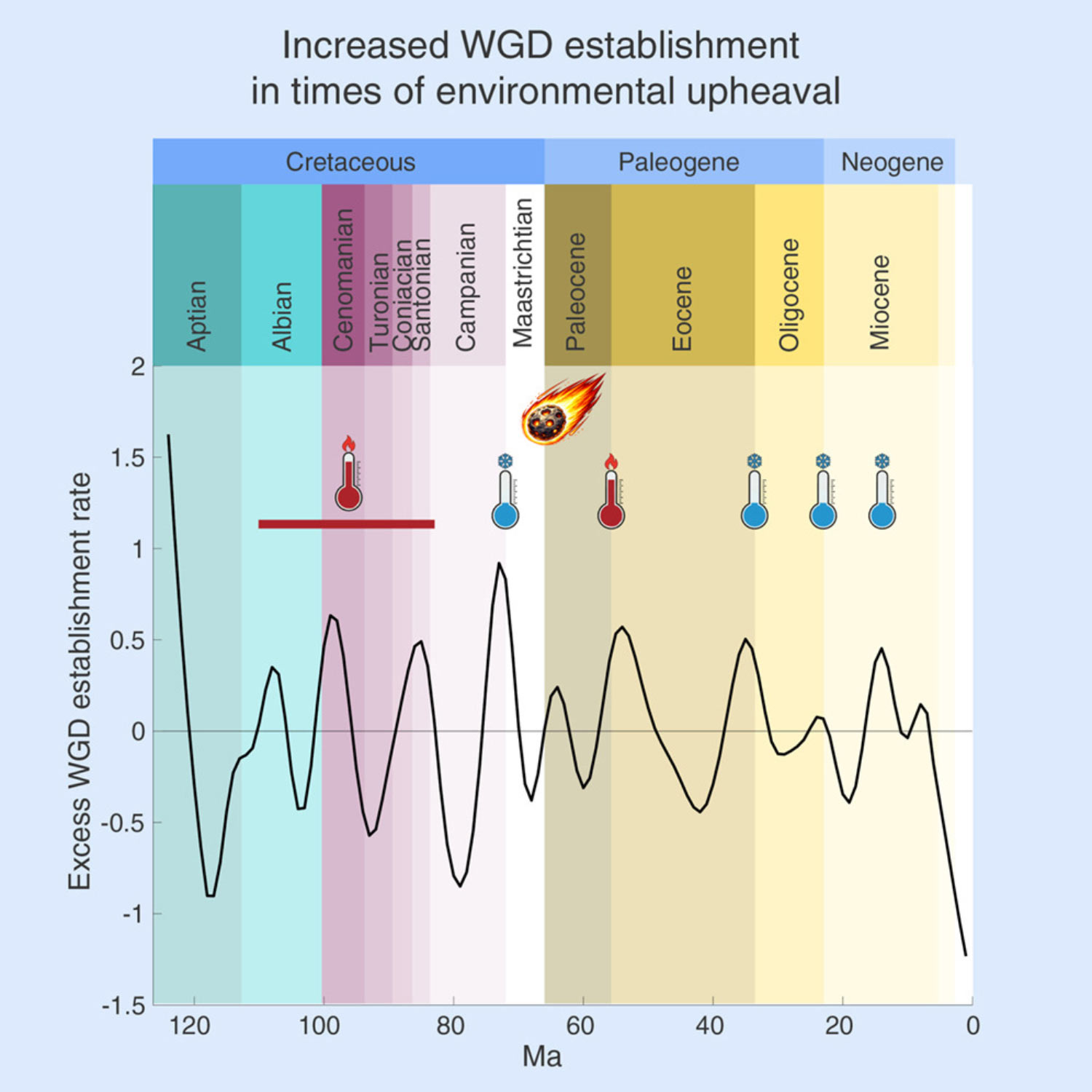
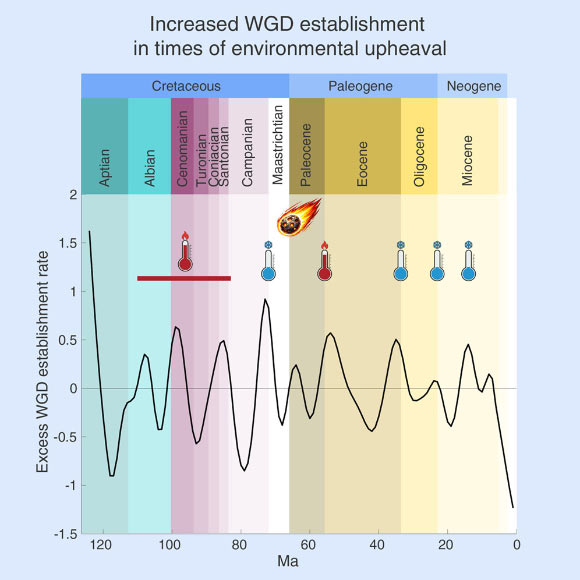
The research conducted by Chen and colleagues involved the compilation of an extensive genomic archive from 470 flowering plant species. This compilation facilitated the dating of 132 ancient whole-genome duplication events, which were observed to be non-uniformly distributed. The findings underscored a significant concentration of these duplication events around critical junctures characterized by profound environmental instability and mass extinction occurrences. Image credit: Chen et al., doi: 10.1016/j.cell.2026.04.008.
Typically, most life forms possess two sets of chromosomes, with each set inherited from a parental source. However, within the diversity of flowering plants, a substantial number of species exhibit the presence of additional chromosome sets, a phenomenon stemming from spontaneous occurrences of complete genome replication.
For instance, the majority of commercially cultivated banana varieties feature three chromosomal sets, whilst wheat, a staple grain, can possess up to six sets, a condition scientifically defined as polyploidy.
The process of whole-genome duplication transpires with considerable frequency among plant species, and it can impose significant metabolic and genetic burdens.
The maintenance of larger genomes necessitates a greater allocation of nutritional resources, elevates the susceptibility to deleterious genetic alterations, and can adversely impact reproductive viability.
Consequently, only a marginal proportion of these duplicated genomic structures are successfully preserved and propagated across successive generations in natural populations.
Conversely, episodes of genome amplification can serve to augment genetic variability, thereby facilitating the acquisition of novel functionalities by existing genes.
These emergent genetic characteristics may equip organisms with enhanced resilience to environmental stressors, such as extreme thermal conditions or arid climates.
Dr. Yves Van de Peer, a distinguished researcher affiliated with Ghent University, observed, “Whole-genome duplication is often perceived as a terminal evolutionary pathway in environments characterized by stability.”
“However, in circumstances of adversity, it possesses the potential to confer unexpected adaptive advantages.”
In an effort to elucidate the mechanisms underlying the persistence of certain duplicated genomes, Dr. Van de Peer and his research team undertook an in-depth analysis of the genomic compositions of 470 distinct flowering plant species, thereby establishing one of the most comprehensive datasets of its nature to date.
Their methodology involved the meticulous identification of gene clusters exhibiting near-identical pairings – a definitive indicator of prior whole-genome duplication incidents.
Subsequently, this genomic data was juxtaposed with information derived from 44 plant fossil records to ascertain the temporal origins of these duplication events.
The resultant analysis unveiled a remarkable correlation: the genomic segments that have endured through evolutionary time predominantly originated from whole-genome duplications that occurred during periods of substantial environmental flux.
These critical periods encompass the mass extinction event precipitated by an asteroid impact approximately 66 million years ago, several phases of global cooling that led to widespread ecological collapse, and the Paleocene-Eocene Thermal Maximum (PETM) around 56 million years ago, a time marked by accelerated global warming.
These findings offer a compelling explanation for a persistent enigma: the prevalence of polyploidy in plant genomes, coupled with the fact that only a select few of these duplicated genomes survive over extended geological timescales.
It is posited that under conditions of extreme environmental stress, polyploid plants may have acquired a competitive advantage.
The researchers suggest that traits that are typically considered disadvantageous, such as the maintenance of an enlarged and more intricate genome, can transform into beneficial attributes in such scenarios.
This investigation also provides valuable insights into the potential adaptive responses of flora to contemporary climate change.
During the PETM, global temperatures escalated by an estimated 5 to 9 degrees Celsius over a span of approximately 100,000 years, a rate of warming that bears notable resemblance to current climatic trends.
“Although the current rate of global warming is significantly accelerated,” stated Dr. Van de Peer, “our historical observations indicate that polyploidy may play a crucial role in enabling plants to navigate and adapt to these challenging environmental conditions.”
A scholarly publication detailing these groundbreaking findings was disseminated on May 8 in the esteemed journal Cell.
_____
Hengchi Chen et al. The emergence of polyploid organisms during epochs of environmental disruption. Cell, published online May 8, 2026; doi: 10.1016/j.cell.2026.04.008